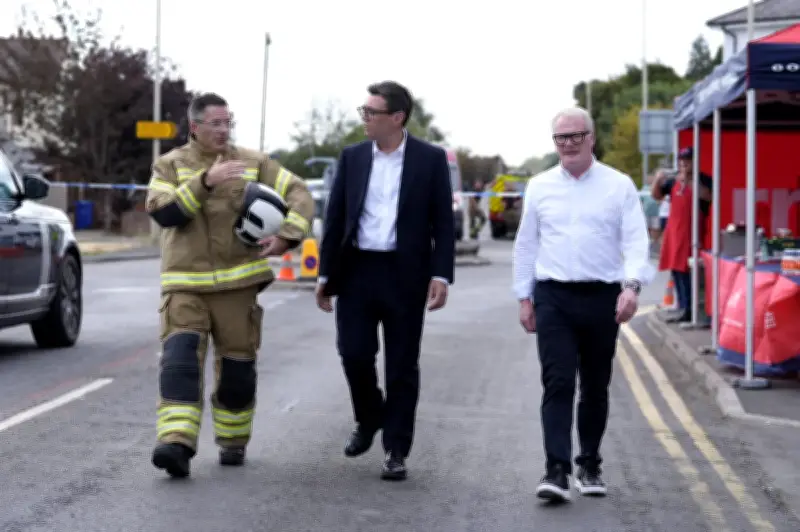
Andy Burnham has urged members of the public not to light fires in “tinderbox” Britain, ahead of a meeting with farmers whom he warned are “at the sharp end of a changing climate”.
The Prime Minister is set to unveil a £65 million funding package for farmers at the weekend, amid fears hot, dry weather could drive up food prices on supermarket shelves.
His announcement will follow his visit to Stourbridge in the West Midlands, where a wildfire spread across more than 500 acres and destroyed 19 homes earlier this week.
Emergency alert and heat records
In the town, he announced a temporary ban on disposable barbecues, and he later urged home cooks and gardeners to “take extra care” by not lighting any fires “in gardens, the countryside or other open spaces, including parks, moorland and wooded areas”.
Millions of people in England and Wales received an alert on their mobile devices on Friday evening, warning them of “a very high risk of wildfires nationally”. Mr Burnham said the emergency alert system was triggered at the request of fire and rescue officers.
Friday was provisionally a record-breaking 10th day in 2026 where temperatures have exceeded 35C or more, according to the Met Office. Frittenden, near Ashford in Kent, was among the hottest places, where temperatures reached 35.3C.
Funding package for farmers
The Prime Minister is expected to tell farmers in South West England that “the ability to grow our own food is national security” and will promise to “treat it that way”. He will also say “farmers are at the sharp end of a changing climate, and they should not be carrying that risk alone” and that he understands the impact of “lower income, higher costs, and no rain in the forecast”.
The new funding package will go towards supporting environmentally friendly food production methods through the Sustainable Farming Incentive (SFI), with an extra £50 million for this year’s pot – bringing the total SFI budget to £290 million. Farmers will also get £15 million in support for building on-farm reservoirs to provide supplies during future dry summers.
Military deployment and fire response
Announcing an earlier set of measures on Friday, Mr Burnham warned “Britain is a tinderbox right now” with “37 fires smouldering around the country”. He said 100 military personnel – from Queen’s Own Gurkha Logistic Regiment, supported by the 22 Engineer Regiment – had been deployed to South Wales to offer “critically needed” support to fight fires throughout the region.
Among their equipment are four water bowsers, each capable of storing and transporting 20,000 litres of water, and a further 100 members of the Armed Forces were deployed on Friday evening. Aerial firefighting capacity, such as helicopters to dampen flames, will be commissioned at a national level, the Prime Minister added.
He also said: “The temporary ban on barbecues, disposable barbecues, comes in today. All retailers will be receiving notification of that ban, and we ask them to, obviously, implement it in full until further notice when we can remove it.” Smokers who have finished with their cigarettes should “take great care”, he continued.
Political reactions and warnings
After the emergency alert was distributed, telling people that they “should not undertake any activity that could start a fire, including disposable barbecues, firepits, garden incinerators or fireworks”, Mr Burnham wrote on X: “Please do not light any fires in gardens, the countryside or other open spaces, including parks, moorland and wooded areas. Our firefighters and emergency responders are working around the clock in incredibly difficult conditions.”
The alert was “the most extensive use” of the UK’s mobile phone alert system, Cabinet Office minister Louise Haigh said.
Shadow environment secretary Victoria Atkins criticised Mr Burnham, saying he “has been slow in realising that much of the country has been in drought for weeks, with terrible impacts for future food prices due to poor harvests”. The Conservative frontbencher continued: “In reality, Labour are overseeing record farm closures, cutting the farming budget by £100m and slapping new death and fertiliser taxes on family farms. We welcome the Government adopting some of the measures we have been demanding for weeks and months now, particularly around access to water, but Labour has still failed to face up to the hardships it has dumped on family farms. Labour needs to work with the sector on winter forage, reverse its controlled heather-burning ban to help prevent wildfires, get a grip of bluetongue (a disease mainly spread by biting midges affecting sheep and cattle), abolish the fertiliser tax and scrap its disastrous family farm and family business taxes to give farmers a fighting chance and slow rocketing food price inflation for the public.”
Alistair Carmichael, who chairs the Commons Environment, Food and Rural Affairs Committee, also urged the Government to consider dropping plans to bring in a carbon levy – known as the carbon border adjustment mechanism (CBAM) – on fertiliser from January next year. He told the Press Association that “the price of fertiliser has skyrocketed” and also said farmers struggle to get planning permission to build small reservoirs, regardless of whether they have the funding. Bringing small reservoirs into the permitted development regime – to bypass a full planning process – “would be a quick and easy win”, the Liberal Democrat MP for Orkney and Shetland added.
“If farmers had the sense that the Government was on their side instead of on their back all the time, then actually the industry itself would come up with investment,” Mr Carmichael told PA. “The biggest barrier to investment is confidence and I think that if there was just a few signals about making it easier to develop farming – so planning regulations, environmental regulations, on-farm reservoirs – then the farming community themselves would have the confidence to go out and borrow, and banks would be prepared to lend.”
Mr Carmichael also warned a “phenomenal number of people” were living with the effects of wildfires, including “farmers, gamekeepers, shepherds, land managers”.
Food producers earlier this week warned fruit, vegetable and grain supply chains were affected by this summer’s heatwaves. Dr Liliana Danila, chief economist at the Food and Drink Federation, said: “Competition for fewer resources will in turn push up the price of ingredients for manufacturers. The UK’s food and drink manufacturers work hard to absorb costs where they can, but are already grappling with rising costs as a result of war in Ukraine and in Iran, so we expect the additional upward pressure of reduced crops will be reflected in retail prices into next year.”