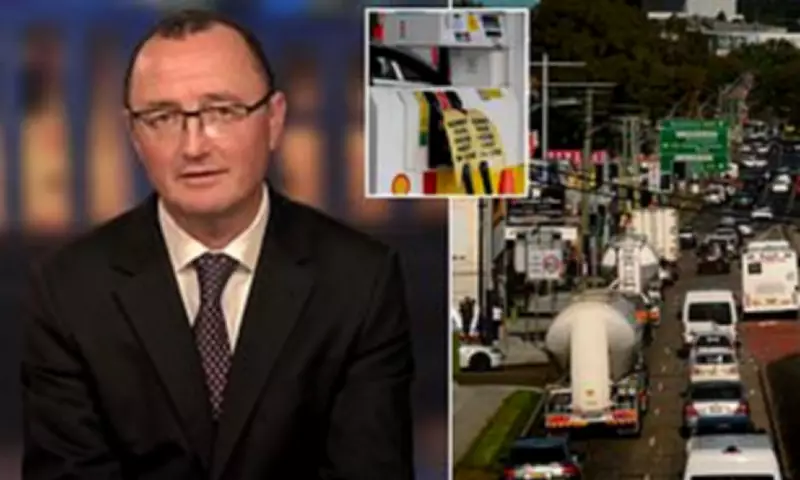
Australia's fuel security could unravel within weeks, a leading defence expert has starkly warned, as the nation faces the prospect of a global bidding war over rapidly dwindling supplies. This alarming forecast comes despite recent reassurances from Energy Minister Chris Bowen, who stated on Monday that Australia's fuel supply extends beyond mid-April and well into May.
Government Assurances Versus Market Realities
Minister Bowen emphasised that normal fuel flows have been guaranteed by major Asian exporters including Japan, South Korea, and Singapore, aiming to ease concerns that these nations might curb exports to protect their domestic supplies. However, Michael Shoebridge, Director of Strategic Analysis Australia, has cautioned that such diplomatic assurances could quickly evaporate during a severe shortage.
'Countries always meet their own needs first,' Shoebridge told news.com.au. 'It's helpful to have those discussions, but the practical reality of the energy market is going to be that the supplies go to the highest bidder, and it doesn't seem to me that government assurances will change that.'

The Impending Supply Crunch
Shoebridge explained that as energy supplies from the Gulf region, available before recent conflicts, are consumed around April 20, prices will inevitably surge. 'We will be in a bidding war, along with many others, for more limited fossil fuel supplies,' he stated, highlighting the fragility of Australia's position.
Prime Minister Anthony Albanese is travelling to Singapore on Thursday to meet his counterpart Lawrence Wong, as the government seeks to shore up fuel supplies by leveraging Australia's gas exports to support oil-based fuel supply chains. This diplomatic move underscores the severity of the situation.
Australia's Precarious Import Dependence
Australia's petrol imports are heavily reliant on a narrow group of suppliers. Singapore accounts for approximately 55 percent of supply, followed by South Korea at 22 percent, India at 11 percent, and Malaysia contributing a further 10 percent. Smaller volumes are sourced from Japan, Brunei, and several European nations.
Shoebridge pointed out that Japan, in particular, has a highly fuel-intensive manufacturing sector that it would prioritise in any shortage scenario, potentially jeopardising exports to Australia.
Confidence Versus Control
Despite these pressures, Assistant Foreign Affairs and Trade Minister Matt Thistlethwaite has reported receiving pledges from Japan, South Korea, and Singapore that fuel shipments to Australia would continue. However, at least six fuel shipments to Australia have already been cancelled or deferred, with further delays or cancellations expected.
Shoebridge criticised what he termed a 'level of magical thinking' in the government's approach. 'Mr Thistlethwaite is making it sound like the Australian Federal Government is able to dictate what our companies do, and he's assuming the same is true for Singapore and Japan - that their governments have absolute control over their refineries and who they sell their product to,' he said.
'I don't think that's true; it's still not true in Australia. We've had a very arm's length government to corporate relationship, including around energy. Governments telling each other that they've got each other's back is interesting, but what real levers and control do they have over the real actors here, which are the companies?'
Current Reserves and Rationing Risks
Australia currently holds fuel reserves equivalent to 39 days' worth of petrol, 29 days' worth of diesel, and 30 days' worth of jet fuel, with over 50 fuel shipments due to arrive in the next month. However, if the supply situation deteriorates, experts warn that rationing could be implemented swiftly.
'We're not talking about months, we're talking about a few days,' warned Sydney University Professor Ben Fahimnia in an interview with 9News. 'We're already seeing the early symptoms of rationing, it's just not officially declared.'

Geopolitical Tensions Exacerbating Crisis
The fuel security crisis is unfolding against a backdrop of heightened geopolitical tensions. Despite US President Donald Trump announcing a two-week ceasefire with Iran, conditional on Tehran immediately reopening the strategic Strait of Hormuz, fresh explosions rattled America's Arab allies overnight as Iran accused Washington of breaching the agreement.
While Trump insisted the truce was holding, Tehran declared the vital shipping lane closed in response to Israel's strikes on Lebanon, further complicating global energy logistics. Hundreds of service stations have already run out of fuel since the conflict in Iran began in February, illustrating the immediate impact on ground-level supply.
The convergence of diplomatic assurances, market realities, and geopolitical instability creates a perfect storm threatening Australia's energy security, with potentially severe consequences for the nation's economy and daily life within a matter of weeks.