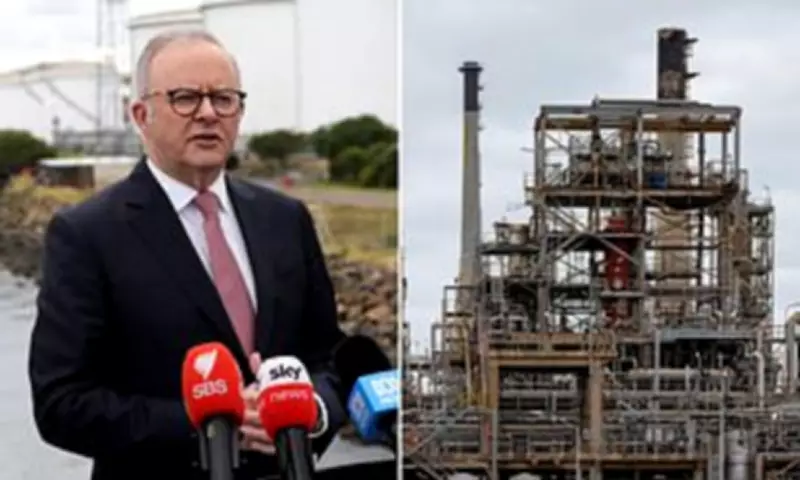
The Australian federal government is engaged in critical discussions with major energy companies regarding the potential construction of the nation's first new oil refinery in nearly seven decades. This initiative emerges from growing concerns over national fuel insecurity and the country's heavy dependence on imported petroleum products.
Addressing a Critical Vulnerability
Prime Minister Anthony Albanese's office has officially confirmed that these high-level talks are actively underway. The central focus is evaluating whether expanding Australia's domestic refining capacity could significantly diminish the nation's reliance on foreign fuel supplies. A key proposal under consideration involves the development of an entirely new refinery facility.
If this ambitious project receives the green light, it would mark the first oil refinery built on Australian soil since the 1960s. Industry analysts estimate the venture could carry a staggering price tag of up to $10 billion, reflecting the scale and complexity of modern refinery infrastructure.

A Nation Dependent on Imports
Australia's current refining landscape is remarkably sparse, operating only two major oil refineries located in Geelong, Victoria, and Brisbane, Queensland. This limited domestic capacity forces the nation to import approximately 90 percent of its fuel requirements, a precarious position that has drawn intense scrutiny.
This reliance on overseas supply chains has been thrown into sharp relief by ongoing geopolitical conflicts in the Middle East and increasing volatility within global energy markets. The situation underscores a strategic vulnerability that the Albanese government is now urgently seeking to address.
Government Mobilises Financial Support
To actively encourage and support domestic fuel production, the federal government has taken a significant step by amending the investment mandate of the $15 billion National Reconstruction Fund. This legislative change now permits the fund to assess and finance proposals specifically aimed at expanding Australia's fuel-making capabilities.
While the fund is expected to prioritise upgrades and modernisation of the existing Geelong and Brisbane infrastructure, officials have explicitly stated that backing a brand-new refinery project remains a distinct possibility. The fund's flexibility is seen as crucial for developing a comprehensive, long-term energy security strategy.
National Cabinet to Deliberate
Prime Minister Albanese is scheduled to brief state and territory leaders on this pressing issue during a National Cabinet meeting. The topic of fuel security and refinery development is anticipated to feature prominently on the agenda, highlighting its status as a matter of national importance requiring coordinated action across all levels of government.
This high-level discussion comes as the government weighs longer-term measures to fortify Australia's fuel resilience. The urgency of these deliberations has been amplified by a recent, significant disruption at a key national facility.
Geelong Fire Exposes Systemic Fragility
Concerns over Australia's fuel security escalated dramatically earlier this month following a massive fire that broke out at Viva Energy's Geelong refinery on April 15. The Geelong site is a critical linchpin in the nation's fuel supply chain, with the capacity to process roughly 120,000 barrels of crude oil daily.
Commissioned in 1954, the refinery produces a wide range of essential products including petrol, diesel, liquefied petroleum gas, jet fuel, aviation gasoline, and low-aromatic fuel. It supplies more than half of Victoria's fuel needs and contributes about 10 percent of the national total, making its operational continuity vital.
The incident starkly highlighted the inherent fragility of Australia's fuel security framework, given the country's dependence on just two ageing refineries and a vast network of imported supply. It served as a powerful catalyst for renewed political and public focus on the issue.
Political Debate Intensifies
Opposition Leader Angus Taylor has seized upon the fuel security crisis, calling last week for Australia to dramatically 'accelerate' domestic oil and gas exploration efforts. He framed the issue not merely as an economic concern, but as a fundamental matter of national security.

'We need to accelerate exploration, getting those small companies out there, innovating and finding those new reserves of oil and gas in this country that can give us the fuel security we need,' Taylor told reporters in Perth.
Taylor argued that Australia should be thinking beyond short-term stockpiling strategies. 'We shouldn't be talking about whether it needs to be 30 or 60 days of stockholding in this country, although that's important,' he stated. 'We should be talking about whether it's 30 or 60 years' worth that we can extract from under the ground using our great natural resources in this country.'
The debate now centres on whether building new refining capacity, accelerating resource exploration, or a combination of both represents the most effective path to achieving long-term fuel independence and security for the nation.