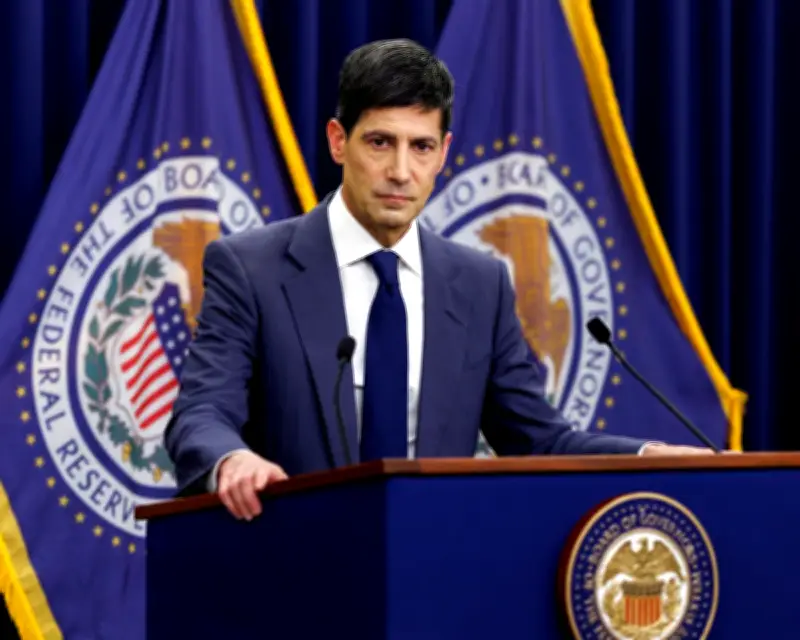
The Federal Reserve held interest rates steady on Wednesday but signaled a possible rate hike before the end of the year, causing US stock markets to drop in afternoon trading.
Rate Decision and Market Reaction
The Fed was widely expected to keep rates at a range of 3.5% to 3.75%, where they have remained since December. The decision was unanimously supported by the Fed's voting committee. The Dow closed 500 points lower, and the S&P 500 and Nasdaq each fell over 1.2% soon after the announcement.
The Fed's open market committee stated that "economic activity is expanding at a solid pace despite elevated uncertainty that owes, in part, to the conflict in the Middle East." The committee's monthly policy statement was notably shorter than previous ones, acknowledging that "inflation remains elevated relative to the committee's 2% goal, in part reflecting supply shocks that have driven price increases in certain sectors, including energy." The Fed reiterated its commitment to "deliver price stability."
Projections and Policy Outlook
The Fed released projections showing when individual officials predict rate changes will occur. Nine members projected at least one rate increase this year. New Chair Kevin Warsh confirmed he was the sole board member who did not contribute to the projections. This marks a U-turn from March, when 12 of 19 officials projected at least one rate cut by year-end.
Warsh's Plans for the Fed
In his first press conference as chair, Warsh announced plans to overhaul the central bank, particularly its public communications. He will create five new taskforces to assess the "broad conduct of monetary policy," including communications, the Fed's balance sheet, data, productivity, and jobs. These groups will "examine current practice, consider alternatives, and ultimately propose next steps for policy-maker consideration." Warsh noted he would enlist "some of the very best minds, both inside and outside the economics profession."
One taskforce will reassess how the Fed communicates with the public, including news conferences, dot-graph projections, and meeting transcripts and minutes. "I don't want to prejudge the outcomes but I'm open-minded about what they could be," Warsh said.
Economic Context
Warsh emphasized his belief that monetary policy "cannot have a very significant effect on particularly prices," a shift from his reputation as an "inflation hawk" during his tenure as a Fed governor from 2006 to 2011. "The price of oil in the markets or the price of a dozen eggs does not have first-order consequences to what we're doing," he said. "But we have an important job there. And it's to make sure that those changes in oil, or beef, or eggs or milk don't broaden in the economy."
Warsh begins his four-year term amid heightened inflation and geopolitical uncertainty. A sharp spike in energy prices due to the Middle East conflict has pushed inflation to 4.2%, the highest since 2023 and well above the Fed's 2% target. Although a ceasefire deal between the US and Iran sent oil prices tumbling to a three-month low, it may take months for energy prices to return to prewar levels. Hourly earnings dropped to a seasonally adjusted 0.7%, indicating that price increases have eroded wage gains over the past year.
Political Dynamics
It remains unclear whether higher inflation will convince a majority of the Fed's 12 voting members to call for a rate increase. Core inflation, which excludes volatile food and energy prices, has risen only mildly to 2.9% from the year prior. The labor market remains relatively strong, with the unemployment rate steady at 4.3%.
President Trump has continued to advocate for lower rates but said last week he doesn't "want to have a big influence" on Warsh. "Kevin is fantastic, and I want him to do whatever he wants," Trump said in an interview with Meet the Press, while reiterating his desire for a rate cut. Before his nomination, Warsh argued for rate cuts, publicly agreeing with Trump during a tense period between the White House and the Fed. At Wednesday's news conference, Warsh declined to answer whether he had met with Trump since starting his term.
Warsh is likely to receive more favorable treatment from the president compared with his predecessor, Jerome Powell, whom Trump repeatedly harassed for holding off on rate cuts. In January, Powell was investigated over renovations at the Fed headquarters that went over budget, but the justice department dropped the case after political pressure. Powell called the investigation a "pretext" to pressure the central bank to lower rates.
Accepting the John F. Kennedy Profile in Courage award earlier this month, Powell warned that politicizing the Fed could permanently damage trust in the central bank. "The public would lose faith that the central bank will make decisions based only on what's best for all Americans," Powell said. "The Fed's credibility would be lost."