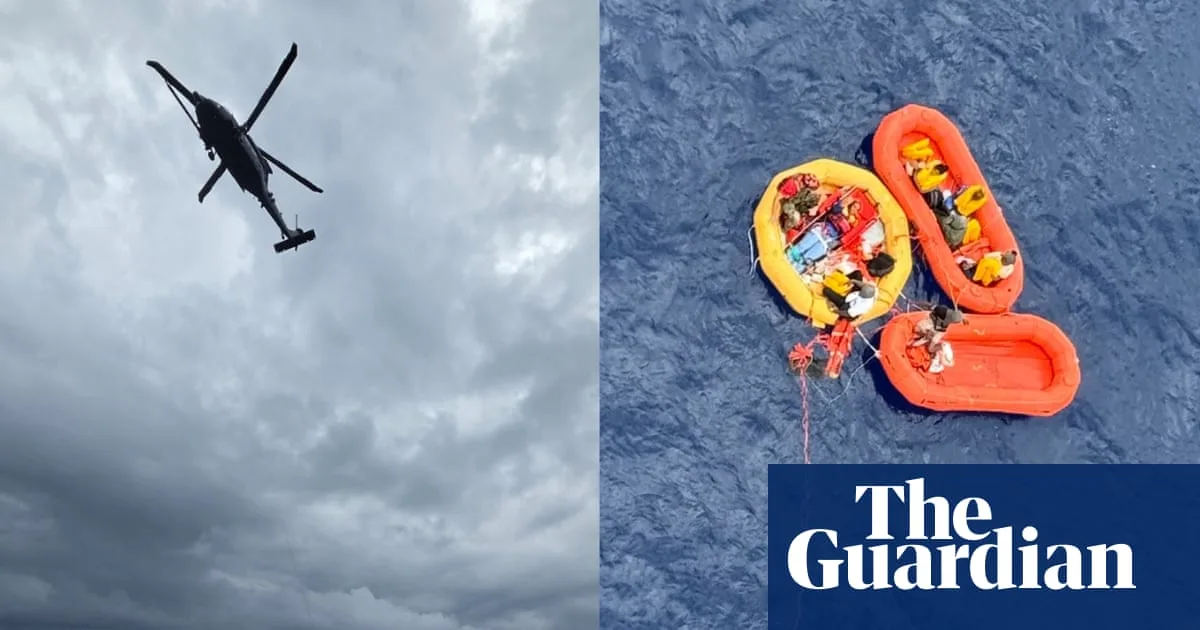
A military rescue crew in Florida has described the survival of all 11 people from a plane crash in the Atlantic Ocean as 'pretty miraculous', after revealing that its helicopter had only five minutes of fuel left when the last survivor was hoisted to safety.
The 920th Rescue Wing, based at Patrick Space Force Base near Cape Canaveral, responded on Tuesday to a distress signal from a small Beechcraft twin-propeller aircraft that had ditched into the sea about 80 miles east of Melbourne, Florida. The survivors, all Bahamian adults, had been packed into a single life raft for approximately five hours before rescuers arrived in a Combat King II transport plane and an HH-60W Jolly Green II helicopter.
Major Elizabeth Piowaty, pilot of the transport plane, said: 'I've not known anyone to survive ditching in the ocean. And from what I've seen, for all those people to survive is pretty miraculous.' Over nearly 90 minutes, the helicopter crew made nine lifts in choppy seas to retrieve all survivors, who were then flown to waiting ambulances at Melbourne airport.
Lieutenant Colonel Matt Johnson, the helicopter pilot, revealed that his aircraft reached 'bingo time' – the point at which fuel is critically low – just as the last person was lifted. He noted that while the helicopter could refuel in flight, doing so would have delayed getting survivors, some requiring urgent medical attention, to shore. An incoming thunderstorm added urgency to the operation.
The aircraft was reportedly on an internal flight between the Bahamian islands of Marsh Harbour and Grand Bahama when it ditched. The cause of the emergency is under investigation. Passenger Olympia Outten, who was travelling with her son and niece, said the pilot appeared to have got off course in stormy weather with fuel running low. She recalled being trapped with her seatbelt on before her son helped free her, and she prayed for rescue. The US aircrew, who had been conducting water rescue training in the area, responded to the plane's signal, bringing joy to the survivors as the swell increased and storms loomed.