Swedish firm Maurten’s high-carb drinks, bicarb sludges and hydrogels are giving super spikes a run for their money. Inside an unremarkable Gothenburg office building rented from the local university are a series of conference spaces named after the modern greats of distance running. There is the Eliud Kipchoge room, the Keely Hodgkinson room and, the latest addition, the Sabastian Sawe room, in homage to the man who recently redefined the limits of human endurance.
When Sawe last month in London became the first person to run an official marathon in under two hours, much of the coverage focused on the Kenyan’s carbon-plated shoes. But here, on the west coast of Sweden, a team of scientists, nutritionists and technicians believe another factor was just as significant, if not more so. “We don’t have the megaphone that the shoe industry has,” says Olof Sköld, co-founder and chief executive of the sports nutrition brand Maurten. “We are not that visible. But if you talk to the athletes and coaches, the elite world knows who we are.”
A glance at the feet on major marathon podiums reveals an array of brands from Adidas and Nike to Asics and On. Where shoe brands differ, there is only one constant among the very best runners: since 2018, every men’s and women’s marathon world record has been run by an athlete using Maurten nutrition products. Sawe’s extraordinary London Marathon time of 1hr 59min 30sec was the latest. In London alone, seven of the top eight men had an official relationship with the Swedish company, alongside five of the top six women. There is a distinct possibility the few exceptions did on an unofficial basis as well. At the very top of the sport, Maurten has become inescapable.

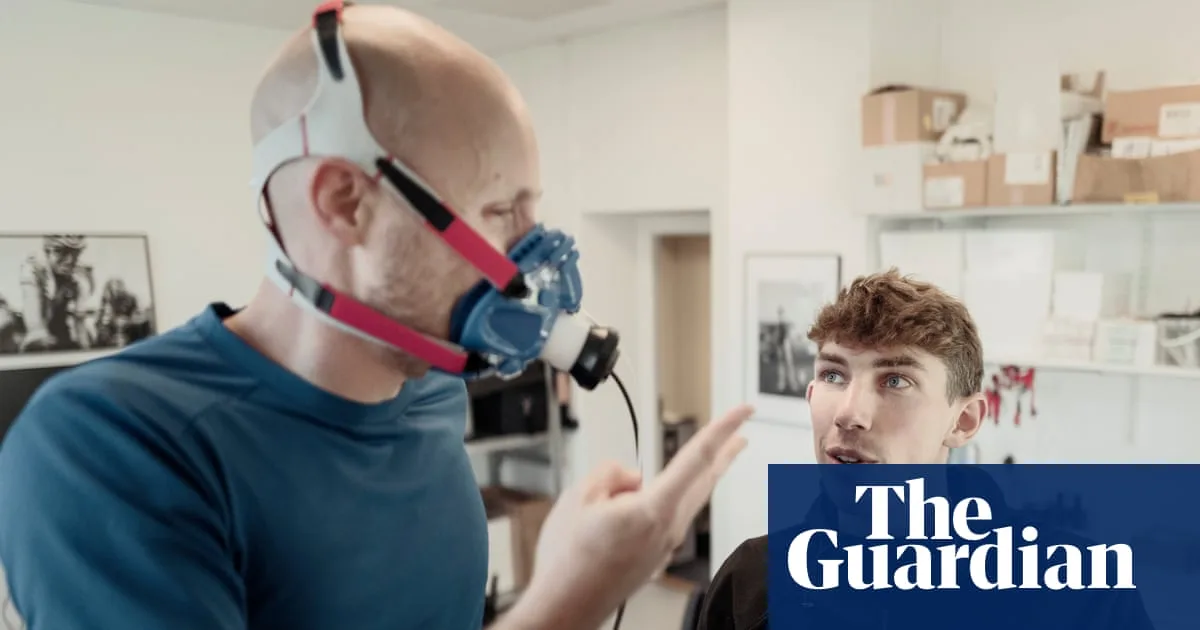
In the weeks before Christmas, the company’s head of nutrition, Tobias Christensson, welcomed Sawe’s coach, Claudio Berardelli, to its Gothenburg headquarters. Maurten had worked with Sawe’s team for some time, but it was a chance to explain the detail behind its products – most of which Berardelli was familiar with – and present some of its latest findings. Founded in 2015, Maurten’s initial differentiator was the creation of a sports drink that employed a novel hydrogel as a “vehicle” to transport carbohydrates. It was originally intended to improve dental health by reducing the sugar and acidity content of energy drinks, but early experiments suggested the concept had far greater performance‑enhancing benefits. By encapsulating carbohydrates in the hydrogel, it would in effect bypass the stomach and be absorbed in the intestine. That allowed considerably greater quantities of carbohydrates to be taken onboard during exercise without the gastrointestinal problems expected with most sports drinks. It was, says Christensson, an “absolute gamechanger”.
Sköld says: “When we first started testing it with elite runners in Kenya and Ethiopia, they said it was magical because it disappears. If you are a 50kg runner, you feel every bit of water inside. They believed it was magical because they were drinking something and it felt like it was disappearing inside them.” Although definitive proof of Maurten’s concepts remains limited – Christensson admits there is “a lot of critique and discussion around the importance of the hydrogel technology” – Berardelli was shown a number of recent studies. One found that an athlete attempting a marathon at two-hour pace would be entirely depleted of glycogen energy stores within 85 minutes if they took on no additional carbohydrates. Maurten’s method of rapid replenishment, Christensson argued, was vital to anyone seeking to push such boundaries.

So, too, was its next innovation. The performance-enhancing benefits of sodium bicarbonate – better known as baking soda – were first identified almost a century ago. The theory is that by neutralising excess hydrogen ions associated with muscular fatigue, bicarb acts as a “blood buffer” to counteract the increase in acidity during intense exercise. While considered to be illegal doping in most horse sports, it is perfectly legal for sportspeople to consume. But the reality of potentially severe, and highly common, gastro issues meant few had historically tried. Bicarb had been top of Maurten’s ambitions from the company’s formation, but it took until 2023 to release a product that is now ubiquitous at international-level middle- and long-distance running competitions. Costing £15 per serving, its bicarb system employs the same concept as the earlier hydrogel technology.