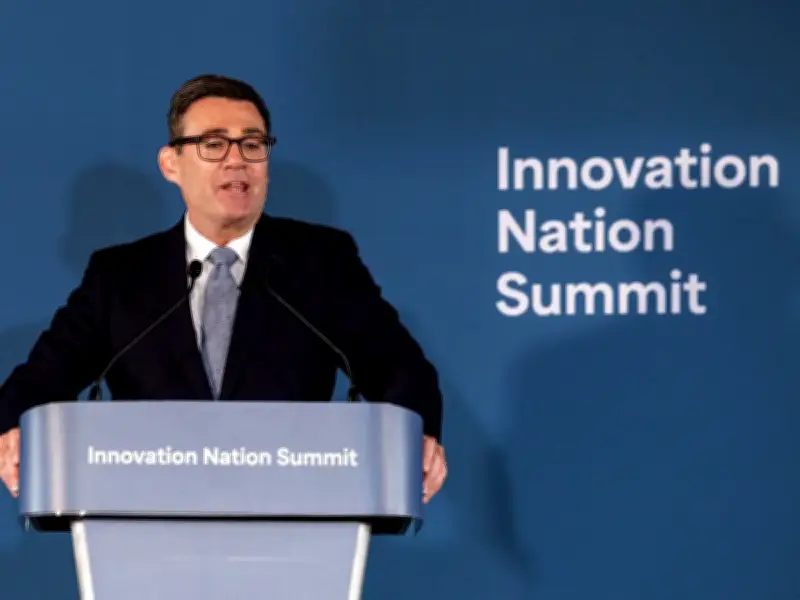
Andy Burnham has said Manchester will pioneer a new model of public finance, as he called for Britain to become the world's leading 'innovation nation'. Building on the region's existing approach to investment, the prime minister said the government will devolve local innovation partnerships funds to established mayors from 2028.
Summit remarks
Mr Burnham made the remarks on Friday at the Innovation Nation Summit at Bruntwood SciTech, in Manchester, where he said that while the UK was home to outstanding research and start-ups, too many firms had gone abroad to scale up, due to lack of investment here. He also said he'd ban non-compete clauses in employment contracts, calling them a 'drag on innovation'.
The prime minister said he wanted all UK regions to have a Good Growth Fund, modelled on the one launched in Greater Manchester in 2025.
Devolving funding
“In terms of the devolution of research and innovation funding, this is something that people here long called for and actually pressed me, when I was mayor, to make a priority,” he told the MEN after the speech.
“We've developed an approach to funding around brownfield and housing, and we've built that up through the Good Growth Fund, but we've not landed that ability to add research and innovation into the mix. This does that.
“What it means is by the end of the decade, we will have a new model of public finance in the UK and Manchester will have pioneered it.”
Describing it as a 'game changer', Mr Burnham said Britain can be the world's 'leading innovation nation'. He also announced that UK Research and Innovation (UKRI) would commit £1 billion over the next four years to back regional innovation clusters, saying that there had been 'too much drift' in recent years.
These clusters, he said, could lead to investment, growth and good jobs, 'fairly distributed across all parts of the UK', as part of a drive to 're-industrialise the UK'.
Historical context
“Re-industrialisation – that is a serious part of this mission and re-industrialisation that is felt by all people in all places,” he said. “To anyone who says we can't be that, I say we did it before, so why not?”
Mr Burnham was preceded on stage by former prime minister Gordon Brown. When he was chancellor, from 1997-2007, Mr Brown introduced research and development tax credits, as well as setting out the 10-year science and innovation investment framework.
Mr Brown told the crowd that research had found 127 innovative clusters covering every region and nation of the UK, but more needed to be done to find the country's 'lost Einstein's'. He praised the prime minister for his 'place-based policy', which he 'pioneered in this country and Manchester is such a good example of this'.
Mr Brown added: “Manchester led the Industrial Revolution and Manchester will be the next Industrial Revolution.”
Mr Burnham spoke highly of Greater Manchester's legacy in scientific inventions, including Sir Ernest Rutherford's splitting of the atom at The University of Manchester in 1917. He also mentioned UK Biobank – the world's most comprehensive dataset of biological, health and lifestyle information – which will soon be moving to the Manchester Science Park.
Investment and EU ties
“The government is investing over 80 billion in research and innovation in this spending review,” said Mr Burnham. Mr Brown said the nation sometimes had 'blind spots' in relation to innovation.
Agreeing with his comments, the prime minister said there are many start ups that began in the UK but were then scaled up in a different country. He said: “We've let too much go overseas and that's a blind spot we've got to be honest about and do something to correct.”
Sir Keir Starmer's government had been exploring restrictions on non-compete clauses since late last year, including a total ban. At the summit, Mr Burnham said the use of the clauses had stopped workers leaving to join other companies, or founding their own businesses. He called his ban on non-compete clauses the 'Bosman ruling of the innovation sector', referencing a court decision in 1995 which changed how footballers in the European Union could move between clubs.
Mr Burnham mentioned having 'closer relations' with the European Union in his speech. He said there was 'a call from Europe for more youth ability and students from Europe to study here', which will be discussed at the upcoming UK-EU summit.
Asked if he was opening the doors to re-join the EU, he said: “I do not see how we lift levels of growth back to where we would want them to be without developing closer ties,” he said. “Brexit has hit our growth and we just have to be honest about that. But at the same time, [we must] go carefully and do so in a way that keeps the British public in charge.
“They are the ones who will decide our future relationship with Europe.”