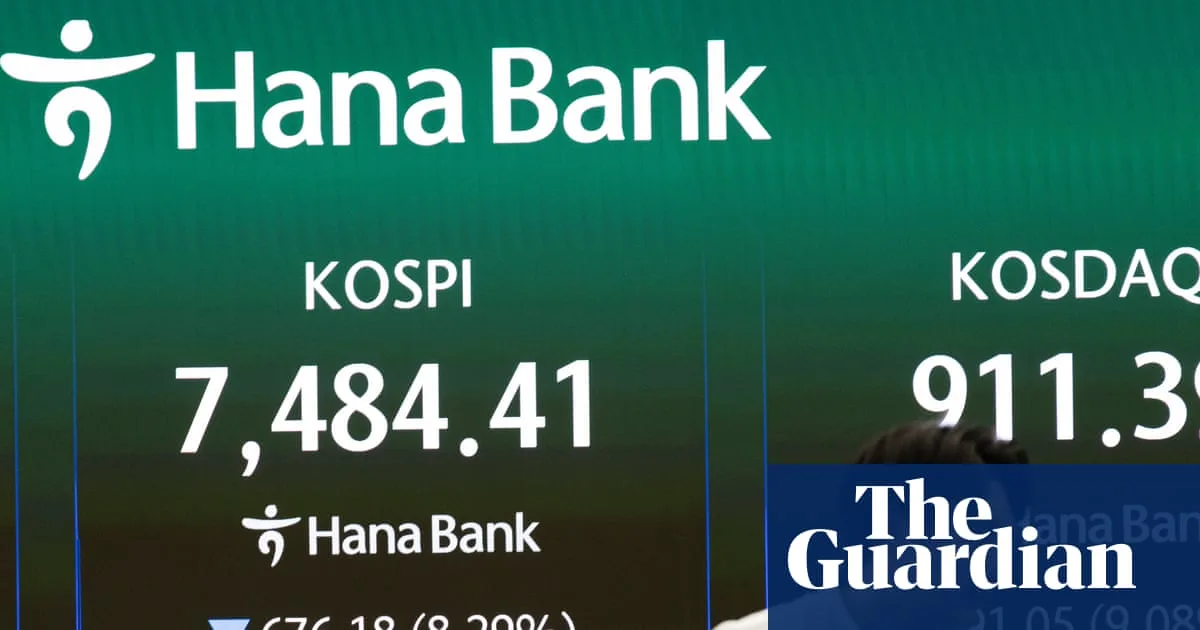
Stock markets in Asia and Europe fell sharply on Monday following a sell-off in US tech stocks last week, as investors grew concerned about how artificial intelligence companies would fund their ambitious spending plans. Meanwhile, oil prices seesawed after Iran and Israel exchanged strikes, with Brent crude initially jumping nearly 5% to $97.60 before falling back to $94.60 after Iran halted military operations.
In Asia, the South Korean Kospi index slumped almost 9% at one point, briefly suspending trading, led by chip makers Samsung Electronics and SK Hynix. Japan's Nikkei 225 fell 3%, and Hong Kong's Hang Seng dropped 1.5%. In London, the FTSE 100 opened 0.4% lower, with Rolls-Royce and IAG among the biggest fallers, while oil companies BP and Shell rose.
US markets opened higher on Monday, with the S&P 500 gaining 1% in early trading as chip shares led a recovery from Friday's losses, when the tech-heavy Nasdaq lost nearly 5%.
European tech firms at the heart of the AI boom also suffered. BE Semiconductor Industries fell 4.5%, ASML dropped 3.2%, and Aixtron lost almost 6%. Telecoms firm Nokia fell 5%.
Investors are increasingly nervous about the valuation of AI stocks amid rising prospects of higher inflation and interest rates. Susannah Streeter of Wealth Club said markets are pricing in a greater likelihood of a Federal Reserve rate rise, noting that tech giants with deep pockets are seeking fresh funding for “eye-watering” capital expenditure. Charu Chanana of Saxo said investors now want clearer proof of earnings delivery and monetisation, suggesting a “positioning reset” rather than the end of the AI story.
The rise in Brent crude followed direct strikes between Iran and Israel, raising fears that the conflict could prevent the reopening of the Strait of Hormuz, through which a fifth of the world’s oil and gas supply flows. Donald Trump, speaking to Fox News, said he was “not happy” about Israel’s strikes, which he claimed were not coordinated with the US.