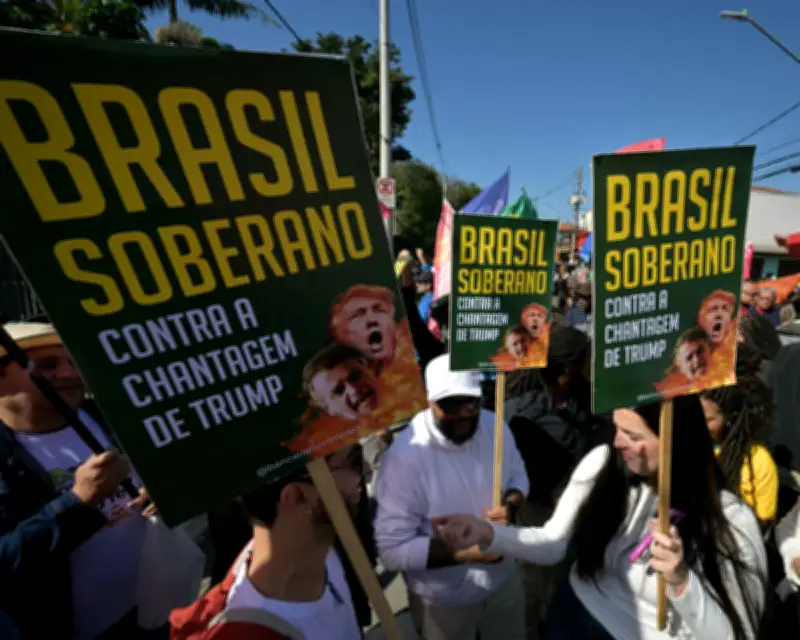
Brazil has vowed to retaliate against Washington's decision to impose 25% tariffs on imports of some Brazilian products, with President Luiz Inácio Lula da Silva's office describing the move as 'a regrettable milestone' in bilateral relations. The office attributed the tariffs to pressure exerted on the White House by the family of far-right former President Jair Bolsonaro.
Tariffs Scheduled for July
The new tariffs are set to take effect on 22 July. Once implemented, Brazil — which historically runs a trade deficit with the US — will become the second most heavily tariffed country by Washington, after China. The Office of the United States Trade Representative (USTR) confirmed the tariffs late on Wednesday, citing what it described as Brazil's 'unreasonable acts, policies, and practices' that had 'harmed US commerce'.
Brazil, however, says it repeatedly sought to present data refuting the allegations and views the decision as primarily political. Politicians from Lula's party also see it as an attempt by Donald Trump to influence Brazil's upcoming elections.
Political Context
Lula, whose relationship with Trump has been marked by ups and downs and is currently at a low point, is seeking re-election in October. His main challenger will be one of Bolsonaro's sons, far-right Senator Flávio Bolsonaro, chosen to run after the former president was convicted for attempting to overturn the 2022 election, which Lula won.
The USTR investigation began in July last year. At the time, Trump cited Bolsonaro's ongoing trial as one reason for launching it, saying it 'should not be happening' and calling it 'a witch-hunt that must end IMMEDIATELY'. Another of Bolsonaro's sons, then-congressman Eduardo Bolsonaro, claimed credit for encouraging Trump to take retaliatory measures against Brazil. He was later stripped of his seat after moving to the US.
Brazil's Response
Lula's office said on Wednesday that the tariffs resulted from 'a narrative constructed with the active collaboration of the Bolsonaro family'. It stated, 'They are false patriots who plotted and publicly defended actions against our country, driven by electoral objectives.'
US Secretary of State Marco Rubio, who met with Bolsonaro's sons in Washington, posted that there should be no confusion about why the US imposed the tariffs: 'President Lula and his government have not negotiated with the US in good faith. For the past year, Lula has put his own ego ahead of making a deal for the welfare of the Brazilian people, and these tariffs are the price for that.'
Domestic Impact
Opinion polls, including one released on Wednesday, have shown that the tariffs have strengthened Lula's position against Flávio Bolsonaro. More than half of Brazilians blame the Bolsonaro family for the tariffs. This prompted Flávio Bolsonaro to ask the US, during a USTR hearing last week, to suspend the tariffs because they could benefit Lula electorally. After his request was ignored, the senator blamed Lula for the new tariffs on Thursday morning, reposting Rubio's comments and adding: 'Lula is no longer fit to be president of Brazil. We are on a plane without a pilot. Brazil's Biden has become grumpy, reckless and a danger to our nation.'
Retaliation Measures
Lula's office said it would 'immediately begin the procedures to invoke the instruments provided for under the Reciprocity Law', which allows Brazil to adopt retaliatory measures against specific countries. After the US Supreme Court ruled against many of Trump's tariffs imposed under a different law, Brazil will become the first country targeted under the new strategy, which relies on Section 301 of US trade law — a provision authorising investigations into alleged unfair trade practices.
The USTR's final decision alleged that Brazil adopted practices that 'burden or restrict' US commerce, including the use of Pix, a free and highly popular instant payment system, which it argued harmed US credit card companies. Lula's office rejected the allegations, stating, 'Brazil does not recognise the legitimacy of investigations that are not grounded in multilateral trade rules.'
The USTR also said the tariffs were justified by 'illegal deforestation', arguing that it gave Brazilian farmers an unfair advantage over their US counterparts. Besides the irony noted by many analysts — that the Trump administration cited an issue that surged during the presidency of its ally Bolsonaro — Lula's office dismissed that part of the report as 'absurd': 'The entire world knows that, since 2023 [when he took office], we have taken decisive action against environmental crimes and drastically reduced deforestation across all Brazilian biomes.'