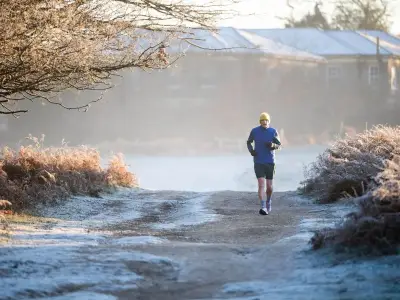
Forecasters at the Met Office are warning of a 70% chance of colder weather and frosty spells in the UK as a Sudden Stratospheric Warming (SSW) event could take place as soon as next week. If confirmed, it would be the earliest major event of its kind ever recorded in the satellite observation era.
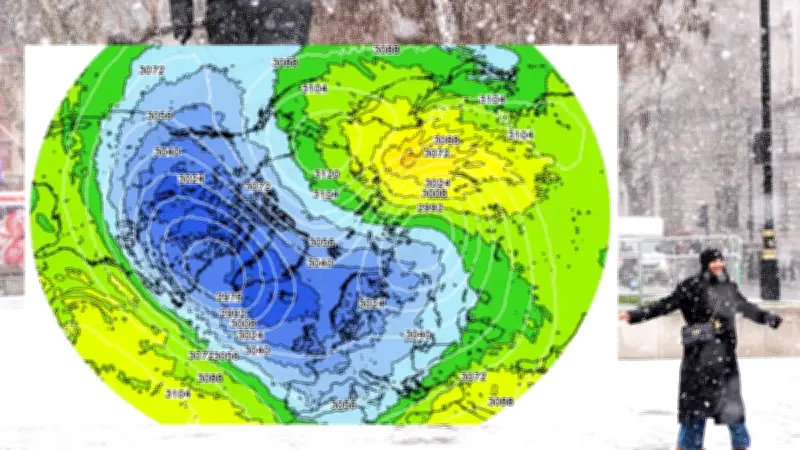
The weather phenomenon occurs when the Polar Vortex—a strong current of air spinning in an anti-clockwise ring around the Arctic at around 150mph—is disturbed or deformed. This can cause the spin cycle to wobble or break up, sometimes even turning in the opposite direction.
What Happens During Sudden Stratospheric Warming
When the Polar Vortex collapses, cold air sinks into the troposphere, the layer below the stratosphere, and changes the shape of the jet stream below it. The jet stream, a ribbon of fast-moving air that determines most UK weather conditions, can wiggle and wind, creating Rossby Waves. During this process, the stratosphere warms rapidly, sometimes by up to 50C in a couple of days.
When the jet stream oscillates, blocking areas of high pressure can form over the North Atlantic, sending bitterly cold Arctic air towards northern Europe. This leads to colder, frostier, and drier weather in the UK and northern Europe.
Link to El Niño
The event is closely linked to El Niño, which has continued to strengthen to unprecedented levels across the Pacific. An El Niño is declared when sea surface temperatures are higher than usual over several months, causing warm seas to slosh back into the central Pacific and triggering thunderstorms that warm the atmosphere. As the warm air expands, it increases pressure in the troposphere, which can disturb and displace the Polar Vortex.
The stratosphere could begin to warm from November 5. Sudden Stratospheric Warming has not yet been declared, and the long-range forecast for next week predicts highs of just 12C and lows of between 6C and 7C, with dry conditions and gusts of around 29mph.
Impact and Historical Precedent
Effects of Sudden Stratospheric Warming can take anywhere between two to six weeks to be felt. In 2018, the breakdown of the Polar Vortex brought the Beast from the East to the UK, forcing schools to close and causing widespread transport shutdowns. The snowstorm saw thousands of schools close, and a 60-year-old man from Welling in London died after trying to save his dog from a lake. As many as 11 others died amid the snowy conditions.
The Met Office told The Independent that a highly unusual disruption of the stratospheric polar vortex is now underway, noting that if it becomes a major SSW, it will be the earliest such event on record. The Met Office added that while SSWs often promote the chances of cold UK weather, there remains uncertainty over the influence on weather at the surface at this stage.