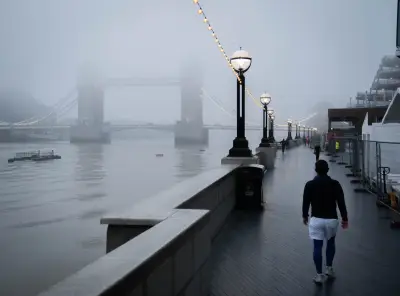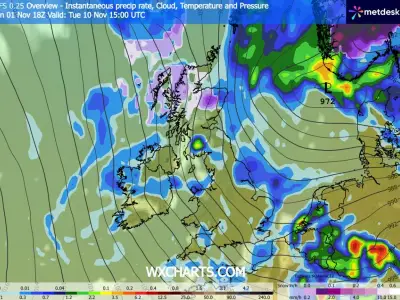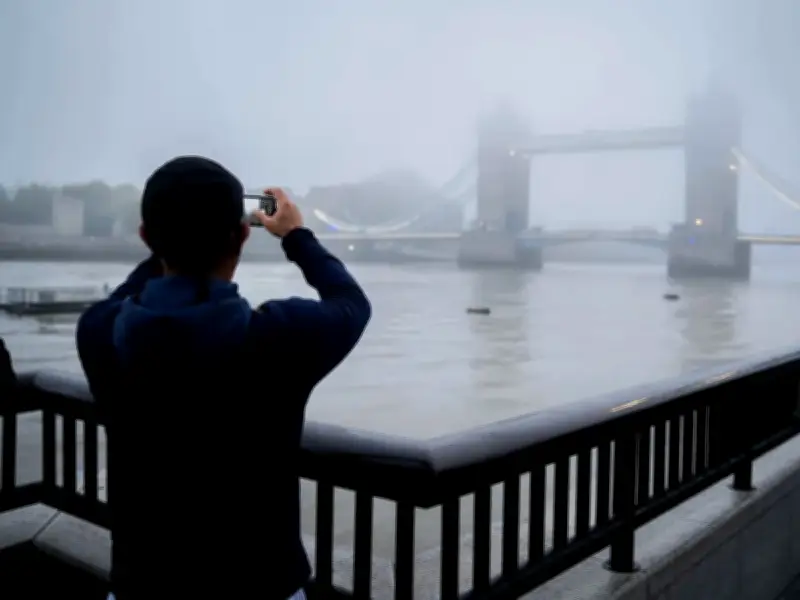
Thick fog has hit large parts of the UK this morning (Monday, November 9), continuing a pattern that caused widespread disruption over the weekend. On Friday night (November 7), fog led to diverted flights, obscured major fireworks displays, and disrupted TV coverage of Altrincham FC's FA Cup match in Greater Manchester.
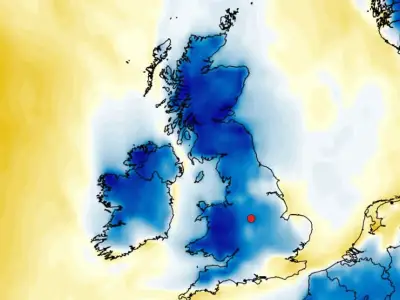
A yellow weather warning for fog, stretching from York to Bath and covering most of the South East and eastern England, remains in place until 11am. The Met Office has warned of difficult travel conditions on Monday morning, with commuters advised to prepare for delays.
Fog warning details and affected areas
The warning came into effect at 6pm on Sunday and will last until 11am on Monday, affecting parts of the East Midlands, East of England, London and South East England, North West England, South West England, Wales, and Yorkshire and Humber. Visibility could fall to 50 metres or less in some places, with possible delays to bus and train services and a chance of flight cancellations.
Fog forms when there is essentially a cloud at ground level, reducing visibility to less than 1000 metres. Like clouds, fog is caused by tiny water droplets suspended in the air, but not all fog forms in the same way. Dense fog, when visibility falls below 100 metres, can cause severe travel disruption. The thickest fogs tend to occur in industrial areas where more pollution particles allow water droplets to coalesce and grow.
Why the UK has seen so much fog
Niamh Murray, Met Office operational meteorologist, explained that current conditions are the “perfect recipe” for fog. “With autumn and winter and getting fog during this time of year, we get much longer nights, and that allows temperatures to fall away,” she told the Press Association. “We get a longer period of cooling and also the temperatures are much lower, so they're much closer to the temperature that we need for the air to become saturated and therefore form fog. Another thing that we need to form fog is quite light winds, not absolutely no winds. We just have the perfect recipe at the moment: light winds, clear skies, long nights, to allow that fog to develop. And particularly if we see the negative numbers (temperature in degrees Celsius), it can quite stubborn to clear the next day.”
Motorists have been urged to take extra care in the low-lying cloud after a crash involving more than 30 vehicles during foggy conditions closed a motorway for nearly 12 hours. The M20 in Kent was shut both ways between junctions 8 and 9 near Maidstone after the pile-up on Saturday evening, which seriously injured two people.
Advice for drivers
AA president Edmund King previously said: “Fog can transform a familiar road in a matter of minutes, so drivers need to be prepared to adapt their speed and leave more room between themselves and the vehicle ahead. One of the biggest mistakes is simply following the rear lights of the car in front. It can give you a false sense of security and means you may be travelling too close to react safely if that vehicle suddenly stops. Ultimately, there's no prize for arriving a few minutes early. Give yourself extra time, slow down and drive to what you can actually see ahead.”