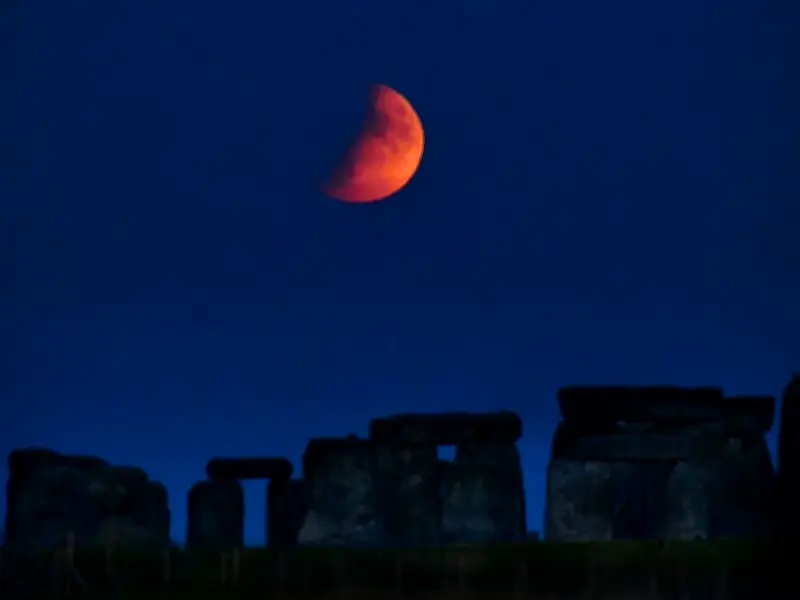
A partial lunar eclipse will be visible across the UK and Ireland on the morning of August 28, 2026, with roughly 93% of the Moon expected to be engulfed by Earth's umbra at the event's peak.
The phenomenon, often called a "Blood Moon," will see the Moon drift through Earth's shadow overnight. Only a portion of the lunar surface will enter the dark central zone, or umbra, while the rest remains in the lighter outer shadow, or penumbra. The event stops just short of a total lunar eclipse, but the substantial coverage will create a dramatic spectacle.
What is a partial lunar eclipse?
A partial lunar eclipse occurs when the Moon travels through Earth's penumbra while only a section penetrates the darker umbra, according to the Express. As a result, part of the Moon appears markedly darkened while the rest remains lit, producing the characteristic "bite" effect.

How and when to see it in the UK
The eclipse will be visible across the UK and Ireland in the early hours of Friday, August 28. Viewing conditions may become trickier as the event progresses because the Moon will descend toward the horizon. For the best view, sky-gazers should find a high vantage point with an unobstructed view of the south-western sky.
No specialist equipment or protective eyewear is needed, making it safe to watch with the naked eye. However, visibility will depend on weather conditions, and cloud cover could block the view for some.
The penumbral phase begins at 2.23am BST, with the more noticeable partial eclipse starting at 3.33am BST. The event peaks at 5.12am BST, when around 93% of the Moon will be in Earth's deepest shadow. Observers in the UK and Ireland will not see the eclipse to its conclusion, as the Moon will set before the event ends. In London, moonset is expected at approximately 6.15am, while the partial eclipse is scheduled to conclude at 6.51am BST.
What to expect from the Blood Moon
During the eclipse, the shadowed part of the Moon may adopt a reddish or bronze hue. This occurs when sunlight is filtered through Earth's atmosphere and redirected onto the lunar surface, allowing warmer red tones to reach the Moon while other colours are scattered away.
The eclipse will be observable not only across the UK and Ireland but also from large parts of Europe, Africa, and the Americas. Depending on location and time zone, some regions will see the event on the evening of August 27 rather than the early hours of August 28.