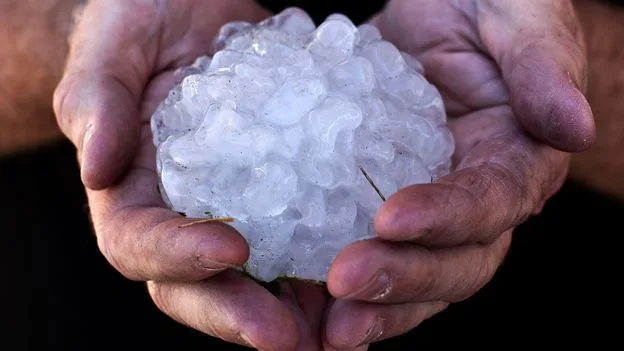
Rising global temperatures are making hailstorms more violent, with larger chunks of ice and more intense downpours, scientists warn. In the UK, a heatwave in Leicestershire on 21 July 2021 was suddenly interrupted by golf-ball-sized hailstones that smashed windows and damaged cars. The event, while severe, was mild compared to a hailstorm in Calgary, Canada, in June 2020, where tennis-ball-sized hailstones caused damage to at least 70,000 homes and vehicles, leaving a repair bill of C$1.2bn (£720m).
Climate change is altering the pattern of hailstorms. In Texas, Colorado and Alabama, records for the largest hailstone have been broken in the last three years, with sizes up to 16cm (6.2 inches) in diameter. In 2020, Tripoli, Libya, was struck by hailstones nearly 18cm (7.1in) across. Giant hailstones, classed as those with a diameter greater than 10cm (3.9in), are extremely rare but indicate a trend. Hail damage in the US now averages more than $10bn (£7.6bn) a year.
Hail forms when water droplets are carried upward into a thunderstorm. Updraughts take them into cold parts of the atmosphere where they freeze. Moisture accumulates on the outside, causing the hailstone to grow in layers. The speed of growth depends on the amount of moisture in the air. A 103km/h (64mph) updraft supports golf-ball-sized hail, while a 27% faster updraft can create baseball-sized hailstones, according to the US National Oceanic and Atmospheric Administration.
Destructive storms producing hailstones more than 25mm (1in) in diameter require specific conditions, says Julian Brimelow, a physical sciences specialist at Environment and Climate Change Canada. These include enough moisture, powerful updraughts, and a trigger factor like a weather front. Such conditions are typical in regions like the US Great Plains and Australia’s Gold Coast, which are prone to supercell thunderstorms that produce very large hail due to rotating updraughts.
As the planet warms, the amount of moisture in the air increases, leading to heavier rainfall and more extreme storms. "Areas where hailstorms are favoured are likely to shift," says Brimelow. "An area now where sufficient moisture is a limiting factor may become more moist and consequently, hailstorm frequency may increase." Observations and climate modelling suggest hailstorms will become more frequent in Australia and Europe, but decrease in some other regions.