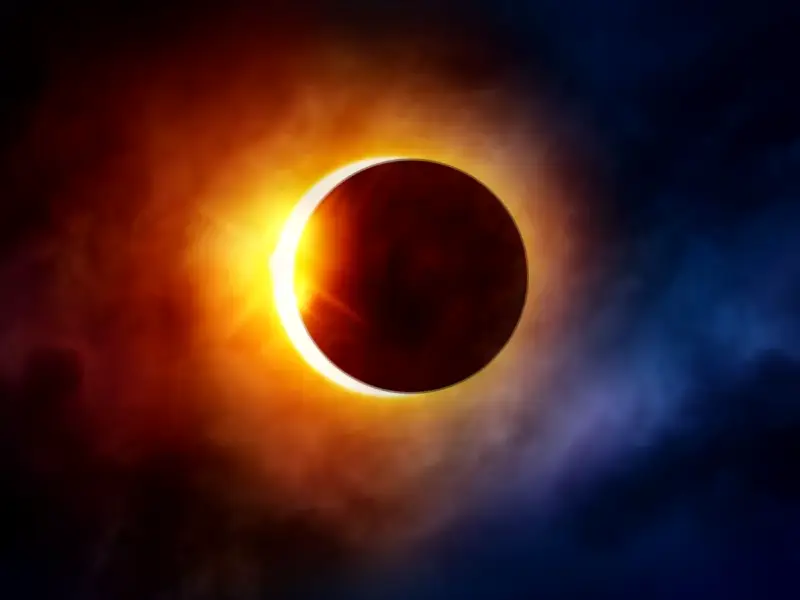
Britons are counting down to a spectacular celestial show today as the Moon slides in front of the Sun in the UK's first near-total solar eclipse in over half a century. The rare event will see daylight dim as the Moon blocks out more than 90% of the Sun in Britain, creating a fascinating crescent shape in the evening sky.
What Time Is the Solar Eclipse in the UK?
Exact timings will depend on your location, but the event will begin shortly after 6pm, with the maximum eclipse occurring at shortly after 7pm before the Sun gradually re-emerges. In London, the eclipse will sweep in at 6.17pm, peak at 7.13pm and end at 8.06pm.
According to the Royal Observatory Greenwich, the timings for today's solar eclipse are as follows: Edinburgh and Glasgow – begins at 6.08pm, eclipse maximum at 7.05pm and ends at 8pm. Galway and Dublin – begins at 6.12pm, eclipse maximum at 7.10pm and ends at 8.05-06pm. Manchester and Liverpool – begins at 6.13pm, eclipse maximum at 7.10pm and ends at 8.03-04pm. Norwich – begins at 6.15pm, eclipse maximum at 7.10pm and ends at 8.04pm. London, Bristol and Cardiff – begins at 6.17pm, eclipse maximum at 7.12pm and ends at 8.06pm. Truro, Cornwall – begins at 6.18pm, eclipse maximum at 7.16pm and ends at 8.10pm.
How to Make a Pinhole Viewer for the Solar Eclipse
With specialised eclipse glasses selling out across the country today, there's a quick and easy alternative for viewing this evening's spectacle. A pinhole viewer can be put together at home with no specialist equipment needed. You only need three basic items: a cardboard box, a sheet of kitchen foil and a pair of scissors.
Educational platform Twinkl Resources shared a step-by-step video guide on TikTok showing exactly how to assemble your own pinhole projector. You begin by opening up your cardboard box and taping a strip of white paper down one side of it. It doesn't matter which side, but the opposite side must be suitable for cutting holes into. Once your paper is secured, cut out two squares from the opposite side of the cardboard box. Cover one square with a sheet of kitchen foil and secure it with tape. Then, use a pin to make a small hole in the centre of the foil. Make sure the box is completely sealed at the top, so the only gaps are the pin hole and the empty square. Your pinhole projector is now complete and ready to use.
How to Watch the UK Solar Eclipse Without Special Glasses
If you couldn't get your hands on the special eclipse glasses quickly enough, you can still watch the solar eclipse safely by using indirect projection methods. The safest and easiest ways are pinhole projectors (without looking directly at the sun through the pinhole), household objects with small holes like colanders, or welding helmets for direct viewing.
Experts have warned that looking directly at the Sun without proper protection can cause permanent eye damage and ordinary sunglasses are not enough. Only special solar eclipse glasses that are ISO 12312-2 certified should be used. Eclipse glasses that do not carry the safety standards, or ordinary sunglasses, should never be used as they reduce glare, making it feel more comfortable to look at the Sun for longer, but still allow harmful solar radiation to reach the retina.