Thousands of people across Merseyside witnessed a partial solar eclipse on Wednesday, August 12. The Moon covered more than 90% of the Sun, marking the most coverage seen from the UK and Ireland since the 1999 eclipse, according to Royal Museums Greenwich.
Rare astronomical event draws crowds
The UK last witnessed a solar eclipse in March 2025, but that time only around 30-40% of the Sun was covered. Tonight, more than 90% was obscured, causing the sky to dim as the Moon blocked out the sunlight. People gathered at beauty spots across Merseyside on a summer evening to witness the event. The next partial eclipse may not occur until 2050.
Homemade viewers and special glasses
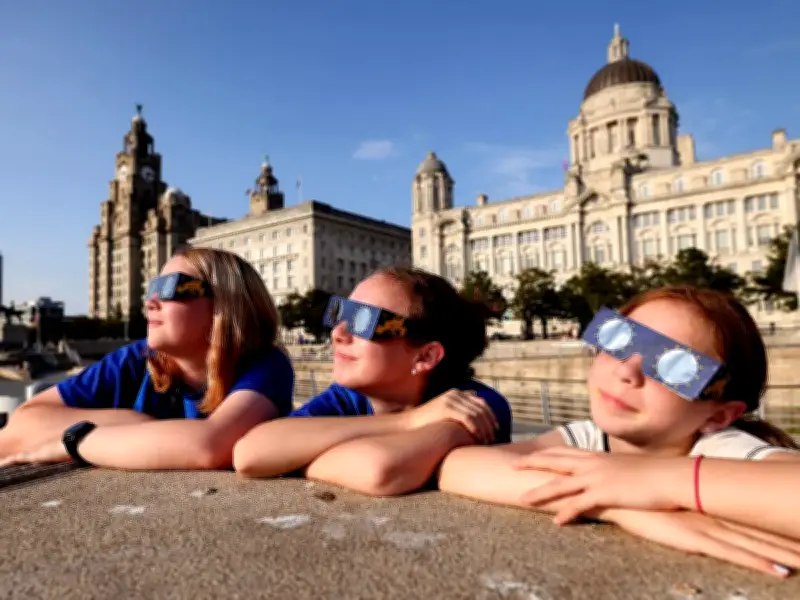
Sam, from Formby, went to the Pier Head with her children Dylan and Caden, who built their own eclipse viewer using a kitchen colander and a piece of paper. Sam said the sunlight formed a “perfect circle” through the makeshift device. Anna and Simon, who live in Liverpool, bought a pack of 10 solar glasses from Amazon for £8. Anna, who has seen a “total eclipse” in her home country of Greece, said the sun through the glasses “just looks like the moon”.
Samuel and Oliver, from Hertfordshire, on holiday in Liverpool, made their own viewing glasses using an empty cardboard box and tin foil. Their mother, Siri, said the boys had spent “hours” on their homemade equipment after “reading lots of articles.” She added: “They were so excited to come and use it today. It’s really quite rare so it’s quite cool to see. I hope it works.”
Crowds gather at beaches and venues
In New Brighton, crowds watched as hundreds of birds returned to shore to roost as daylight faded. On Crosby Beach, thousands gathered to watch the event. As the eclipse peaked, The Beatles' 'Here Comes The Sun' was played by a DJ on top of the bus at The Bus Yard, an outdoor bar and street-food venue. The next total solar eclipse visible from the UK will not occur until September 23, 2090.
The eclipse began just after 6pm, reaching its maximum at 7:10pm in Liverpool. ECHO photographers captured sky gazers across Merseyside, including at the Pier Head, Crosby Beach, and New Brighton.