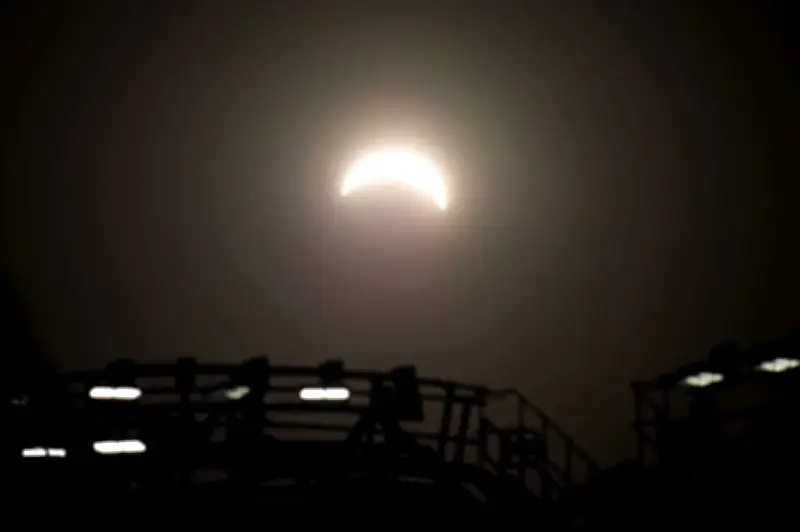
Thousands of people have gathered across the island of Ireland to watch a rare partial solar eclipse. One of the biggest gatherings was at Phoenix Park in Dublin, where huge crowds came out to experience the once-in-a-generation astronomical event. Crowds also gathered at Queen’s University in Belfast for a watch-along event under cloudy skies, as well as at the Armagh Observatory and a number of other locations.
Crowds cheer as skies darken
In Phoenix Park, crowds cheered and clapped as the skies darkened at the moment the moon covered the sun. A telescope had been erected to give people a safe view of the eclipse, while others brought their own homemade viewing devices fashioned from cereal boxes.
Colm Healey, from Dublin, said he came because it would be the only chance in his lifetime to see the rare celestial event. He said: “It is great to see the crowds here and so many people that are interested. I have got my eclipse glasses so I’m well prepared.”
Jack Donovan and Paul Cantwell had travelled from Wicklow. Mr Cantwell said: “We wanted to come because we’ll never see anything like it again. It’s such a rare occasion, it’s cool.” “We haven’t got glasses but we’ll hopefully get a view through the telescope.”
Eclipse events at Croke Park and city centre
At Croke Park in Dublin, crowds watched the eclipse before the friendly football match between Manchester United and Leeds United. Two enterprising stewards had brought along welding masks to watch the eclipse safely.
Earlier, hundreds of people brought a Dublin city centre street close to a standstill as they queued to buy glasses to view the eclipse. On Wednesday afternoon, the queue outside the Designist shop in George’s Street snaked for hundreds of yards. Some of those in the queue said they had been waiting for up to two hours to get the glasses, on sale for 10 euro, to enable them to view the rare astronomical event.
Among those in the queue was Kim Olin, who said she did not mind having to wait. She said: “I want to get a pair of glasses to look at the eclipse. The next one won’t be until 2090 and I won’t be alive by then so this is my last chance. I have no idea how long I’ll have to wait, the queue is very long. I just want one pair, so as long as they don’t run out.”
Bobby McQuillan said he had been waiting in the queue for more than an hour. He said: “It will be worth it in the end. It is a once-in-a-lifetime event and the forecast is that we will have a good view of it in Dublin.”
Armagh Observatory reports packed viewing
Meanwhile, the solar eclipse also generated excitement in Co Armagh as families gathered to observe the “remarkable astronomical event”. The director of Armagh Observatory and Planetarium, Professor Michael Burton, said visitors feel part of the “cosmic happening” as the moon was set to cover more than 90% of the sun. It was described as likely to be the deepest eclipse seen from the region since the total eclipse of August 1999 and the last time that such an eclipse will be seen here until 2090.
The west and south of Ireland were to see 98% coverage of the sun while this was expected to be around 94% in the east and north of the island. Some areas of the world are expected to see a total eclipse, including parts of Spain, Greenland and Iceland. Armagh Observatory joined those in Dunsink, in Dublin, and Blackrock Castle in Cork in organising viewing events.
“We’re having one of these remarkable astronomical events, which tells us that we live on a spaceship – spaceship Earth – and it’s travelling around our solar system,” Mr Burton said. “What’s going to happen tonight is that the moon is going to come between the Earth and the sun, and the moon is just about the same angular size as the sun is, and it’s going to just about block it all out and so we’re going to get an eclipse. It’s not going to be a total eclipse. It’s not going to go totally dark, but about 94/95% of the sun will be blocked out.”
Mr Burton said the planetarium in Armagh was “packed out” in anticipation of the eclipse. “It does remind us that we are a small part of the universe, and this is a cosmic happening out there, and we are part of that,” he said. “Most of the time, the stars are looking cleverly distant, and we don’t really feel like we relate for them. But an eclipse is one of those occasions where we know we’re part of a greater sphere, we’re part of major events in our solar system.”
Dr Rok Nezic, conducting science communication and outreach at the Armagh Observatory & Planetarium, said the anticipation had been building for hours before the eclipse. “It is something that can excite you about space because while eclipses are kind of common, to have them near you is very rare, and so it’s always nice to see the excitement around that,” he said. “I will say, it’s always also hard to judge how much people get excited because we’re always excited, it’s our job, but it’s been so far fantastic.”
Dr Nezic said he “really hopes” this eclipse will inspire the next generation of astronomers, adding: “Just a couple days ago, I was talking to someone from America who, as a high school student, experienced an eclipse over in the states, and she was saying, she’s been chasing them again ever since, so she’s now going to Spain to do that.”