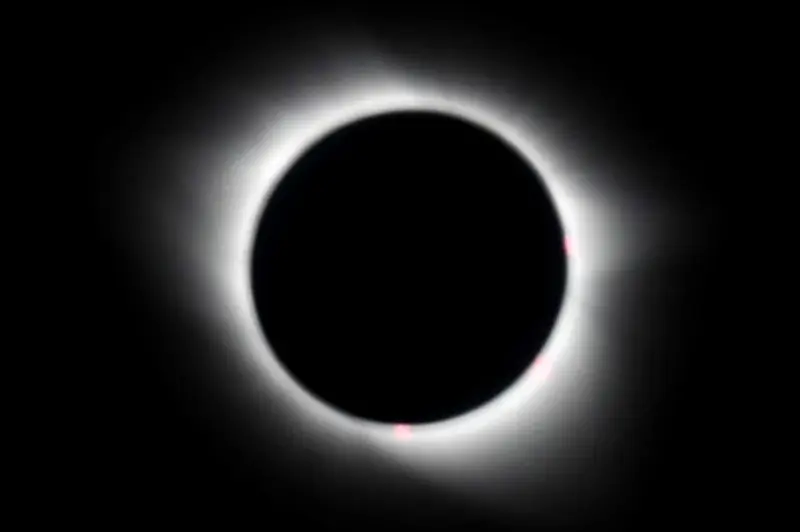
London will see its most complete solar eclipse in over a quarter of a century today. The moon will pass directly between the Earth and the sun, blocking the sun's light almost entirely. Around 90% of the sun will be covered, triggering a rare natural phenomenon. There won't be a better eclipse in Britain until 2090.
What is a solar eclipse?
An eclipse occurs when the moon moves directly between the sun and Earth, blocking the sun's light to part of Earth, totally or partially. The type of solar eclipse experienced depends on the relative positions of the sun, Earth, and moon, as well as where on Earth you're watching from. Wednesday's event will be a partial eclipse, a rare occurrence because of how much of the sun will be blocked.
When is the solar eclipse and what is the best time to watch?
This week's solar eclipse will begin at 6.17pm for those in London, Bristol, and Cardiff. The height of the eclipse is expected at 7.13pm for Londoners, and it will last around 1 hour and 49 minutes until 8.06pm. For those in Manchester and Liverpool, the eclipse will commence at 6.13pm, while for those in Scotland, it will begin closer to 6.08pm. Some European countries, like Greenland and Iceland, are set to experience a total eclipse.
How to watch the eclipse safely
Partial solar eclipses carry more risks than total solar eclipses, because the latter involves the sun being entirely covered, albeit only briefly. During a partial solar eclipse, it is never safe to look at the sun without eye protection, even though it looks as though it is being blocked by the moon.
“The glasses you use must comply with the ISO 12312-2 international safety standard. Glasses that have reached this safety standard will have the ISO standard printed on them, and they will have a manufacturer’s report showing their compliance based on rigorous testing. They must also be free of any perforations or folds in the silvered lenses, as any damage to them risks making them unsafe to use,” says Dr Greg Brown, astronomer at the Royal Observatory Greenwich.
“Do not under any circumstances use ordinary sunglasses – not only do these not provide the necessary protection from the sun’s light, but the little light that they do block will make viewing the sun feel more comfortable even while the risk is still very much present. Solar eclipse glasses have a special silver filter that blocks all but one part in 100,000 of the sun’s light, with some transmitting even less than that. They also specifically reduce the ultraviolet radiation down to safe levels, making the light of the sun safe to observe,” Dr Brown continues.
Alternatively, a live stream provided by The Standard allows safe viewing. You can also check with your local astronomical society to see if they’re running any eclipse-viewing events or build your own pinhole projector.
Best places to watch the solar eclipse in London
There are plenty of apps which will help you find the clearest possible view of the eclipse, including Eclipse Horizon Checker. The general rule of thumb is that high vantage points in elevated spots like Primrose Hill and Greenwich Park will be the best place to secure a view.