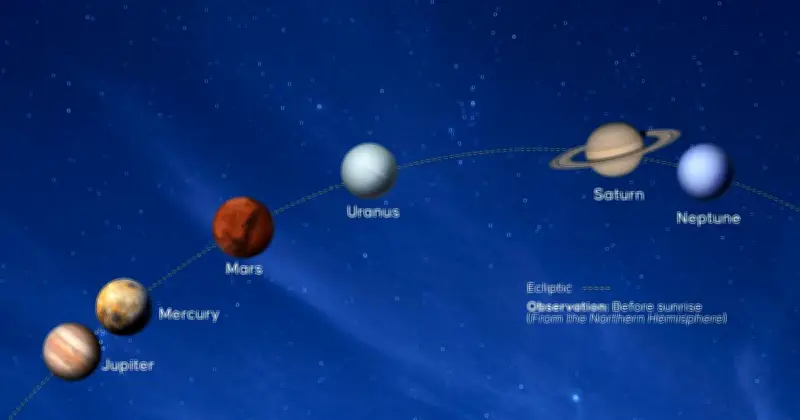
Six planets will appear across the morning sky before sunrise on August 12, 2026, in a rare planetary alignment. Jupiter, Mercury, Mars, Uranus, Saturn and Neptune will take part in the large planetary alignment, with the best opportunity coming before sunrise. Mars and Saturn will be the easiest planets to spot with the naked eye, while Mercury will be much lower and harder to pick out, and Jupiter will sit even closer to the horizon. Uranus will require binoculars and Neptune will need a telescope. Venus will not be part of the August lineup.
How to see the alignment
The event is a morning alignment, meaning observers will need to be outside before dawn. From the Northern Hemisphere, the planets will stretch across a broad arc from the eastern horizon towards the southwest. In the Southern Hemisphere, the arc will extend towards the northwest. The planets will not form a perfectly straight line. Instead, they will appear along the same broad path across the sky because their orbits around the Sun are roughly aligned with the ecliptic.
The alignment is also not a physical line-up in space. The six planets will remain at very different distances from Earth and will be positioned at different points in their individual orbits. Their apparent grouping is a line-of-sight effect from Earth. The exact viewing conditions will vary depending on location, the local horizon, sky clarity and the time of sunrise. In some locations, August 11 or August 13 may provide a better practical viewing opportunity than August 12, particularly because Mercury and Jupiter will rise close to sunrise.
Viewing times and tips
For London, the main date is August 12. The listed sunrise time is 5:41am, with the preferred viewing window calculated at around 4:54am to 5:03am, reports Star Walk. The viewing window is based on Mercury reaching five degrees above the horizon until the beginning of civil twilight, when the Sun is six degrees below the horizon. This provides enough altitude for Mercury to rise above the eastern horizon while the sky remains dark enough for the brighter planets to stand out.
Jupiter will be even lower than Mercury, so observers should regard this period as the earliest practical opportunity to try to spot both of the low eastern planets. For observers in many Northern Hemisphere locations, the most useful compromise will be roughly 30 to 60 minutes before local sunrise. Those hoping to find the fainter planets should begin much earlier. Two to three hours before sunrise, Saturn, Neptune, Uranus and Mars will already be well positioned in the sky. This will provide the best opportunity to search for Uranus and Neptune using binoculars or a telescope.
Brightness and visibility
As dawn approaches, Mercury will appear low in the eastern sky, followed by the even lower Jupiter. This creates the best opportunity for observers attempting to see the largest possible number of planets without optical equipment. In many Southern Hemisphere locations, however, Mercury and Jupiter may not become reasonably positioned until late in twilight, sometimes only minutes before sunrise. This can make the two planets particularly difficult to observe.
The planets involved in the alignment also vary considerably in brightness. Mars will have an apparent magnitude of 1.3 and Saturn 0.5, making them the easiest naked-eye targets. Mercury will be brighter at magnitude -1.0 but its low position and the increasing daylight will make it difficult to observe. Jupiter will have a magnitude of -1.8 but will sit extremely low in the brightening eastern sky. Uranus, at magnitude 5.7, will be much harder to see and will require binoculars, while Neptune, at magnitude 7.7, will require a telescope.
The alignment therefore does not necessarily mean that observers will see all six planets at once. Location, weather, the horizon and timing will all affect what can actually be seen. Finding Mars and Saturn alone would still provide a worthwhile viewing opportunity, while a clear eastern horizon could allow observers to add Mercury and potentially very low Jupiter.
The six planets will appear to rise at different times. Saturn and Neptune will be visible first, followed by Uranus and Mars, with Mercury and Jupiter completing the apparent parade closer to dawn. The event is often described as a "planet parade" because observers can follow the planets across the sky from one position to another. However, the planets are not physically grouped together in space. Their apparent alignment occurs because, from Earth's perspective, they are seen close to the ecliptic — the path in the sky along which the planets appear to travel because they orbit the Sun in roughly the same plane.