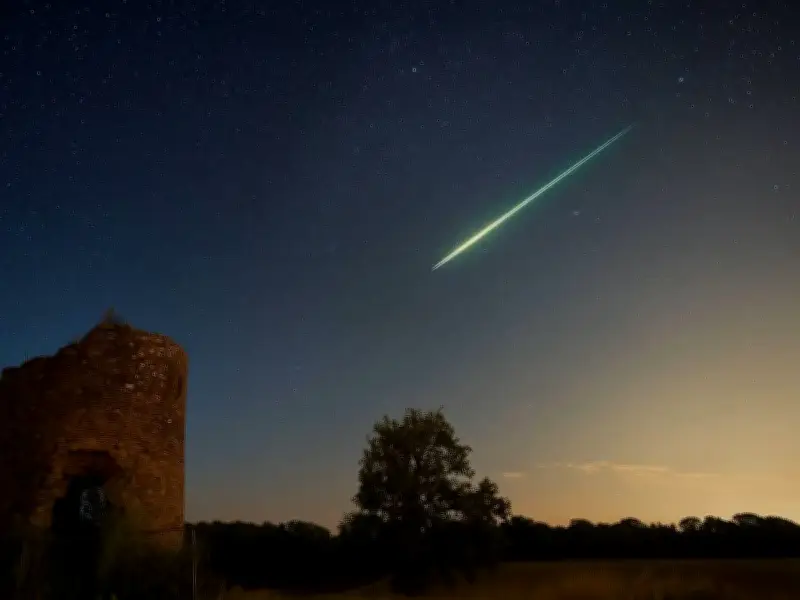
The Perseid meteor shower is set to thrill stargazers just hours after millions were left in awe by the solar eclipse. The shower reaches its peak in the early hours of Thursday (August 13) following weeks of activity, with comets visible from midnight until dawn.
First Time Eclipse Coincides with Meteor Shower Peak
It is believed to be the first time the peak of a meteor shower has coincided with a solar eclipse. Alfredo Carpineti, space and physics editor at IFL Science and author of the book Invisible Rainbows, said: "It's so exciting to have these two events happening on the same day.
"I've gone through 5,000 years' worth of eclipse data from NASA, and it looks like Wednesday will be the first time there's an eclipse happening on the same day as the peak of a major meteor shower."
What Causes the Perseid Shower
Meteor showers, or shooting stars, occur when the Earth passes through pockets of space laden with debris left behind by comets and asteroids. The Perseid shower is caused by fragments of the Swift-Tuttle comet, the largest solar system object to pass Earth on a regular basis at 16 miles in diameter, according to the Natural History Museum.
While the shower will take place above the UK, the Met Office indicates that clear skies are only anticipated over England and Wales - meaning stargazers in Northern Ireland and Scotland will have their views hampered by cloud cover.
Best Viewing Tips
The optimum way to witness the Perseid meteor shower is to seek out a countryside hill with minimal artificial light, and gaze at the sky at a 60-degree angle. "The darker the skies, the better your chances of seeing the really faint meteors as well," Dr Ashley King told the Natural History Museum. "You could go to the coast or stand on a hill in the middle of the countryside somewhere."
Patience is also key, Dr King added. "You might not be able to see anything for the first 10 minutes while your eyes adjust to the dark," Ashley said. "Once you get used to the low light levels you'll begin to notice more and more. So don't give up too quickly."
Some experts suggest it can take as long as 40 minutes for your eyes to fully adapt to low light conditions, and given that summer nights can still carry a chill, it's advisable to wrap up well and settle into a chair to prevent straining your neck from tilting your head back for extended periods. At its peak, there could be 100 shooting stars an hour, with the peak expected at around 3am.