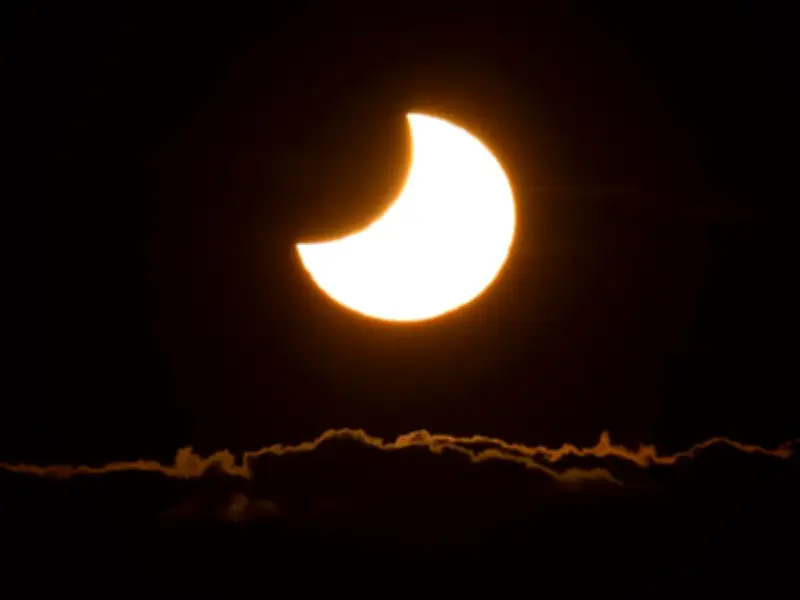
The UK is set for a double celestial spectacle this week as the Perseid meteor shower reaches its peak just hours after the most significant partial solar eclipse in nearly three decades.
The annual meteor shower, one of the most brilliant and dependable displays of shooting stars, will reach maximum activity overnight from August 12 into August 13. In perfect conditions, up to 150 meteors per hour could blaze across the night sky.
The Perseids are typically active from July 17 through August 24, but the highest number of meteors will be visible during the peak. Millions are anticipated to look upwards for the partial solar eclipse on Wednesday evening, just before the meteor shower's climax.
Best time to watch the Perseid meteor shower
The Royal Observatory Greenwich states that people in the UK could start spotting meteors as early as sunset because the Perseids' radiant stays above the horizon. However, the prime viewing period is expected to be between midnight and 5.30am on August 13, when the highest number of meteors should be observable.
The Observatory explains that moonlight frequently serves as natural light pollution, making dimmer meteors more difficult to spot, but that won't pose an issue during this year's peak. This year's peak also aligns with a new Moon, producing perfect dark-sky conditions for watching the shower.
How to boost your chances of witnessing it
Experts suggest planning in advance and checking the weather forecast before venturing outside. For the best view, stargazers should hunt for locations with minimal light pollution, such as rural areas or a nearby park.
Giving your eyes approximately 15 minutes to adapt to the darkness can also make dimmer meteors simpler to detect, while steering clear of phone screens. The Observatory recommends finding an open spot with an unobstructed view of the horizon and notes that binoculars or telescopes aren't needed because meteors can emerge anywhere across the sky.
A stargazing app can also assist in pinpointing the constellation Perseus, from which the meteors seem to emerge.
What triggers the Perseid meteor shower?
The Perseids form when Earth travels through debris abandoned by Comet 109P/Swift-Tuttle. As the minuscule fragments plunge into Earth's atmosphere at incredibly high velocities, the air ahead of them becomes severely compressed and heated, causing the particles to incinerate.
Smaller bits evaporate entirely, creating brilliant streaks of light across the night sky, while larger chunks can generate breathtaking fireballs. The Perseids are regarded as one of the year's most spectacular meteor showers due to their ability to consistently deliver brilliant meteors, lengthy luminous trails and an abundance of visible shooting stars.
The Royal Observatory Greenwich hails the annual spectacle as one of the standout moments in the astronomical calendar for meteor watchers.
The myths and legends behind the Perseids
The Perseid meteor shower has sparked myths and folklore for centuries amongst various cultures. In Greek mythology, the meteors are connected to the hero Perseus, who famously defeated the Gorgon Medusa before wedding Andromeda. The name "Perseids" derives from the Greek term "Perseides", meaning the descendants of Perseus.
Within certain Catholic traditions, the annual display is also referred to as the "Tears of St Lawrence" since the shower's peak occurs near the feast day of the Christian martyr. Ancient Romans, however, linked the phenomenon with the fertility god Priapus, believing the yearly meteor shower signalled a period when he bestowed blessings upon the fields.