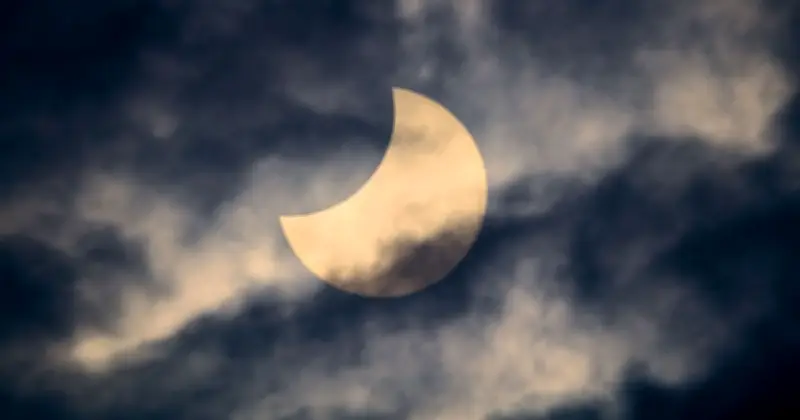
Skywatchers in the UK who miss Wednesday's partial solar eclipse will have another chance to see the celestial phenomenon on August 2, 2027, but a total solar eclipse from Britain is not expected until September 23, 2090.
Partial eclipse on August 2, 2027
The next solar eclipse visible from the UK will take place on August 2, 2027. Like Wednesday's event, the 2027 eclipse will be total in some parts of the world but will appear only as a partial solar eclipse from the UK.
The partial eclipse will begin somewhere in the UK at 8.57am BST and end at 11.01am, although the exact timings and the amount of the Sun covered will depend on where you are watching from. In London, the eclipse is expected to begin at 9.03am, reach its maximum at 10am and end at 10.59am.
Timeanddate forecasts that 41.91% of the Sun will be obscured in London, while the Royal Observatory Greenwich puts the figure at roughly 45%. The amount of coverage will vary around the country. Timeanddate predicts 44.23% obscuration in Southampton, 42.30% in Bristol, 42.23% in Cardiff, 38.65% in Birmingham, 35.55% in Liverpool and 27.64% in Glasgow.
Long wait for totality
Globally, the August 2, 2027 event will be a total solar eclipse, with the path of totality passing through parts of Spain, North Africa and the Middle East. Anyone hoping to experience a total solar eclipse from the UK faces a considerably longer wait.
The next total solar eclipse visible from Britain is not expected until September 23, 2090. A total solar eclipse occurs when the Moon passes directly between the Earth and the Sun and completely blocks the Sun for observers standing within the path of totality. People outside that relatively narrow path instead see a partial eclipse, with only a proportion of the Sun covered by the Moon.
Last total eclipse in 1999
The last time the path of a total solar eclipse crossed the UK was on August 11, 1999. Cornwall was the only part of the UK to experience totality, prompting huge numbers of people to travel to the county in the hope of witnessing the rare spectacle. However, cloud caused poor visibility across many parts of Western Europe, frustrating some of those who had gathered to watch the event. Elsewhere in Britain, observers experienced a partial eclipse rather than totality.
Wednesday's eclipse comes 27 years after that historic event and will be one of the most significant eclipses seen from Britain in decades. But despite the Moon covering the vast majority of the Sun in some areas, totality will remain out of reach for UK skywatchers. For that, Britons will have to wait until September 23, 2090, when the path of a total solar eclipse is finally expected to cross the country once again.