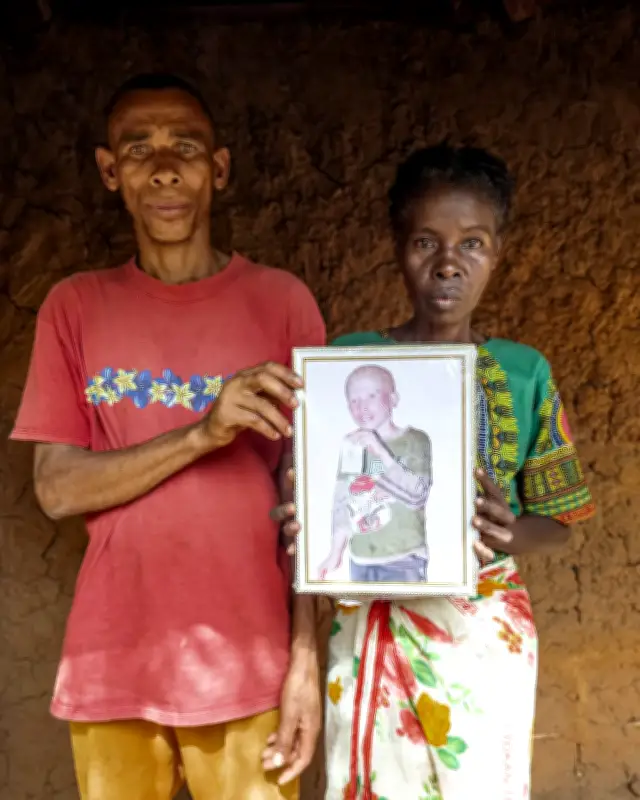
In late May, three men broke into the home of Nicole Soalala on the outskirts of Toliara, a coastal city in southern Madagascar. They attacked her husband with a piece of wood and an axe, then tried to pull away her 18-month-old daughter, Landricia, who has albinism. Soalala held the child tight, but the men wrenched the girl away and ran. Days later, Landricia's decapitated body was found at a witch-doctor's home; her head was discovered wrapped in plastic bags in a suitcase a couple of kilometres away.
Landricia is among 13 people with albinism killed in Madagascar this year, according to Albinos Madagascar, an organisation set up in 2022 to advocate for people with the condition. Every victim was beheaded, and all but three were children aged from nine months to 14 years. The association says this is already the worst year on record for killings of people with albinism in the country.
Superstitions and targeted body parts
Albinism is an inherited genetic condition that reduces melanin pigment in the skin, hair and eyes, and occurs in all ethnic groups. It often leads to poor vision and heightens the risk of skin cancer. In sub-Saharan Africa, prevalence is the highest worldwide, affecting more than one in 4,000 people in some countries, according to the World Health Organization.
People living with the condition face severe threats, including ritual killings, rape and mutilation, in several African countries. These attacks are driven by harmful superstitions that their body parts bring wealth, political success and good luck. In Madagascar, the eyes of a person with albinism are particularly sought after. Children are targeted because of beliefs suggesting their innocence will make any potion made from their body parts more powerful; they are also vulnerable and easier to kidnap.
Fulgence Soja, president of Albinos Madagascar, who lives with albinism himself, said: “The situation is very critical, very cruel. There are a lot of big problems facing us, and we feel really unsafe.”
Attacks spreading across the country
This level of brutality against people with albinism is said to be a recent phenomenon in Madagascar. Soja remembers first hearing about a beheading of someone with albinism in 2017. Muluka-Anne Mitti-Drummond, the UN independent expert on albinism, started receiving reports of killings in Madagascar in 2021. “We had recorded more than 28 cases of attacks between late 2020 and 2022; the majority were against children. I was very concerned,” she said.
Mitti-Drummond found that profiles of attackers varied, and included relatives of victims, community members, people who travelled from other regions, and dahalos (cattle raiders). “Most perpetrators are acting with the intent of selling body parts or exploiting a person with albinism for financial means,” she wrote. “In many cases, only the middleperson is caught, while the masterminds of the attacks remain unknown.”
Life-altering sums of money are paid to those willing to kill a child with albinism and procure their eyes. Often entire networks are involved, and violence is said to increase in the run-up to elections. Sources told the Guardian that, because of this and the expense, high-powered people, including senior politicians and business people, were probably ordering some of the killings.
Poverty and desperation fuel the crisis
Madagascar is one of the poorest nations on Earth, with about 80% of its population living on less than $2.15 (£1.60) a day. Since independence from France in 1958, the country has experienced bouts of political instability, disputed elections and violent coups. In October 2025, youth-led protests toppled president Andry Rajoelina, and Col Michael Randrianirina declared himself head of a transitional government for what he said would last 18 to 24 months.
The country is also among the most vulnerable to the climate crisis, with drought, floods and cyclones causing death, displacement, and damage to crops and infrastructure. Sabina Lauber, a senior human rights adviser to the UN in Madagascar, believes this is driving people to target individuals with albinism. “Madagascar is one of the very few countries in the world where every development and wellbeing indicator has decreased over the last 10 years,” she said. “At the same time, the population has dramatically increased and so there is a level of desperation for survival. People are turning to harmful practices to address the problem.”
Tohovery Razakamanana, a UN human rights officer, says a significant proportion of attacks have occurred in or near mining areas, particularly mines for precious stones and gold. He notes that while attacks used to be concentrated in certain areas of the south, they are now happening all over Madagascar. “To get back to the very beginning,” he said, “it all started in the deep south. Then we observed some cases in the south-east, south-west, midwest, and then in the north. But rarely in the capital and surrounding districts.”
Families living in terror
An atmosphere of terror now exists for people with albinism and their families. Odette, 20, lives in a city in northern Madagascar. In February, her cousin Marcellin, 14, who also had albinism, was murdered. He was beheaded and his body left under a mango tree; his head has never been found. Odette has a three-year-old son and earns about 3,000 ariary (50p) a day from working in the fields and doing odd jobs. She said her child's father told her: “I love the colour of your skin, but I'm not going to be with you, because you're varira.”
One evening about a month ago, she heard a group of men approach and bang on the door of her rented home. She ran to her mother's house and decided to move in with her wider family. “I am a varira like Marcellin, so I'm really scared,” she said. “The house is not a good one, it's not secure. I worry that there aren't enough people here and that if someone comes, they will murder me.”
About 90 miles (150km) west, nine-year-old Veroline and her younger brother, both with albinism, live under the mayor's protection in a village near a Unesco-recognised national park. Three members of the armed forces watch over them. Their older brother, Rakotombelo, 14, was killed in May; Veroline was sleeping in the same room when men crashed through the wooden door. Their aunt, Rasoa, and her husband were held hostage in the next room. “They carried knives and said 'Don't move, or we will kill you',” she said. When they left, she realised her nephew's head had been cut off.
At Rakotombelo's funeral, a secret ballot was held among villagers to determine who they suspected had committed the murder. Fourteen people were arrested and are being detained, according to Francois Xavier Zaranaina, the mayor. Rasoa's husband is one of them. “We don't have any proof, but all I can say is that some of them might have done it, some of them probably didn't do it, but because of various rumours and conflicts, those people were arrested,” said Zaranaina, who is eager for Veroline and her brother to no longer be his responsibility. “They are burdens,” he said.
National response and calls for action
The killings have become an issue of national concern. The president has deployed his personal guard to hunt down perpetrators, and the first lady has promised to open a centre in the south where people with albinism can seek refuge. On 4 August, a video was posted on the president's Facebook page showing alleged perpetrators behind the murder of a child with albinism who were caught in a sting operation; among the accomplices were the child's grandfather and police officers. Two days later, the president wrote in a post: “Because I heard that there are still people threatening to kill this albino child and her mother, I have decided that the family will be brought up to [the capital] Antananarivo immediately, and I will personally take full responsibility for their lives!” The Guardian could not independently verify the information in the posts, or the videos.
UN experts and local advocates emphasise that addressing the crisis requires collaboration. Soja, who is now advising the president on the issue, wants a national action plan that addresses security, education and health “so that we can live like everyone else”. Before that, he says: “The priority is to stop [the killings] because any solution for people of albinism to be able to educate themselves and go to work, depends on that.”
Razakamanana at the UN says a lack of accurate data remains a stumbling block. He is urging the government to conduct a census to determine how many people with albinism there are in the country. “Even educated people in the capital are not aware [that albinism is a genetic condition]. We have to start with awareness-raising campaigns and education,” he added.
Four months on from the murder of baby Landricia in Toliara, Soalala and her husband's grief is still raw. Tears form in Soalala's eyes as she talks about her daughter, who had a reddish tint to her hair with chocolate-coloured eyes. “She took after her father, and was a calm and happy child,” she says. Soalala still cries often, and her youngest remaining child, Patricia, who also has albinism, often asks where her younger sibling is. “I tell her she is dead, I don't want to lie. I also tell her I don't want to talk about it,” says Soalala. The family lives in a constant state of anxiety and terror. “I can't sleep at night because I'm so scared and anxious. The evil people might still be seeking this child,” she says.