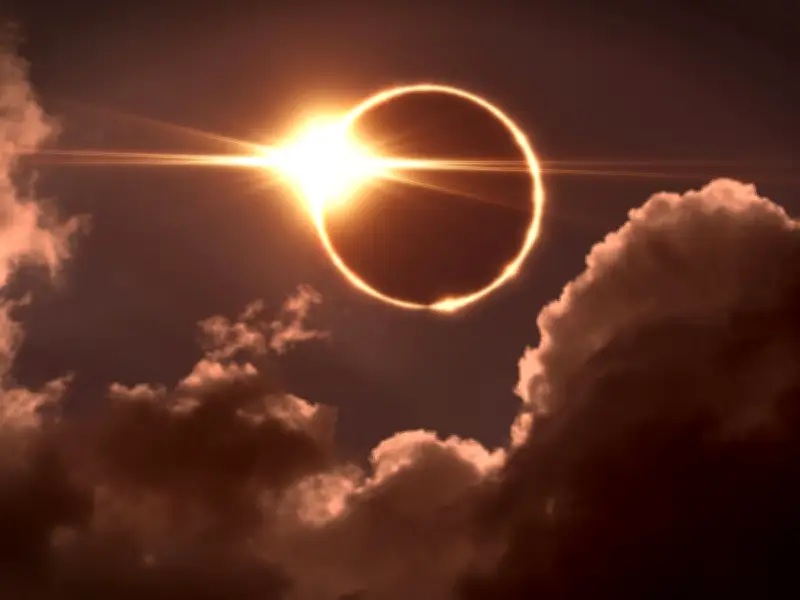
Scots across the country are being urged to safely look to the skies this week as a rare phenomenon is set to occur. On Wednesday, August 12, stargazers will be able to view a partial solar eclipse, which will allow some Scots to see over 90 per cent of the sun covered by the moon.
With the last solar eclipse over Scotland taking place over a decade ago, this is truly a sight you won't want to miss. As the total eclipse is taking place hundreds of miles away across Greenland, Iceland and northern Spain, the UK will not see a full eclipse.
However, some parts of the country are expected to see a 'bigger bite' than others. Set to begin at 6pm on Wednesday, the Isle of Barra is predicted to be the most eclipsed populated place in the country with a whopping 93 per cent coverage.
Ranking Scotland's best solar eclipses
With many people intrigued by the rare solar event, STV weatherman Sean Batty has ranked the best solar eclipses that have taken place in Scotland over the decades. Analysing coverage and which parts of the country had the best sightings, will the 2026 eclipse make the top five list?
1954 - 100 per cent coverage
Taking the top spot is the solar eclipse that took place in 1954. While this spectacular event achieved 100 per cent coverage, only those living in Unst and northern Yell in Shetland were able to have the once in a lifetime view of a total eclipse.
According to Batty, for those living in Unst the sky went completely dark for almost two minutes as the moon travelled over the sun. Meanwhile, as Yell just clipped the path of totality, the full eclipse only lasted a couple of seconds.
This event became even more special for locals as many astronomers at the time decided to travel to Sweden to observe the eclipse due to Shetland being so remote. Other areas of Scotland were also able to watch the rare sight, with Aberdeen and Inverness said to have had 88 per cent coverage.
2015 - 99 per cent coverage
The second best solar eclipse in Scotland occurred just over a decade ago, making it the one that most people watched and recall in recent memory. However, it seems that it wasn't humans who were treated to the best view of the eclipse that day.
Taking place on March 20, 2015, the island of Rockall experienced a coverage of 99 per cent. This Scottish island is extremely remote, resulting in an 11-hour boat ride from the Outer Hebrides to reach it.
While the gannets seem to get the best view of the 2015 eclipse, people living on the Isle of Lewis were able to observe 98 per cent of the sun being covered by the moon. Not far behind was Inverness and Fort William with 95 per cent coverage, while Edinburgh and Aberdeen observed 93 per cent.
1925 - 99 per cent
Going back a bit further for third place is the 1925 eclipse. While this eclipse also provided a 99 per cent coverage, this mainly took place over Rockall and St Kilda, which had approximately 40 people living there at the time.
However, those on the western side of the Isle of Lewis may have also been able to experience an almost full eclipse as some parts missed out by just one per cent.
1927 - 98 per cent
Crowned the best solar eclipse for the south of Scotland is the fourth place 1927 event. Taking place on June 29, Gretna in Dumfries and Galloway was plunged into darkness as 98 per cent of the sun was covered.
This would have been a shock for early risers as the eclipse took place at around 6:30am, switching the bright morning back to night for a few moments. Unlike the other eclipses, the Western Isles reportedly "missed out" on the event the most, with residents being pushed back to a 91 per cent eclipse.
While Glasgow and Ayr achieved 96 per cent coverage, Edinburgh was Scotland's most eclipsed city at the time with a 97 per cent blackout.
2026 - 97 per cent
Just pushing the April 1921 eclipse out of the top five is this year's partial solar eclipse which is now only a few days away. However, Batty does say that others may not agree with the ranking.
He said: "Now this is where things get a little controversial. If we’re only counting the Scottish mainland and populated islands, the eclipse of April 1921 would probably take fifth place, with around 95 per cent of the sun covered across parts of the Northern Isles."
"But I’ve included Scottish territory such as Rockall in the rankings above, so it’s only fair to do the same for 2026. That pushes this year’s eclipse up to 97 per cent over Rockall, with Barra seeing 93 per cent."
For those eager to see August's eclipse, it is important to not to look directly at the sun as the powerful rays can damage your eyes. Instead, you can make a solar eclipse projector or buy specially made glasses.