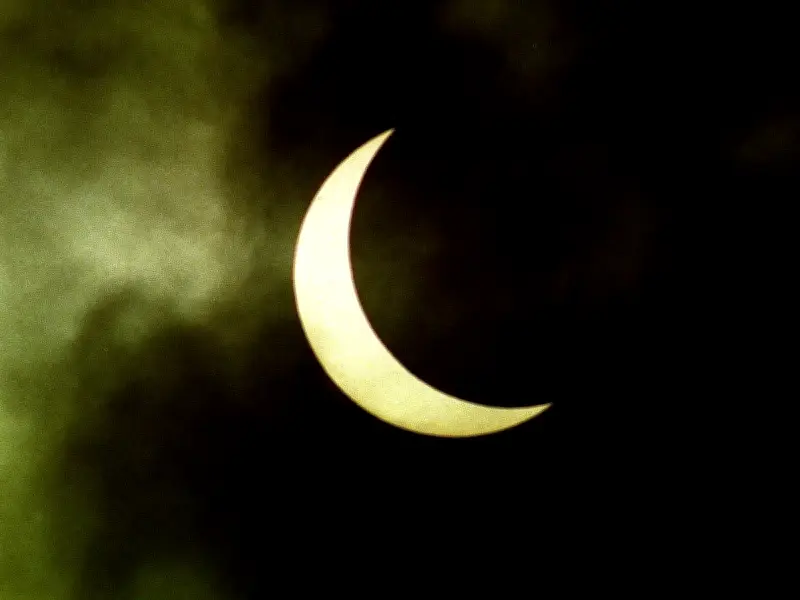
On Wednesday, August 12, the UK will experience a partial solar eclipse for the first time in almost three decades, with the Moon passing and blocking over 90% of the Sun. The sky will darken and a glowing crescent will be visible as only part of the Sun appears. Timings across the UK will vary slightly by location.
Peak times and visibility
The sky will turn slightly dimmer as the partial solar eclipse peaks after 7pm. It will be the most coverage over England since 1999, when Cornwall witnessed totality. Parts of Spain, northern Portugal and Iceland will see the first total solar eclipse visible over mainland Europe in 27 years. The next total solar eclipse visible from the UK won't occur until September 23, 2090.
Safety advice
It is never safe to look directly at the eclipse without proper eye protection. The Sun will appear dimmer than usual, but that doesn't mean it's safe to look at it directly. Government advice stated: "It's a rare and exciting event that many people will be keen to watch. But looking directly at the Sun without the right protection can cause permanent damage to your eyesight." It added: "The reduced brightness can override the body's natural reflex to look away, allowing intense sunlight to reach and damage the retina. This damage happens without causing any pain, so you may not realise harm is occurring until it's too late."
Making a pinhole projector
Special solar eclipse glasses, made from cardboard with high-strength filters, are available for purchase, but for those without them, the Royal Astronomical Society has shared advice on building a pinhole projector at home. This allows you to see the eclipse by projecting the Sun's light onto another surface. You can use two pieces of paper, a colander, or tree leaves. With two pieces of paper, make a small hole in one and hold it above the other to see the shadow cast. Hold up a colander and look at its shadow, or look at shadows cast by leaves on the ground, as gaps between leaves act as natural pinhole projectors.
The Royal Observatory will livestream the solar eclipse on August 12 for those unable to watch outside. The peak of the eclipse will occur between 7.05pm and 7.16pm, depending on location.