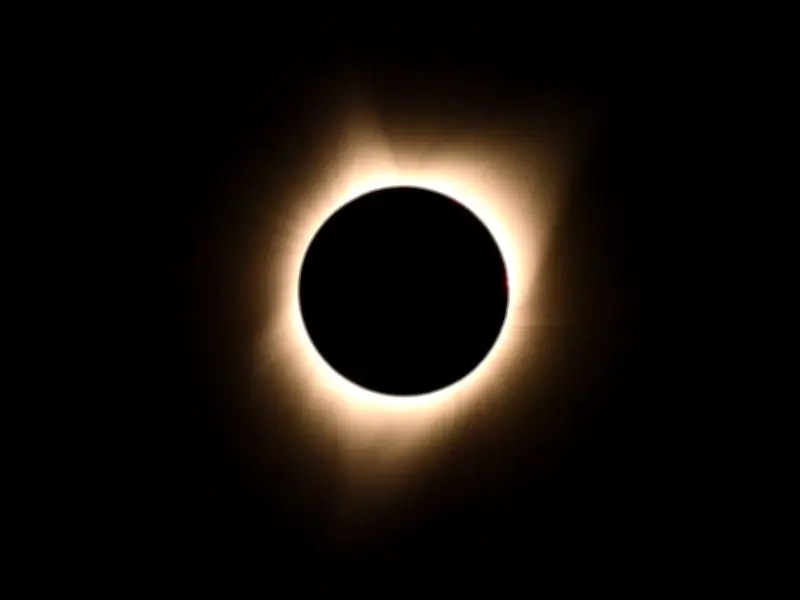
The skies over the North East will darken tonight as the Moon temporarily blocks the Sun, creating the region's most dramatic solar eclipse in almost three decades.
The partial solar eclipse is expected to begin at around 6.10pm BST and end at approximately 8pm, reaching its peak at around 7.07pm when about 90% of the Sun will be obscured by the Moon.
For those unable to step outside, a free livestream from the Royal Museums Greenwich in London will run from 6.10pm until 8pm.
Best viewing spots in the North East
According to eclipse experts, the Northumberland Coast is the best general area in the region to watch the event, with its long stretches of open coastline providing clear, unobstructed views of the low evening Sun.
Bamburgh Beach is highlighted as a standout location, while the Simonside Hills offer an elevated vantage point looking west. Higher ground near Hadrian's Wall provides panoramic views across the surrounding countryside.
For those closer to Newcastle and Tyneside, open spaces such as the Town Moor offer one of the city's best viewing spots due to the lack of tall buildings. The hill surrounding the Angel of the North is another strong option, and Penshaw Monument near Sunderland offers sweeping views across Wearside.
Further south, the Durham Heritage Coast around Seaham provides clear coastal viewpoints, while Eston Nab near Guisborough offers one of the highest natural vantage points overlooking the Tees Valley.
Eclipse details and timing
The eclipse will begin at around 6.10pm BST across the North East, reaching its maximum at approximately 7.07pm before ending shortly before 8pm. At its peak, around 89.5% to 90% of the Sun will be obscured.
Because the eclipse happens shortly before sunset, the Sun will sit only around 9° to 11° above the horizon at maximum eclipse, making an uninterrupted view towards the west or west-northwest essential.
The North East will see slightly less coverage than south-west England, where parts of Cornwall are expected to see around 95% of the Sun obscured. The deepest eclipse in the British Isles will be in County Kerry, Ireland, where almost 97% of the Sun will disappear behind the Moon.
Once the eclipse ends, skywatchers may be treated to another celestial display, as the event coincides with the peak of the Perseid meteor shower. Those who remain outdoors after darkness falls could see dozens of shooting stars crossing a moonless sky.
How to watch the eclipse safely
Despite most of the Sun being covered, it is never safe to look directly at a partial solar eclipse without proper eye protection. The UK Health Security Agency recommends using only genuine eclipse glasses or handheld solar viewers that meet the international safety standard ISO 12312-2:2015(E). Ordinary sunglasses do not provide enough protection.
Anyone using binoculars, cameras or telescopes should ensure they are fitted with specialist solar filters. Alternatively, a simple pinhole projector made from a piece of card allows the eclipse to be viewed safely without looking directly at the Sun.