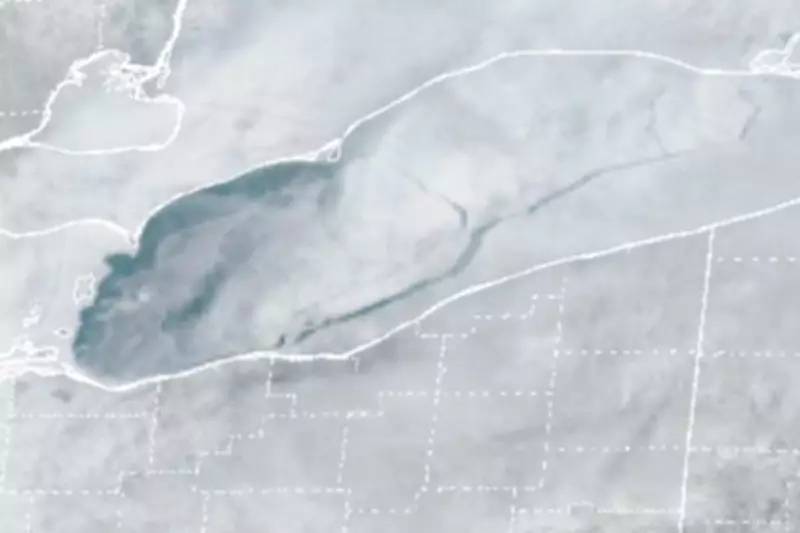
A colossal crack in the ice covering Lake Erie has grown so extensive that it is clearly visible from space, according to satellite imagery released by NOAA. The fissure, which spans over 80 miles from Port Burwell in Canada to Cleveland, Ohio, formed due to intense northerly winds over the weekend, creating pressure that weakened the ice sheet.
Satellite Imagery Reveals Vast Fracture
Satellite images from the National Oceanic and Atmospheric Administration (NOAA) depict the dramatic crack stretching across one of North America's largest lakes. Meteorologists report that strong winds on Saturday pushed the ice southward, leading to significant stress and the subsequent formation of this enormous breach. The crack continued to expand throughout the day, ultimately reaching a length comparable to the distance between major cities on the lake's opposing shores.
Historical Context of Lake Erie Freezes
Lake Erie has only completely frozen over three times in modern recorded history, with the most recent occurrence taking place in February 1996. During a typical winter, ice coverage peaks between 65 and 70 percent. However, current data from NOAA's Great Lakes Environmental Research Laboratory indicates that approximately 95 percent of the lake is now frozen, marking a notable event. In recent years, the lake has approached full ice coverage several times, including in 2025, 2018, 2015, 2014, and 2011.

Safety Warnings Issued by Meteorologists
Meteorologist Aaron White of 10 WBNS emphasized the inherent dangers of lake ice, stating, "This serves as a good reminder that ice is never 100 percent safe. Even if the ice is thick, there can still be some thin spots, or weakening of the ice, leading to cracking." Forecasters are specifically advising residents in the Cleveland area to avoid walking on the ice, engaging in ice fishing, or operating snowmobiles across the lake due to the unstable conditions.
Potential for Further Expansion
The crack may continue to grow in the coming days as temperatures are predicted to rise. White added, "With warmer temperatures in the forecast and most days featuring high temperatures near or above freezing, we're likely to see more melting and ice cracking on lakes across Ohio. Temperatures are expected to remain mild through the end of February." This warming trend reduces the likelihood of Lake Erie achieving a complete freeze-over, a phenomenon that has become increasingly rare.
Broader Weather Patterns Across the United States
Meanwhile, much of the United States has been enduring frigid conditions following several powerful snowstorms last month. Cities like New York and Philadelphia have experienced prolonged periods of sub-freezing temperatures. In late January, a severe cold snap in New York City resulted in at least ten fatalities. Over the weekend, the National Weather Service issued an extreme cold warning for the New York tri-state area, with wind chills making temperatures feel as low as -15 to -30 degrees Fahrenheit.
Ice Formation on the Hudson River
AccuWeather reports that after more than a week of freezing temperatures, ice spread across New York's Hudson River, becoming visible on NASA satellites. While it is improbable for the Hudson to freeze over completely—an event last recorded in 1888—the current conditions highlight the extensive impact of the cold weather across the region. As the cold air is expected to retreat to the Arctic Circle in the coming days, these icy phenomena may begin to diminish, but the dramatic crack on Lake Erie serves as a stark reminder of nature's power and the importance of caution during winter months.