The US launched strikes on Iran for a third consecutive day, targeting port cities including Bushehr and Bandar Abbas, while Iran retaliated with attacks on US allies Bahrain and Jordan, and struck two tankers associated with the United Arab Emirates in the Strait of Hormuz. The escalation comes hours after Donald Trump announced the US would take control of the strait and charge ships a toll for safe passage.
US Military Operations
The US military said its five-hour operation early Tuesday hit targets across Iran, including in Bushehr and Bandar Abbas. It shared videos of strikes intended to “degrade Iran’s ability to attack commercial shipping,” according to a statement. More explosions were heard around noon Tuesday west of Bandar Abbas, as well as in Bushehr and Choghadak, Iranian state TV reported, though no party claimed responsibility for those blasts.
Iranian Retaliation
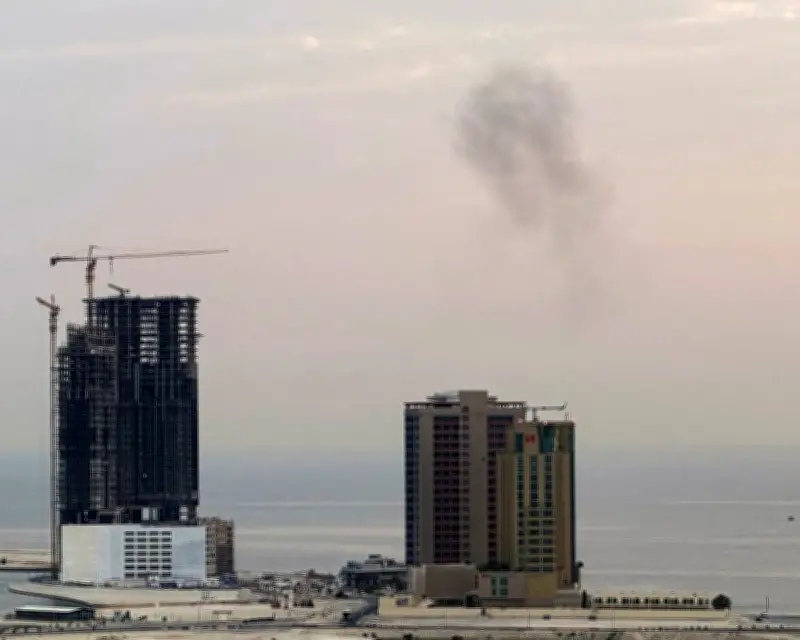
Iran targeted Bahrain, which hosts the US Navy’s Fifth Fleet; Jordan, which houses US air force assets; and two tankers in the Strait of Hormuz. Bahrain said it intercepted several attacks and accused Iran of targeting civilians after explosions were heard in Manama. Jordan intercepted four missiles from Iran, according to its government. The attacks threaten to derail efforts to reopen the Strait of Hormuz, which Iran effectively closed during a four-month war with the US. A memorandum of understanding (MoU) aimed at reopening the waterway has stalled due to violence and negotiation breakdowns.
Trump’s Toll Threat
On Monday, Trump said the US would control the strait and charge ships up to a 20% toll for safe passage, reversing the previous US stance that no country could impose fees on the international waterway under freedom of navigation rules. US Secretary of State Marco Rubio had strongly objected to Iran’s plan to impose fees. Iran’s foreign minister, Abbas Araghchi, responded on X: “20% is of course too much. We will be fair,” insisting Tehran would be the guardian of the strait “for ever.”
Casualties and Diplomatic Fallout
US attacks on Iran have killed at least 28 people since last week, according to Agence France-Presse. The Indian foreign ministry lodged a strong protest with Iran after one Indian seafarer was killed and 10 others seriously wounded in Iranian attacks on two tankers. The UAE threatened to retaliate, while Iran’s Islamic Revolutionary Guard Corps (IRGC) claimed the attack, saying the vessels “ignored repeated warnings.” Iran also called on Jordan to disband US bases, with the IRGC stating: “Not only do we not have any enmity with your country, but we also love you.”
Aviation and Oil Market Impact
The EU Aviation Safety Agency issued a warning for airlines on Tuesday, advising them to avoid flying over Bahrain, Kuwait, Qatar, the UAE, and the Gulf of Oman, citing “unpredictable military developments” that pose risks to civil flights. The price of crude oil rose to a four-week high of over $86 a barrel on Tuesday, though still below the peak of nearly $120 a barrel during the war.
Lebanon-Israel Talks
Separately, Lebanese and Israeli delegations were due to meet in Rome on Tuesday for US-mediated negotiations. Lebanon seeks an Israeli withdrawal from over 600 sq km of occupied territory. Last month, a “framework agreement” was announced for Israeli withdrawal from pilot areas in south Lebanon, with the Lebanese army entering those zones and preventing Hezbollah’s return. Israel’s foreign minister, Gideon Saar, said Israel was ready to implement two pilot zones, calling the framework “the only way forward.” Lebanese President Joseph Aoun demanded an immediate start to withdrawal before other discussions. Hezbollah, not party to the talks, has called for them to stop, raising questions about implementation.