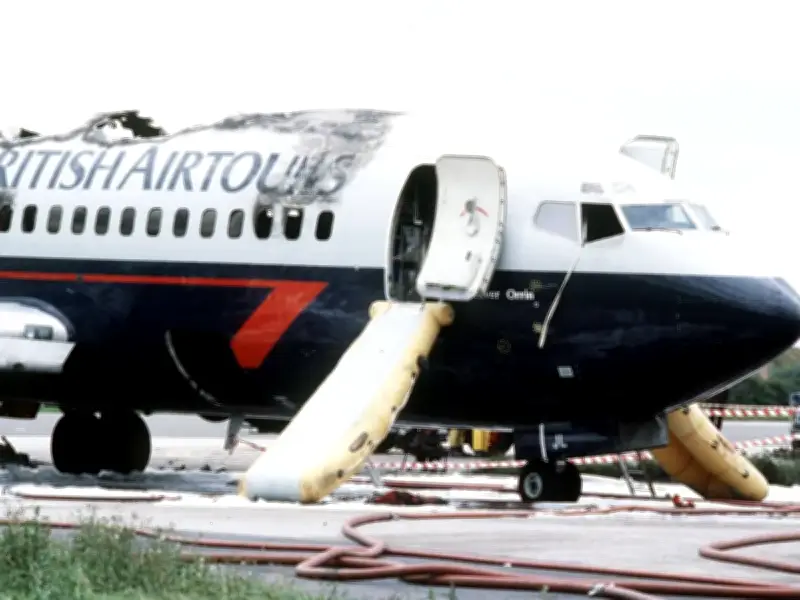
British Airtours Flight 28M departed Manchester Airport bound for Corfu International Airport in Greece 41 years ago today (Saturday, August 22). The catastrophic fire that broke out during takeoff killed 55 people and fundamentally transformed air travel safety, triggering sweeping changes across the commercial airline industry.
The carrier, a British Airways subsidiary, was carrying 131 passengers and six crew members to the Greek island when a loud thump rang out during takeoff. The captain immediately aborted the takeoff following an engine failure that triggered a fire, ordering an immediate evacuation.
Survivors describe terror as smoke engulfed the cabin
Survivors recounted their terror as the aircraft was consumed by "thick black smoke," with many convinced they were "going to die" as the catastrophe unfolded within seconds. In total, 55 lives were lost - the majority succumbing to smoke inhalation rather than burns, as passengers also inhaled toxic fumes released by burning cabin materials.
The harrowing disaster was widely regarded as "a defining moment in the history of civil aviation safety," reports the Express. It laid bare critical failings in evacuation protocols, cabin construction and crew training, prompting the Air Accidents Investigation Branch (AAIB) to issue 31 safety recommendations.
Passengers recall the ordeal of August 22, 1985
Survivors have previously spoken candidly about the ordeal they endured on that fateful day. Sylvia Chappell told an ITV News documentary: "All this black smoke was coming through from the left-hand side, and people were screaming, and the plane wing was burning. I thought: 'I'm going to die here.'"
"The smoke was terrible. There were like little flames in it, and then people panicking. I was suffocating. I was dying. I couldn't go down the aisle because there were too many people," she added.
Fellow survivor Charles Hickson told the documentary: "We were shuffling forward in the plane but we weren't getting out. It was only minutes we were on that plane but a lot happened. Two or three gulps of that and you were in trouble, unconscious."
"The main steward was trying to get us out the front of the plane, but the chute snagged. There's a bulkhead at the front and so you have a corridor to walk through and there are two exits, but only one person can get through at time," he said.
Safety changes still visible on every flight today
Several of the safety enhancements adopted by manufacturers and airlines are instantly noticeable. Every aircraft now features emergency floor-level lighting, guaranteeing passengers can follow lit pathways to exits even when smoke blocks overhead signage. Exit passages and aircraft aisles have additionally been broadened.
Combustible foams and materials, which caused passengers to inhale poisonous substances, were substituted with fire-resistant seating materials. The disaster also profoundly influenced crew preparation: for anyone who has sat beside an emergency exit and been questioned by cabin crew about their ability to operate the door during an emergency, the 1985 Manchester Airport tragedy is why that question exists.
There are also exit row briefings and safety cards ensuring how passengers act during evacuations. The whole ordeal was triggered by a part within the left engine, known as a combustor can, which detonated during takeoff.