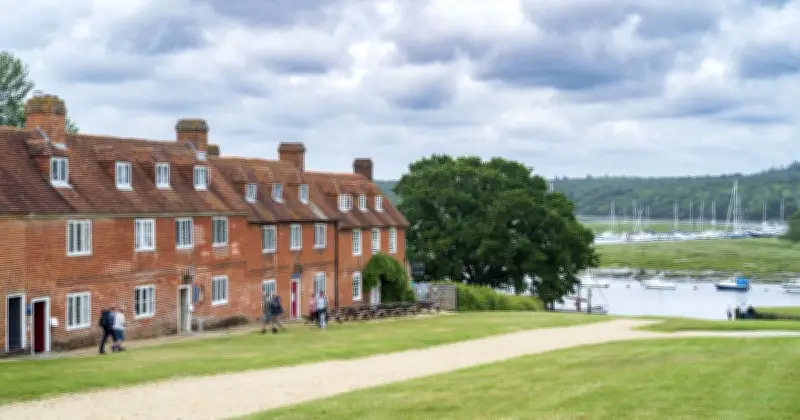
The idyllic coastal village just two hours from London that changed British naval history is the hamlet of Buckler's Hard, which has a rich maritime history. Buckler's Hard is a quaint hamlet in the New Forest district of Hampshire. Just a two hour drive from London sits the idyllic village of Buckler's Hard, an unspoilt haven which remains untouched by the passage of time. With two rows of Georgian cottages running down to the river, the region is part of the 9,000-acre Beaulieu Estate, which it sits 4km south of.
While it does indeed have residents, it is also a living museum that played a pivotal role in UK naval history as a premier 18th-century private shipyard that supplied over 50 Royal Navy vessels and was also a key player for the Royal Navy during World War II. Its maritime history even gave the area its name. Buckler likely comes from the Buckle family, who lived in the local area as early as 1668, or possibly references an early local boatyard owner. Meanwhile, Hard is a traditional nautical term used in Southern England to describe a firm, gravelly stretch of shoreline where boats can naturally land, load, or unload.
The area proved ideal for the development of shipbuilding, as it possessed access to a sheltered but navigable waterway with gravel banks capable of supporting slipways for vessel construction and launch. Timber for hulls was also readily available from the surrounding New Forest. As such, it provided the timber to build warships that defeated the Spanish and French fleets in the 1800s.
Three of the warships that served in Admiral Horatio Nelson's Navy and took part in the famous Battle of Trafalgar were built there. HMS Agamemnon, a 64-gun warship, was built at the shipyard and launched in 1781; HMS Swiftsure, a 74-gun third-rate ship of the line launched in 1787; and HMS Euryalus, a 36-gun frigate launched in 1803, were all constructed in Buckler's Hard.
The area also played a pivotal role during World War II, acting as a base for motor torpedo boats. Most importantly, a portable concrete slipway was constructed in the area to repair and service these vessels. The UK needed to reclaim France from Germany, which meant capturing a harbour. However, all the harbours were stacked full of defensive structures and artillery, making them impossible to approach without a great loss of life. As a solution, someone came up with the idea of making a prefabricated harbour and towing the sections across the channel. They used floating pontoons to support the floating roadways that were used to facilitate the unloading of vital supply ships. Fifty of these concrete, floating pontoons were built at Buckler's Hard.
In another nautical connection, Buckler's Hard was where Sir Francis Chichester began and finished his 1966-67 solo voyage around the world in the Gipsy Moth IV, the first ever purpose-built ocean racer. In order to highlight their impressive nautical history, the Buckler's Hard Maritime Museum opened in 1963 in the former New Inn building. It serves as a memorial to the men of the village who built warships for the Royal Navy while also showcasing the Hampshire hamlet's rich shipbuilding heritage, maritime history, and other wartime stories. It is also set to feature in BBC series Villages by the Sea.