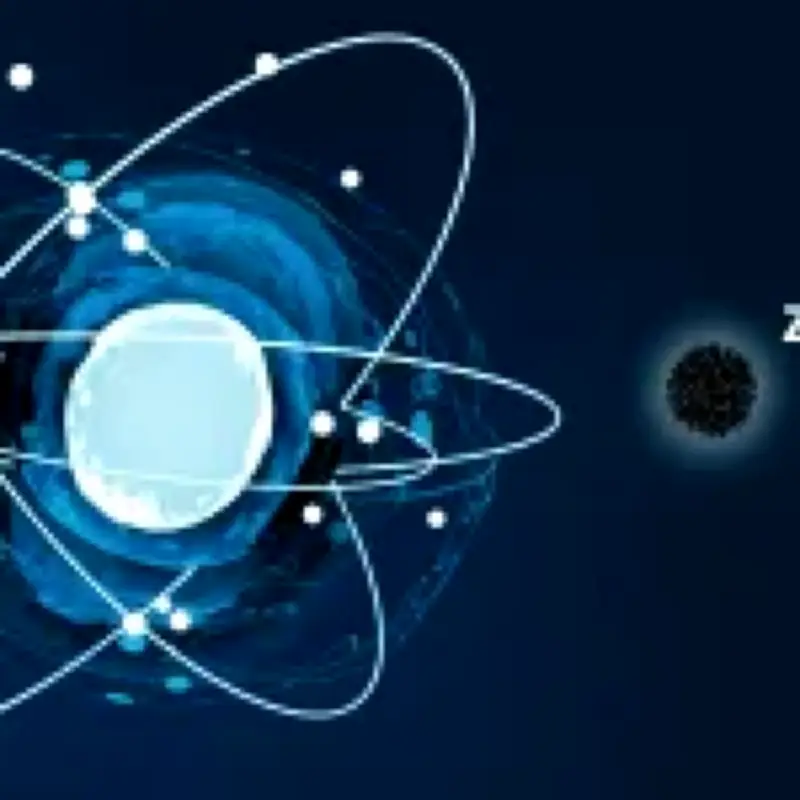
A UK-led team of scientists has announced the discovery of a world so tiny it is about 100 billion times smaller than an atom, dubbed the 'Zeptoverse'. The finding, revealed today, comes after more than 42 years of searching and could help explain why the universe exists.
'Zepto' means one sextillionth, or a 10 followed by 21 zeroes. The team, led by Dr Harry Cliff of the University of Cambridge, used the LHCb detector, part of the Large Hadron Collider in Geneva, to explore this minuscule scale.
How the Zeptoverse Was Found
For decades, atoms were thought to be the smallest things in the universe, until scientists discovered subatomic particles and then even smaller components like quarks. One type, the 'beauty quark' (also called the 'bottom quark'), is central to this research. Beauty quarks exist for only one and a half trillionths of a second before decaying, and the team hunted for their interactions at a scale of a billion-trillionth of a metre. These interactions occur in a rare decay that happens in every 10 billion beauty quarks.
Chris Parkes, a University of Manchester physicist involved in the project, explained the scale: 'You'd need to do some serious shrinking: as a person is to an atom, an atom is to the Zeptoverse.' The LHCb experiment, which slams particles together in head-on collisions, is powerful enough to detect these tiny signals, allowing the team to comb through years of data.
Why the Zeptoverse Matters
The discovery could shed light on mysteries like dark matter, an invisible substance that makes up 26% of the universe and acts as cosmic glue holding galaxies together. Dr Michael Wood, a physicist at New York's Canisius University not involved in the discovery, noted that dark matter does not reflect light, so it cannot be seen with our eyes. He added that dark matter has mass because it surrounds galaxies and affects gravitational effects; galaxies would rotate slower if only shining matter were present.
The Zeptoverse could also help explain antimatter. When matter and antimatter collide, they annihilate each other. The universe began with equal parts of both, but for unknown reasons, matter prevailed. Dr Cliff said there are 'very good reasons to think new particles are hiding in the Zeptoverse that would explain some of the biggest mysteries in science.'
Future of UK Research in Doubt
The LHCb is being upgraded with a £150 million investment from 28 countries to produce 10 times more quarks, but the UK's share was withdrawn by UK Research and Innovation in January. The funding agency said it sought independent advice and took forward a portfolio of new infrastructure investments, including clean energy, medical imaging, and cultural heritage, but there were more exciting applications than it could support. Dr Cliff expressed uncertainty about the UK's future role, saying, 'The future of this science in the UK is now in doubt.'