Stellar Distortion Could Be Masking Alien Contact Attempts, Scientists Warn
For decades, humanity has scanned the cosmos for signs of extraterrestrial intelligence, but a groundbreaking study now suggests our methods may be fundamentally flawed. Researchers argue that 'space weather' from distant stars could distort incoming radio transmissions, causing them to slip past our detectors unnoticed.
The Problem with Narrowband Signal Searches
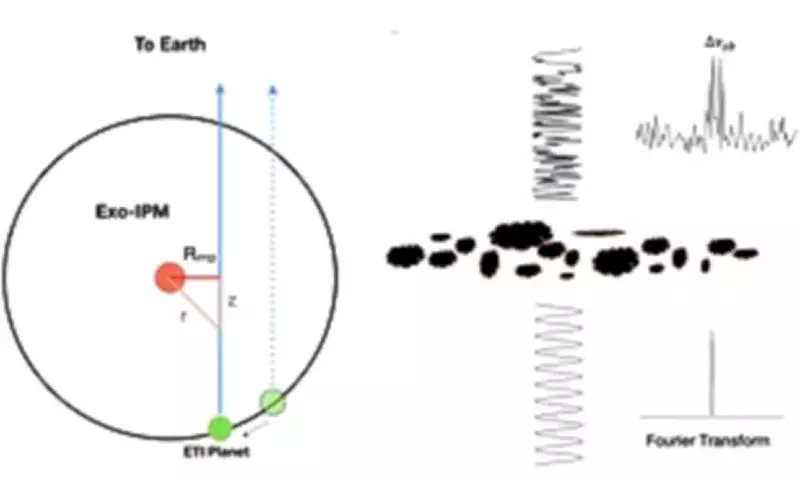
Traditionally, searches for alien life have focused on identifying sharp spikes in radio frequency—signals unlikely to arise from natural cosmic processes. However, experts highlight a critical oversight: even if an extraterrestrial transmitter emits a perfectly narrow signal, it may not remain so as it traverses its home star's atmosphere.
This distortion, occurring near the signal's origin, can 'smear' the frequency, rendering it invisible to Earth-based telescopes optimized for focused radio waves. Dr Vishal Gajjar, an astronomer at the SETI Institute and lead author of the paper, explained, 'Searches are often optimized for extremely narrow signals. If a signal gets broadened by its own star's environment, it can slip below our detection thresholds, even if it's there, potentially helping explain some of the radio silence we've seen in technosignature searches.'

How Stellar Plasma Affects Radio Transmissions
To investigate this phenomenon, the team analysed radio transmissions from spacecraft within our solar system. By measuring how turbulent plasma from stars like the Sun impacts these signals, they extrapolated the effects across various space environments. Their findings indicate that M-dwarf stars, which make up approximately 75 percent of stars in the Milky Way, are particularly prone to causing such distortions.
Grayce C. Brown, co-author of the study, emphasised, 'By quantifying how stellar activity can reshape narrowband signals, we can design searches that are better matched to what actually arrives at Earth, not just what might be transmitted.' This insight could revolutionise detection strategies, allowing astronomers to identify signals that are not 'perfectly razor-thin' upon arrival but may still originate from alien life.
Implications for the Fermi Paradox and Future Searches
Published in The Astrophysical Journal, the research challenges the interpretation of the 'Great Silence'—the apparent lack of contact with extraterrestrials. The authors concluded, 'The so-called Great Silence, when extended to the radio technosignature searchers, is not solely evidence for the absence of transmitters, but also a reflection of our detection limitations arising from a mismatch between the assumed signal morphology and the broadened line shapes.'
Looking ahead, scientists urge astronomers to incorporate these findings to avoid systematically missing technosignatures. Promising candidates for alien life, such as the Earth-sized planet TRAPPIST-1e and the water world K2-18b, could be better scrutinised with updated methods.
Expert Opinions and Historical Context
Dr Gentry Lee, a NASA veteran with over half a century of experience, recently asserted that while aliens likely exist, they have not visited Earth. He stated, 'There exists nothing today that says any alien or any alien machine has ever landed on the planet Earth. If you believe otherwise, you are being misled.' However, he remains optimistic about discovering life elsewhere, noting, 'We are going to find life of some kind somewhere else. The odds are overwhelming.'
Historical events like the 1977 'Wow!' signal—a 72-second radio blast from Sagittarius that was 30 times stronger than background radiation—continue to fuel speculation about extraterrestrial contact. While conspiracy theories abound, scientists emphasise the need for refined detection to separate natural phenomena from potential alien messages.

Key Discoveries in the Search for Alien Life
- Discovery of pulsars: First identified by British astronomer Dame Jocelyn Bell Burnell in 1967, these rotating neutron stars were initially mistaken for alien signals.
- 'Wow!' radio signal: Detected in 1977, this powerful burst remains unexplained, with some attributing it to intelligent extraterrestrials.
- Fossilised Martian microbes: In 1996, a meteorite sparked debate over possible life on Mars, though contamination concerns later arose.
- Behaviour of Tabby's Star: Observed in 2005, its unusual dimming led to theories of alien megastructures, now largely discounted in favour of dust rings.
- Exoplanets in the Goldilocks zone: In 2017, seven Earth-like planets were found orbiting TRAPPIST-1, offering promising conditions for life.
This study underscores that our quest for alien contact may require a paradigm shift, as stellar distortions could be hiding signals right under our noses.