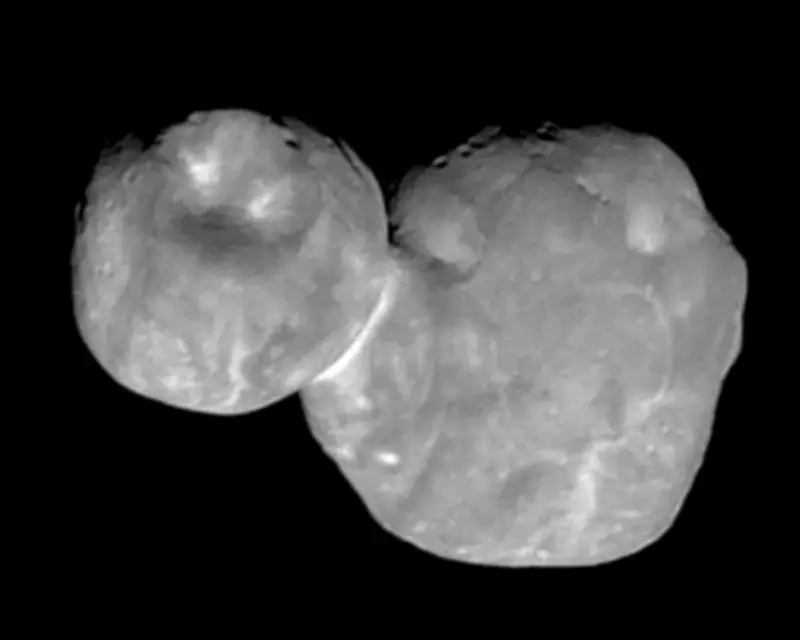
Fresh Insights into Arrokoth's Snowman-Like Formation
Scientists have unveiled new computer simulations that shed light on how the ultra-red, 4-billion-year-old body known as Arrokoth, located in the distant Kuiper belt, acquired its distinctive snowman-like shape. This research adds significant weight to the theory that Arrokoth's two lobes were produced through a process of gravitational collapse, offering a detailed mechanism for this non-violent formation.
The Kuiper Belt and Its Primitive Objects
Arrokoth resides in the Kuiper belt, a vast, thick ring of icy objects beyond Neptune's orbit. This region is home to most known dwarf planets, comets, and small, solid rubble heaps called planetesimals, which serve as the building blocks of planets. Notably, not all planetesimals are rounded; astronomers estimate that 10-25% of those in the Kuiper belt, including Arrokoth, feature two lobes, giving them a peanut or snowman appearance.
Previous studies suggested that Arrokoth's shape, composition, and minimal cratering indicate both lobes formed simultaneously in a gentle manner, likely via gravitational collapse. However, the specifics of this process remained debated until now.

Simulations Confirm Gravitational Collapse Mechanism
In a groundbreaking study published in the Monthly Notices of the Royal Astronomical Society, researchers led by Jackson Barnes of Michigan State University conducted 54 computer simulations. These models involved an initial pebble cloud with 105 particles, each about 2 kilometers in radius, representing a low-resolution version of the true scenario, which likely involves around 10^24 millimeter-sized particles.
"It's so exciting because we can actually see this for the first time," said Barnes. "This is something that we've never been able to see from beginning to end, confirming this entire process." The simulations demonstrated that gravitational forces within rotating pebble clouds can cause particles to clump into planetesimals of varying sizes.
Formation of Contact Binaries
The team found that in some cases, two small planetesimals ended up orbiting each other, gradually spiraling inward until they touched at velocities of 5 meters per second or less. This gentle collision resulted in the formation of a double-lobed planetesimal, known as a "contact binary." "Some of the contact binaries in our model look strikingly like Arrokoth," Barnes noted.
Unlike prior simulations that ignored particle contact physics, this new approach accounted for how particles rest upon each other upon collision. Earlier models suggested such impacts would merely create larger, spherical objects, but the updated simulations reveal the potential for snowman-like shapes.
Support for Planetary Formation Theories
Barnes emphasized that these findings bolster the long-held view that planetesimals generally form through gravitational collapse. Alan Stern, principal investigator of NASA's New Horizons mission, welcomed the study, stating it aligns with previous work and supports the hypothesis of gentle formation processes for Arrokoth.
However, Alan Fitzsimmons, an emeritus professor at Queen's University Belfast, pointed out a discrepancy: the simulations indicate only 4% of objects form as contact binaries, whereas telescopic surveys suggest higher fractions. "It may be that Mother Nature prefers other ways of making them, or that future even more complex simulations can close the gap between what is calculated and what we see," he remarked.
This research not only enhances our understanding of Arrokoth but also provides crucial insights into the early solar system's dynamics, highlighting the role of gravitational collapse in shaping primitive bodies.