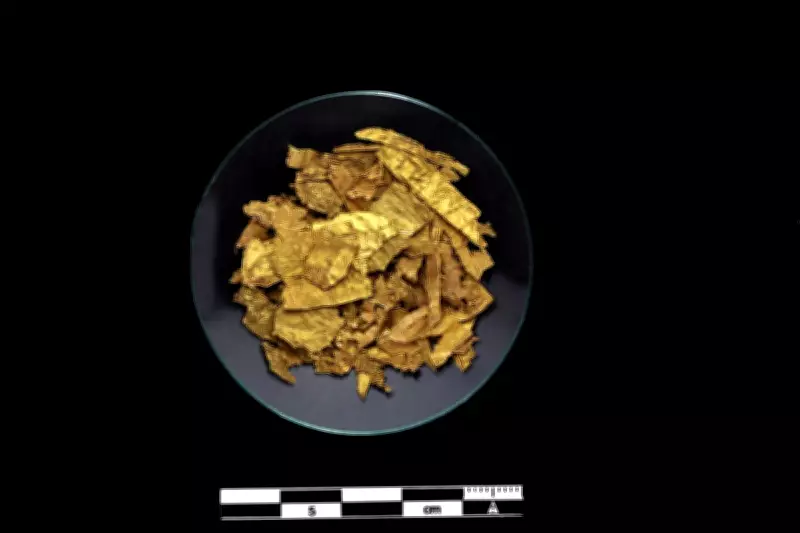
Modern Alchemy: How Big Bang Simulation Accidentally Created Gold
Medieval alchemists spent centuries pursuing the elusive dream of transmuting base lead into precious gold. While chemistry has long established this as impossible, modern physics has now achieved what ancient practitioners could not—though entirely by accident and on an infinitesimally small scale.
The Three-Proton Difference
The fundamental distinction between lead and gold atoms lies in their proton count. A lead atom contains exactly three more protons than a gold atom. This simple numerical difference raises a fascinating question: could removing three protons from lead theoretically create gold?
As physicists working on the ALICE experiment at Switzerland's Large Hadron Collider have discovered, the answer is yes—but the process requires conditions more extreme than anything alchemists ever imagined.

Recreating Cosmic Beginnings
While attempting to simulate the universe's state immediately following the Big Bang, researchers fired beams of lead nuclei at each other at velocities approaching the speed of light. Their primary goal was to study quark-gluon plasma, the primordial matter that existed microseconds after the universe's birth.
During these high-energy collisions, something unexpected occurred. When lead nuclei experienced near-misses rather than direct impacts, the intense electromagnetic forces between them occasionally stripped away protons. In rare instances where exactly three protons were removed, lead nuclei transformed into gold.
Detecting the Impossible
The ALICE team used specialized zero-degree calorimeters to count protons ejected during collisions. Since they cannot directly observe the resulting gold nuclei, detection occurs indirectly through proton counting and careful calculations.
Their measurements reveal astonishing numbers: approximately 89,000 gold nuclei are produced every second during lead beam collisions. The experiment also generated other elements through proton loss, including thallium (one proton removed) and mercury (two protons removed).
The Microscopic Scale of Success
Despite producing thousands of gold nuclei per second, the total quantity remains vanishingly small—about 29 trillionths of a gram. To put this in perspective, producing a single gram of gold through this method would require continuous operation for millions of years.
The electric fields required for this proton-stripping process are approximately one million times stronger than those generating atmospheric lightning. Only particle accelerators like the Large Hadron Collider can create such extreme conditions.
An Unwelcome Byproduct
Ironically, this accidental alchemy creates practical problems for researchers. Once lead nuclei transform into gold, they deviate from their precise orbits within the collider's vacuum beam pipe, colliding with walls within microseconds.
This gradual beam degradation means gold production actually represents a nuisance for physicists, reducing experimental efficiency over time. Nevertheless, understanding this phenomenon proves crucial for interpreting results and designing future particle physics experiments.
Beyond Medieval Dreams
While this breakthrough won't revolutionize gold production or create economic value, it demonstrates fundamental principles of nuclear physics in action. The research provides valuable insights into how elements transform under extreme conditions—knowledge that could inform everything from astrophysics to materials science.
Professor Ulrik Egede of Monash University, who authored the original research, emphasizes that this accidental discovery highlights how cutting-edge physics can still produce surprises that connect with humanity's oldest scientific ambitions.