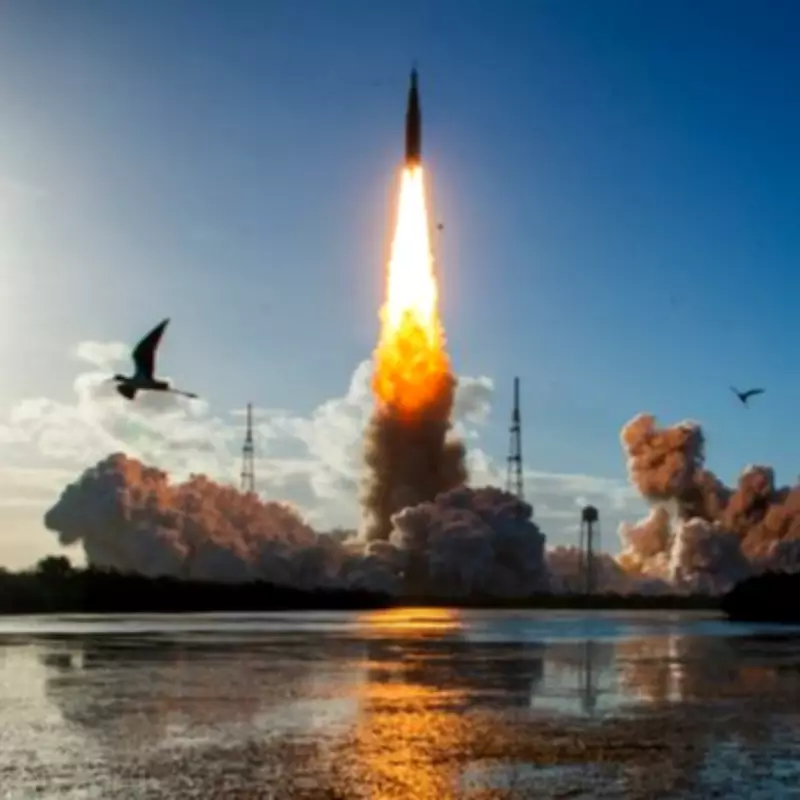
Passenger Films Historic Artemis II Launch from Commercial Flight
A fortunate airline passenger has captured breathtaking mid-air footage of NASA's Artemis II rocket launch, providing a unique aerial perspective on humanity's return to lunar exploration. The video, recorded from a Delta Air Lines flight over Florida, shows the 322-foot Space Launch System rocket ascending toward orbit with its distinctive fiery plume and vapor trail visible against the evening sky.
Unprecedented Aerial View of Lunar Mission
The remarkable clip was posted on TikTok by passenger Kate McCuistion and quickly circulated across social media platforms. Filmed at approximately 6:35 PM local time (10:35 PM UK time) on Wednesday, the video captures the exact moment when NASA's first crewed Moon mission in 44 years departed from Kennedy Space Center in Cape Canaveral, Florida.
The footage clearly shows the rocket's curved trajectory as it accelerates to speeds approaching 17,000 miles per hour. This flight path allows spacecraft to utilize Earth's gravity for acceleration rather than relying solely on fuel, according to spaceflight experts at BBC Sky at Night magazine.

Historic Journey Beyond Earth Orbit
The Artemis II mission marks a significant milestone in space exploration, carrying four astronauts - Commander Reid Wiseman, pilot Victor Glover, mission specialist Christina Koch, and Canadian astronaut Jeremy Hansen - on a journey around the Moon. Following 25 hours of Earth orbit, the Orion spacecraft's engines performed a flawless translunar injection burn, propelling the crew toward lunar space.
NASA deputy associate administrator Lori Glaze expressed profound excitement during a news conference, stating: "For the first time since 1972 during Apollo 17, human beings have left Earth orbit." The successful engine burn places the spacecraft on a free-return trajectory that will utilize the Moon's gravity for the homeward journey.
Technical Achievements and Mission Details
The Orion spacecraft's main engine generated approximately 6,000 pounds of thrust during its nearly six-minute burn - sufficient power to accelerate a standard automobile from zero to 60 miles per hour in under three seconds. Mission controllers successfully addressed minor technical issues during the initial flight phase, including cabin temperature regulation and toilet system adjustments.
This mission will establish a new distance record for human spaceflight, with Orion traveling approximately 4,000 miles beyond the Moon before beginning its lunar flyby on Monday. The spacecraft will ultimately reach about 252,000 miles from Earth - surpassing the previous record of 248,000 miles set by Apollo 13 in 1970.
Global Collaboration and Future Implications
International tracking stations, including the Goonhilly Earth Station in Cornwall, England, are monitoring the spacecraft's progress. While Artemis II represents a crewed lunar flyby rather than a landing mission, it establishes critical groundwork for future surface expeditions and potential Mars missions.
The mission experienced a two-month delay earlier this year due to technical challenges involving hydrogen fuel systems and helium lines. NASA aims to return astronauts to the lunar surface by 2028, preceding China's planned crewed Moon landing around 2030.
Astronaut Jeremy Hansen reflected on the mission's significance, noting that the crew remained "glued to the windows" to observe the phenomenal views. He emphasized that "humanity has once again shown what we are capable of" through this groundbreaking return to deep space exploration.