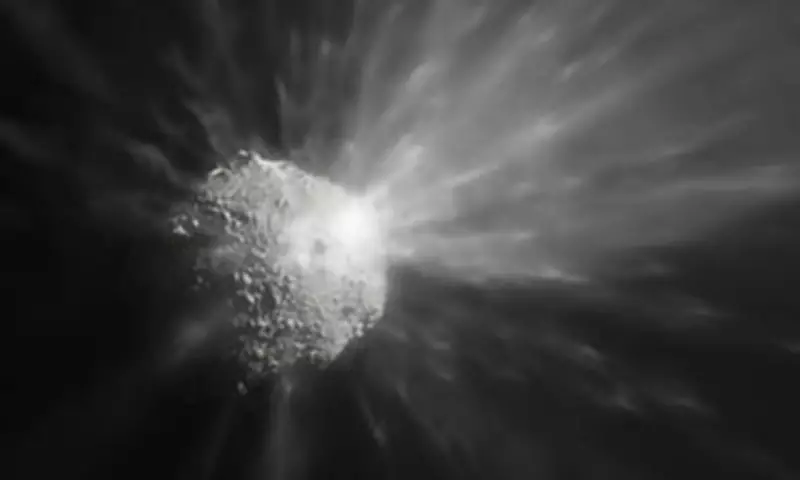
Humanity has achieved a "notable step forward" in its capacity to deflect asteroids that might threaten Earth, according to groundbreaking new research. The study focuses on NASA's 2022 Double Asteroid Redirection Test (Dart) mission, which successfully demonstrated that spacecraft impacts can alter celestial trajectories.
The Historic Dart Mission
In September 2022, NASA deliberately crashed the Dart spacecraft into Dimorphos, a small asteroid moonlet orbiting the larger space rock Didymos. Traveling 6.8 million miles through space at 14,000 miles per hour, the probe's kinetic impact shortened Dimorphos's orbit around Didymos by 33 minutes. This marked the first-ever successful demonstration of planetary defence technology, proving humanity could actively change an asteroid's path.
Unexpected Solar Orbit Changes
Now, scientists from the University of Illinois Urbana-Champaign have revealed an even more significant outcome. Their analysis shows the collision knocked both asteroids slightly off their regular orbit around the Sun. By examining nearly 6,000 instances where Didymos passed in front of stars, blocking their light, researchers calculated that Didymos's orbital speed decreased by 11.7 micrometres per second.

"This is the first time a human-made object has measurably altered the path of a celestial body around the Sun," the researchers emphasized. Although Didymos wasn't directly struck during the mission, gravitational linkage with its moonlet meant changes to Dimorphos affected both bodies.
Implications for Planetary Defence
The findings suggest future missions could target small moonlets orbiting larger asteroids to indirectly change the trajectory of the bigger, potentially hazardous space rocks. "This marks a notable step forward in our ability to prevent future asteroid impacts on Earth," the research team stated.
Thomas Statler, lead scientist for solar system small bodies at NASA Headquarters, explained: "This is a tiny change to the orbit, but given enough time, even a tiny change can grow to a significant deflection. The team's amazingly precise measurement again validates kinetic impact as a technique for defending Earth against asteroid hazards."
How the Impact Created Change
When Dart struck Dimorphos, the collision blasted enormous amounts of rocky debris into space, altering the 560-foot-wide asteroid's shape. As this debris carried momentum away from the impact site, it created an explosive "thrust" that changed Dimorphos's trajectory. This momentum transfer ultimately shifted the entire binary system's solar orbit by 0.15 seconds.
Rahil Makadia, lead author of the study published in Science Advances, noted: "The change in the binary system's orbital speed was about 11.7 microns per second, or 1.7 inches per hour. Over time, such a small change in an asteroid's motion can make the difference between a hazardous object hitting or missing our planet."
Current Planetary Defence Capabilities
Despite this success, planetary defence experts warn that humanity remains vulnerable. Dr. Nancy Chabot, a planetary scientist at Johns Hopkins University who led the Dart mission, revealed there are no other Dart-like spacecraft ready to launch if an asteroid suddenly appeared on a collision course with Earth.
"Dart was a great demonstration," she said recently. "But we don't have another sitting around ready to go if there was a threat that we needed to use it for."
She referenced asteroid YR4, which last year was initially calculated to have a 3.2% chance of hitting Earth in 2032 before further analysis downgraded the risk to zero. "If something like YR4 had been headed towards the Earth, we would not have any way to go and deflect it actively right now," Chabot added.
Future Detection and Deflection
NASA emphasized that early detection remains crucial for effective planetary defence. In a blog post, the space agency wrote: "The key is detecting near-Earth objects far enough in advance to send a kinetic impactor."
NASA is currently developing the Near-Earth Object (NEO) Surveyor mission, a telescope specifically designed for planetary defence that will seek out hard-to-find asteroids and comets that don't reflect much visible light.

Alternative Asteroid Deflection Methods
While kinetic impactors like Dart have proven effective, scientists have proposed several other approaches to planetary defence:
- Multiple Bumps: Successive smaller impacts might be needed for certain asteroid types, particularly carbon-rich asteroids like Bennu.
- Nuclear Option: Detonating a nuclear explosive near an asteroid, though this risks creating dangerous fragments.
- Ion Beam Deflection: Using spacecraft thrusters to gently push asteroids over wide areas.
- Gravity Tractor: Using a spacecraft's gravitational field to slowly tow an asteroid away without physical contact.
Professor Colin Snodgrass, an astronomer at the University of Edinburgh, noted: "The kinetic impactor is definitely the simplest technology to use on the sort of timescale that is most likely to be of concern for this size of asteroid, i.e. years to decades warning time."
The Dart mission's unexpected success in altering solar orbits represents a significant advancement in humanity's planetary defence toolkit, though experts stress that continued investment and preparation remain essential for protecting Earth from potential asteroid threats.