
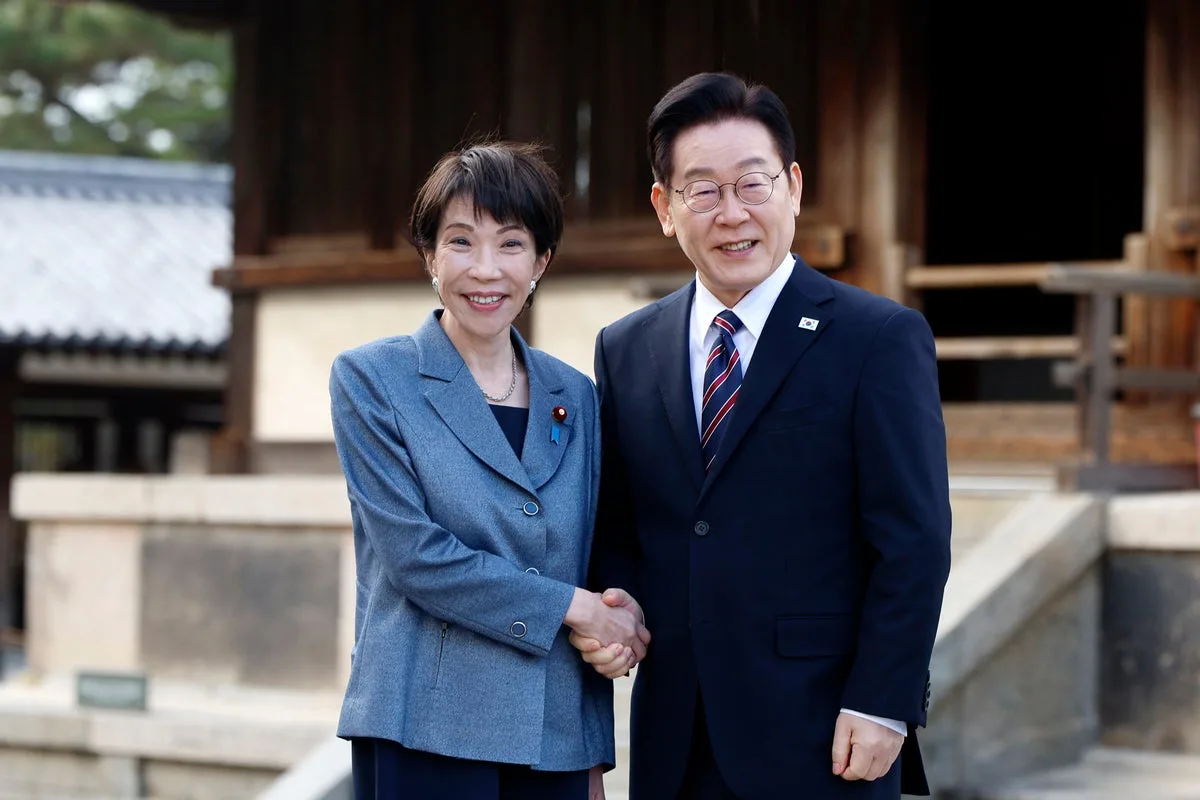
South Korean President Lee Jae Myung and Japanese Prime Minister Sanae Takaichi are set to hold their fourth meeting in about six months on Tuesday, underscoring their push to deepen ties between the historical Asian rivals in the face of geopolitical challenges. Lee will host Takaichi in his hometown of Andong, a southeastern South Korean city famous for a centuries-old traditional folk village that is a UNESCO World Heritage site. In January, the two met in Takaichi’s hometown of Nara, an ancient Japanese capital.
The meetings mark the first time sitting leaders of the two countries have visited each other’s hometowns. South Korea’s presidential office expressed hope that Tuesday’s summit would strengthen mutual trust between Lee and Takaichi. Takaichi told reporters Tuesday morning she hopes the talks will deepen cooperation “under the severe geopolitical conditions such as situations in the Middle East and the Indo-Pacific.”
The summit's official agenda includes economic and energy cooperation, the Iran war and development of their bilateral ties, which have no current sticking points. Experts say the meeting likely will proceed smoothly and the relationship will remain on a positive trajectory for now. “The two countries put more emphasis on agenda for cooperation than contentious issues,” said Choi Eunmi, a Japan expert at the Seoul-based Asan Institute for Policy Studies. “They would now think scenes of constantly fluctuating relationship or eventually negative bilateral ties won’t be helpful to anyone now.”
South Korea and Japan are both key U.S. allies with vibrant democracies. But their relationship has long experienced severe ups and downs over grievances stemming from Japan’s 35-year colonisation of the Korean Peninsula before the end of World War II. Relations began improving in 2023 when Lee and Takaichi’s predecessors took steps to move beyond history disputes and strengthen cooperation, saying they faced common challenges like the U.S.-China strategic competition, supply chain vulnerabilities and North Korea’s advancing nuclear arsenal.
When Lee and Takaichi each took office as new leaders last year, observers worried about Takaichi’s reputation as a right-wing security hawk and anticipation that Lee, a political liberal, would tilt toward North Korea and China and away from the U.S. and Japan. But they have maintained cooperation, even in some unprecedented ways. In August, two months before Takaichi’s inauguration, Lee became the first South Korean leader to choose Japan as his first destination for a bilateral summit. At the end of their meeting in January, Lee and Takaichi drummed to K-pop hits such as BTS’ “Dynamite” in a jam session arranged by the Japanese leader, a heavy metal fan who was a drummer in her college days.
Lee has said he and Takaichi share a view that national leaders must act differently than ordinary politicians. But many observers say the two leaders also likely feel the need to tighten cooperation because they have more grave geopolitical difficulties than their predecessors such as U.S. President Donald Trump’s America-first policy and global economic damage caused by the Iran war. South Korea and Japan both have pledged hundreds of billions of dollars in U.S. business investments. Trump’s tariff war and his transactional approach to security threaten the trust in the U.S. held by many South Korean and Japanese.




