NASA's Asteroid Deflection Test Successfully Alters Space Rock's Solar Orbit
In a landmark achievement for planetary defense, NASA has successfully nudged an asteroid onto a slightly different path around the sun, scientists confirmed on Friday. This historic breakthrough represents the first time humanity has intentionally altered the solar orbit of a celestial body, paving the way for future missions to divert potentially hazardous space rocks away from Earth.
A Deliberate and Controlled Impact
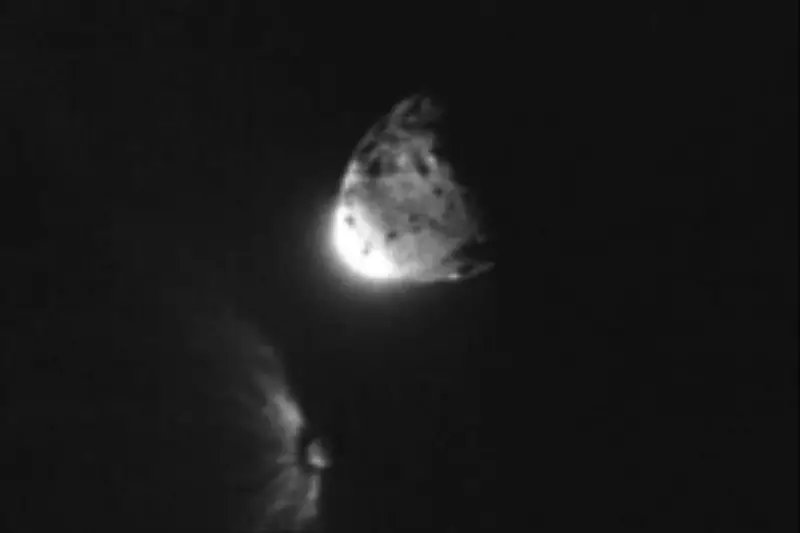
The asteroid, known as Dimorphos, was deliberately struck by NASA's DART spacecraft in 2022 as part of the world's first planetary defense exercise. Crucially, this asteroid never posed any threat to Earth, making it an ideal test subject for this groundbreaking technology. The international research team behind the study published their findings in Science Advances, stating that this marks a notable step forward in our ability to prevent future asteroid impacts on our planet.
The orbital adjustments were remarkably subtle yet significant, amounting to reductions of just one-tenth of a second and 720 meters over a two-year solar journey spanning hundreds of millions of miles. Lead author Rahil Makadia of the University of Illinois Urbana-Champaign emphasized the importance of these small changes in an email statement.

"Even though this seems small, a tiny deflection can add up over decades and make the difference between a potentially hazardous asteroid hitting or missing the Earth in the future," Makadia explained. "For any save-the-planet tests, the key isn't delivering a huge shove at the last minute. The key is delivering a tiny shove many years in advance."
Detailed Measurements Confirm Success
Launched in 2021, the DART spacecraft deliberately plowed into Dimorphos, which orbits a larger asteroid called Didymos as they circle the sun together. While NASA quickly determined that the 2022 strike trimmed the smaller asteroid's orbit around its bigger companion, it took until now for scientists to confirm based on global observations that the impact cut the duo's travel time around the sun by 0.15 seconds.
With each solar orbit lasting 769 days, this represents a real-time slowdown of just over 10 micrometers per second, shrinking the asteroids' 300-million-mile orbit by 2,360 feet. The researchers discovered that all the boulders and other debris flung off Dimorphos during the crash provided as much push to the asteroid as the spacecraft itself, effectively doubling the momentum transfer.
Last summer, a U.S.-Italian team estimated that approximately 35 million pounds of rock and dust were ejected during the impact. Steven Chesley of NASA's Jet Propulsion Laboratory, who participated in the study, noted that the rubble-packed asteroid system was specifically chosen for this mission because Earth remains safely out of its way for the foreseeable future.
"While it is just a single experiment, it is nonetheless an important data point that will be relevant to any future asteroid deflection missions," Chesley stated in an email.
Future Investigations and Dimensions
Scientists expect to learn even more about the impact's aftermath when the European Space Agency's Hera spacecraft reaches the asteroids in November. Unlike DART, Hera will not strike the asteroids but will instead tag along for months of detailed surveying. The mission will deploy a pair of small experimental probes that will peel away and attempt to land on the asteroid surfaces.
Dimorphos measures 525 feet in diameter, while its companion Didymos spans 2,560 feet across. According to the latest study, Didymos possesses approximately 200 times more mass than its smaller sidekick and rotates at a rapid pace. This successful deflection test demonstrates that even modest orbital adjustments, when applied sufficiently early, can significantly alter an asteroid's trajectory over time.
The achievement represents a crucial milestone in developing practical planetary defense strategies that could one day protect Earth from catastrophic asteroid impacts. As space agencies continue to monitor near-Earth objects, this successful demonstration provides valuable data and confidence in humanity's ability to deflect potentially dangerous space rocks through controlled, early interventions.