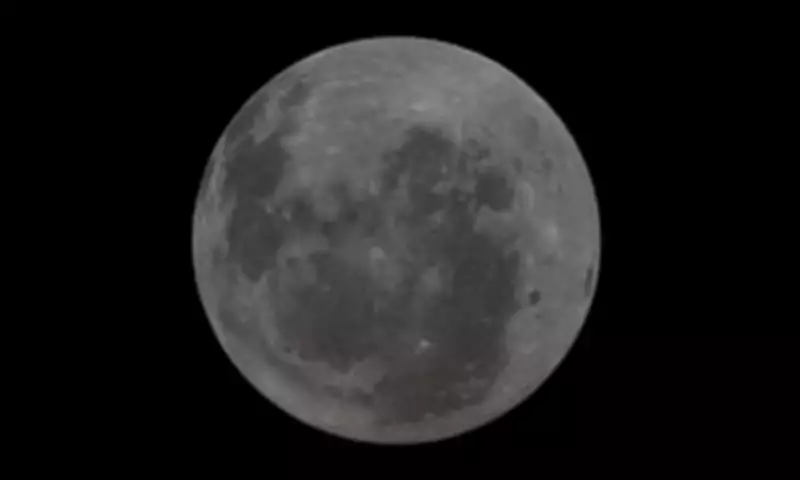
NASA Astronauts Achieve Historic First with Full View of Moon's Orientale Basin
In a groundbreaking moment for space exploration, NASA's astronauts aboard the Artemis II mission have unveiled a landmark image of the moon as they approach the lunar surface for a historic flyby. This picture provides a rare and unprecedented look at a feature long hidden from view—the full expanse of the Orientale basin, visible along the very right edge of the lunar disk. For the first time ever, human eyes have witnessed this enormous impact basin in its entirety, a sight that has eluded observers until now.
The Orientale Basin: A Geological Marvel
The Orientale basin, measuring an impressive 200 miles wide, was formed approximately 3.7 billion years ago when an asteroid collided with the lunar surface at a staggering speed of nine miles per second. The destructive impact of this asteroid is difficult to comprehend, as it is three times the size of the one believed to have wiped out Earth's dinosaurs. While Apollo astronauts partially glimpsed the basin half a century ago, their view was from a far lower altitude compared to the Artemis II crew. Although satellites have photographed the basin in the past, it typically appears as a shadowy smear, making this human-eye observation a significant milestone.
NASA emphasized the importance of this achievement, stating, 'This mission marks the first time the entire basin has been seen with human eyes.' Until now, the basin had only been fully imaged by satellites, often depicted in computer models with gravity anomalies shown in different colors.

Crew Excitement and Mission Insights
From the Orion space capsule, which is more than two-thirds of the way to the moon, mission specialist Christina Koch shared her enthusiasm in an interview. She said, 'What we are probably most excited as a crew about seeing on the moon would be an amazing feature called Orientale. It is sometimes known as the Grand Canyon of the moon because it has all kinds of multi-layered crater rims and a lot of different land formations, and it has lava fields all throughout. It's very distinctive and no human eye previously had seen this crater until today, when we were privileged enough to see it, so we can't wait to share more when we get closer to the moon.'
So far, the 685,000-mile round trip to the dark side of the moon and back has proceeded relatively smoothly. However, the mission has not been without its challenges, particularly concerning the onboard toilet.
Toilet Troubles and Technical Solutions
Among the issues faced by the Artemis II crew, the toilet has proven to be the most persistent problem. Shortly after launch, astronauts reported a malfunction with a 'blinking amber fault light.' After several hours of troubleshooting, it was discovered that the toilet simply needed time to 'warm up' and was subsequently cleared for use. Unfortunately, the contraption broke down a second time due to a frozen vent.
Mission Control at NASA's headquarters responded by orienting the spacecraft so that the vent faced the sun in an attempt to melt the blockage. During this period, the crew was restricted to using the toilet only for solid waste, while a bag-and-funnel system called a Collapsible Contingency Urinal (CCU) was employed for liquid waste. Thankfully, after several hours of solar exposure, the blockage melted, allowing a waste dump to be conducted and the toilet to return to full operational use. Mission control informed the crew, 'Breaking news. At this time you are go for all types of uses of the toilet.'

The titanium toilet, which uses air suction to remove waste, is located in the 'floor' of the capsule, complete with a door and curtain for privacy. It features separate collection systems for urine and solid waste—urine is vented into space, while solid waste is stored for the return trip. This upgraded version of an experimental toilet launched to the International Space Station in 2020 includes modifications to be more practical for female astronauts and is housed in its own tiny room, offering a level of privacy and comfort not available on Apollo missions, where astronauts had to float in a corner. Artemis II astronaut Jeremy Hansen described this space as 'the one place we can go during the mission where we can actually feel like we're alone for a moment.' Another innovation is the automatic start of air flow when the toilet lid is lifted, which aids in odour control.
Mission Progress and Future Objectives
Tomorrow, on flight day six, Orion will reach its farthest point from Earth, sailing 6,400 miles beyond the lunar surface before looping back to begin its journey home. The return trip will take another four days, during which the astronauts will conduct key safety demonstrations, including testing procedures to shield against dangerous radiation from solar flares. As Orion approaches Earth, it will separate key components before plunging into the atmosphere at speeds of about 25,000 mph and splashing down in the Pacific Ocean.
This voyage aims to pave the way for a planned moon landing in 2028, which, if successful, will mark the first human footsteps on the moon since December 1972. The Artemis II mission, with an estimated total cost of $44 billion, involves a crew of Commander Reid Wiseman, Pilot Victor Glover, and Mission Specialists Christina Koch and Jeremy Hansen, and is set to complete a lunar flyby over 10 days, testing critical systems for future lunar exploration.