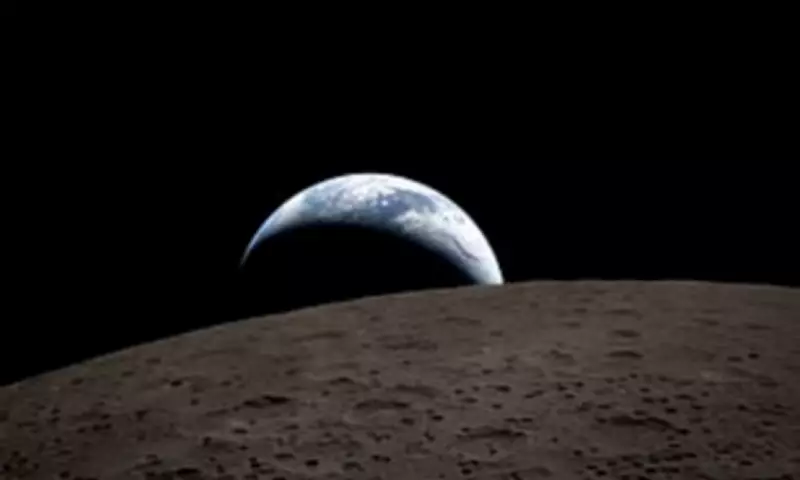
NASA's Artemis II Crew Captures Spectacular 'Earthset' Image During Lunar Flyby
Among the stunning photographs released by NASA from the Artemis II mission, the 'Earthset' image stands out as a truly jaw-dropping spectacle. This remarkable photo showcases the bright blue Earth setting over the lunar surface, with the bulk of the moon eclipsing our home planet. The Artemis II crew, consisting of Commander Reid Wiseman, Pilot Victor Glover, Mission Specialist Christina Koch, and Mission Specialist Jeremy Hansen, captured this iconic shot as they commenced their six-hour lunar flyby.
While it appears as though the Earth is setting, this visual effect is actually caused by the Orion crew capsule drifting over the moon's far side, moving out of direct view of Earth. As the capsule orbited the moon, the four astronauts took turns photographing the lunar terrain, sketching observations, and recording audio descriptions of their experiences. Many of the lunar features they witnessed had not been seen by human eyes since the final Apollo mission over five decades ago.
Ten Intriguing Facts About NASA's 'Earthset' Photo
This image, titled 'Earthset', was taken from the far side of the moon and depicts Earth dipping beyond the lunar horizon. Here are ten details you might have missed in this historic photograph.

1. A Nod to the Apollo Missions
The Artemis II Earthset image serves as a deliberate homage to NASA's earliest lunar expeditions, mirroring the iconic 'Earthrise' photograph. That earlier image, which depicted a distant Earth rising over the moon's horizon, was captured by the crew of the Apollo 8 mission in 1968. Apollo 8 marked the first crewed spacecraft to leave Earth's gravitational influence and the initial human journey to the moon. Similar to Artemis II, the Apollo 8 crew traveled around the moon and returned to Earth, laying the groundwork for future lunar landings. During their mission, astronaut Bill Anders snapped the Earthrise photo as their craft emerged from behind the moon. However, Apollo 8 had an advantage, orbiting the moon ten times before heading home, whereas Artemis II had only a single opportunity.
2. Record-Breaking Distance
The Earthset photo was taken during the Artemis II crew's record-breaking lunar flyby. The Orion crew capsule soared at a height of 41,072 miles above the lunar surface. From this vantage point, the moon appeared roughly the size of a basketball held at arm's length, necessitating the use of zoom lenses to capture the image. This flyby also propelled the crew to an astounding 252,756 miles from Earth, surpassing the distances achieved by the Apollo missions and making the Artemis II astronauts the farthest humans have ever traveled from our planet.
3. Lucky Timing
This photograph was captured at 18:41 EDT on Monday, April 6, merely three minutes before the Orion crew capsule slipped behind the moon, entering a planned communications blackout. With the moon blocking radio signals, the astronauts continued on their pre-programmed flight path without real-time guidance from Mission Control, relying entirely on onboard systems. After forty minutes of tense silence, Christina Koch reestablished contact with Earth, confirming all was well. Consequently, the stunning Earthset image could only be transmitted back to Earth after the crew had completed their journey around the moon.
4. A Crescent Earth and Crescent Moon
In the image, Earth is partially covered by a curved shadow, with one hemisphere experiencing daylight and the other night. What is less visible is that the Artemis II crew also observed a crescent moon. As they traversed the moon's far side, only 20 percent of the lunar surface was illuminated by the sun, leaving large areas hidden from view and challenging to observe.
5. Meteor Craters
Devoid of an atmosphere for protection, the moon endures constant bombardment from meteor impacts. This is a significant benefit for geologists, as the absence of wind erosion preserves these craters, offering a detailed history of the moon's evolution. In the Earthset image, features like the 38-mile-wide Ohm crater are visible, showcasing terraced edges and a central peak formed by a meteor impact that melted the surface. The clarity even reveals 'ray' impacts—straight lines of smaller craters created by debris from the original collision.

6. Bumpy Horizon
While Earth's horizon appears smooth and clean against the darkness of space, the moon's horizon in the photo is bumpy, jagged, and irregular. This texture results from the rims of thousands of craters that densely pockmark the moon's far side. These range from small impact craters measuring six to nine miles in diameter to vast basins over 186 miles across, formed by catastrophic collisions. Viewed from the low angle of the Orion capsule, these overlapping depressions give the horizon a distinctive serrated appearance.
7. A View of Australia and Oceania
Beyond the lunar perspective, this photo provides a fantastic view of our own planet. In the daylight portion of Earth, swirling clouds over Australia and Oceania are clearly visible, adding to the image's grandeur.
8. Different Brightness
It might be surprising that Earth appears much brighter than the moon, despite the crew's proximity to the lunar surface. This is because Earth reflects approximately three times more sunlight than the moon, primarily due to its clouds and oceans, which the moon lacks.
9. Commercial Camera Equipment
Contrary to expectations of cutting-edge technology, this image was captured using a decade-old Nikon D5 DSLR camera, commercially launched in 2016. While initially poorly reviewed, its rugged construction, reliable mechanisms, and high light sensitivity make it ideal for space photography. Originally priced over £5,000, it can now be acquired for around £800.
10. One of Thousands of Photos
The Earthset photo is just one of over 10,000 images taken by the Artemis II crew. Working in shifts with 17 handheld cameras, they meticulously documented the moon's far side. Each crew member received specific training to identify and photograph lunar features like craters and cooled lava patches. These images will offer unprecedented detail, aiding scientists in creating better lunar maps and enhancing understanding of lunar geology.
Artemis II: Key Facts
- Launch Date: April 1
- Mission Objective: To complete a lunar flyby, passing the 'dark side' of the moon and testing systems for future lunar landings.
- Total Distance Traveled: 620,000 miles (one million kilometers)
- Mission Duration: 10 days
- Estimated Total Cost: $44 billion (£32.5 billion)
- NASA Space Launch System Rocket: $23.8 billion (£17.6 billion)
- Orion Deep-Space Spacecraft: $20.4 billion (£15 billion)
- Crew: Commander Reid Wiseman, Pilot Victor Glover, Mission Specialist Christina Koch, Mission Specialist Jeremy Hansen
- Mission Stages: Launch from Kennedy Space Centre, orbital manoeuvres, translunar injection, lunar flyby at 5,523 miles altitude, return to Earth, and splashdown in the Pacific Ocean.