Scientists Unravel Cosmic Mystery of Ultra-Bright Supernovas
Astronomers have finally solved a long-standing cosmic mystery surrounding the universe's most dazzling explosions: superluminous supernovas. These rare celestial events, which can outshine entire galaxies, are now understood to be powered by the remnants of their own violent birth – incredibly dense, rapidly spinning objects known as magnetars.
The Stellar Detective Work
The breakthrough came from studying a colossal stellar event first observed in December 2024, located approximately one billion light-years from Earth. Researchers utilized the Las Cumbres Observatory in California and the Chile-based ATLAS survey telescope to analyze this extraordinary phenomenon. Their investigation revealed that the supernova's exceptional brightness stems from a magnetar – a specific type of neutron star – that remained after the star's catastrophic demise.
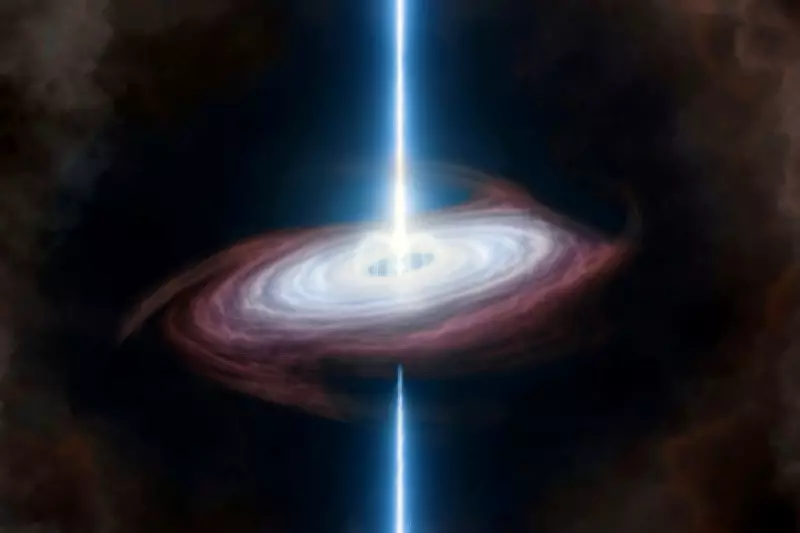
This stellar core, possessing an immensely powerful magnetic field, spins hundreds of times per second. As it rotates, it flings charged particles into the expanding cloud of gas and dust from the original explosion, dramatically amplifying its luminosity to unprecedented levels.

The Physics of Stellar Destruction
Joseph Farah, a doctoral student in astrophysics at the Las Cumbres Observatory and the University of California, Santa Barbara, served as lead author of the research published in the prestigious journal Nature. He explained the fundamental process: "When a massive star exhausts its nuclear fuel, it can no longer resist the crushing force of gravity."
Farah elaborated on the core collapse: "The core of the star is squeezed under the weight of the entire star above it, crushing it so hard that protons and electrons merge to form neutrons." This refers to the three fundamental subatomic particles that constitute atoms. "If the conditions are right, the nascent neutron star will survive the core collapse." The hidden magnetar then becomes the internal engine fueling the supernova's tremendous light output.
Confirming a Long-Standing Hypothesis
The concept of a superluminous supernova was first identified in 2006 by Las Cumbres Observatory astrophysicist Andy Howell, who co-authored this new study. A hypothesis proposing magnetars as the power source for these spectacular events was initially put forward in 2010. Howell now believes these latest findings provide definitive confirmation of that theory, marking a significant milestone in astrophysical research.
Unusual Brightness Fluctuations Explained
Unlike most supernovas, which follow a predictable brightening and fading curve, some superluminous examples – including this particular one – exhibit distinctive undulations in their brightness over several months. These fluctuations become progressively shorter over time. Scientists attribute this phenomenon to Lense-Thirring precession, where the fabric of space-time itself is twisted by the spinning magnetar.
Following the initial detonation, the magnetar's immense gravitational pull draws in some stellar material, forming a swirling disk around it. This disk then wobbles due to Lense-Thirring precession. "This causes the transfer of energy from the magnetar to the newly expanding supernova to vary," Howell explained, creating the observed fluctuations in brightness that have puzzled astronomers for years.
The Scale of Cosmic Brilliance
While the precise characteristics of the star before its spectacular end remain unknown, researchers estimate it was "likely a very massive star" – many dozens of times the mass of our sun and hundreds of thousands of times more luminous, according to Farah.
To illustrate the extraordinary scale of these events, Farah offered a striking comparison: "There's a great 'what if' that asks: what would be brighter, the sun going supernova 93 million miles (150 million km) from Earth, or a hydrogen bomb detonating on your eyeball? And the answer is the supernova – by nine orders of magnitude."

He continued: "So that's just a regular supernova. A superluminous supernova is 10 to 100 – or more – times brighter than that. In absolute terms, our supernova had a luminosity brighter than the output of the entire Milky Way galaxy combined." This revelation underscores the truly astronomical power of these cosmic events that have now been explained through meticulous scientific investigation.