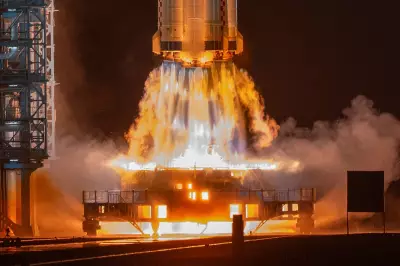
The billionaire space race is escalating into a high-stakes contest as Elon Musk and Jeff Bezos vie for a prestigious NASA contract to land humans on the moon. This competition marks a pivotal moment in space exploration, with both SpaceX and Blue Origin preparing their lunar landers for a critical showdown during the Artemis III mission.
Artemis III: A Crucial Test for Lunar Ambitions
NASA has restructured its Artemis timeline, transforming Artemis III from a planned moon landing into a low-Earth orbit test flight scheduled for 2027. This mission will rigorously evaluate the docking capabilities, life support systems, propulsion, and communications of the competing landers. The agency aims to select the most impressive performer for the historic Artemis IV lunar landing in 2028, which will be the first private-led human moon landing in over five decades.
SpaceX's Starship: A Giant in the Race
SpaceX, under Elon Musk's leadership, secured a $2.89 billion contract to develop the Starship Human Landing System (HLS). This colossal, reusable lander is powered by methane and oxygen and designed to carry up to 100 astronauts and 200 tonnes of cargo. Despite its potential, SpaceX has faced significant challenges, with 11 test flights mostly ending in explosions and delays pushing the next launch to mid-May. The craft features a vertical landing design and a "space elevator" for crew deployment.

Blue Origin's Blue Moon: A Sleek Competitor
Jeff Bezos' Blue Origin received a $3.4 billion fixed-price contract for the Blue Moon lander, with total development costs reaching around $7 billion including company funds. This smaller craft, resembling Apollo-era landers, uses liquid hydrogen and oxygen fuel and can transport four astronauts with a 30-tonne payload. Recently, Blue Origin completed thermal vacuum chamber testing and plans a Pathfinder Mission to the moon's south pole later this year, demonstrating steady progress.
Comparative Analysis of the Landers
Blue Origin - Blue Moon:
- Contract value: $3.4 billion
- Crew capacity: 4
- Cargo capacity: 30 tonnes
- Height: 16 meters (52 feet)
- Diameter: 3.08 meters (10.1 feet)
- Fuel mix: Hydrogen and oxygen
SpaceX - Starship HLS:
- Contract value: $2.89 billion
- Crew capacity: 100
- Cargo capacity: 200 tonnes
- Height: 52.3 meters (172 feet)
- Diameter: 9 meters (30 feet)
- Fuel mix: Methane and oxygen
The Road to Selection and Future Missions
NASA's decision will hinge on which lander is ready for Artemis III and performs optimally during tests. The selected company will lead the Artemis IV moon landing, while the runner-up may supply the Artemis V mission later in 2028. Additionally, the European Space Agency is developing the Argonaut lander for the 2030s, supporting NASA's goal of establishing a permanent lunar base near the south pole to access water ice and minerals.
This intense rivalry underscores a transformative era in space exploration, where private enterprises are driving innovation and competition to new heights. As Musk and Bezos push their technologies forward, the outcome of this race will shape humanity's future on the moon and beyond.