Astronomers Discover Universe's Missing Hydrogen in Vast Galactic Halos
Missing Hydrogen Found in Galactic Halos, Study Reveals

Astronomers Uncover Hidden Hydrogen Reservoirs in Galactic Halos

Astronomers have potentially solved a long-standing cosmic mystery by locating where the universe's 'missing' hydrogen is concealed. A groundbreaking new study has revealed the source of hydrogen that fueled star formation during the period known as 'cosmic noon'.

Hydrogen Gas Clouds More Prevalent Than Previously Thought

Hydrogen gas clouds surrounding galaxies are far more abundant than scientists had estimated, according to the latest research that exposes hidden pockets of the universe's primordial element. Between 10 billion and 12 billion years ago, during the cosmic noon era, galaxies were creating stars at their maximum rate. This intense stellar birth required enormous quantities of hydrogen gas, the fundamental building block for star formation.

Until recently, astronomers had detected only approximately 3,000 of these gas halos throughout the observable universe. The new findings dramatically increase this number to over 33,000, providing researchers with a significantly more comprehensive dataset to investigate how early galaxies originated and evolved.

Wide Pickt banner — collaborative shopping lists app for Telegram, phone mockup with grocery list

Detection Challenges and Technological Breakthroughs

Since hydrogen does not emit light independently, it is primarily detected when positioned sufficiently close to energy sources such as galaxies containing ultraviolet-emitting stars. These energetic sources cause the gas molecules to glow, making them visible to astronomers.

Identifying this faint signal demands prolonged observations with highly sensitive instruments, which have not always been readily available. Consequently, only the brightest and most extreme hydrogen gas halos had been discovered previously.

Massive Data Collection Reveals Diverse Structures

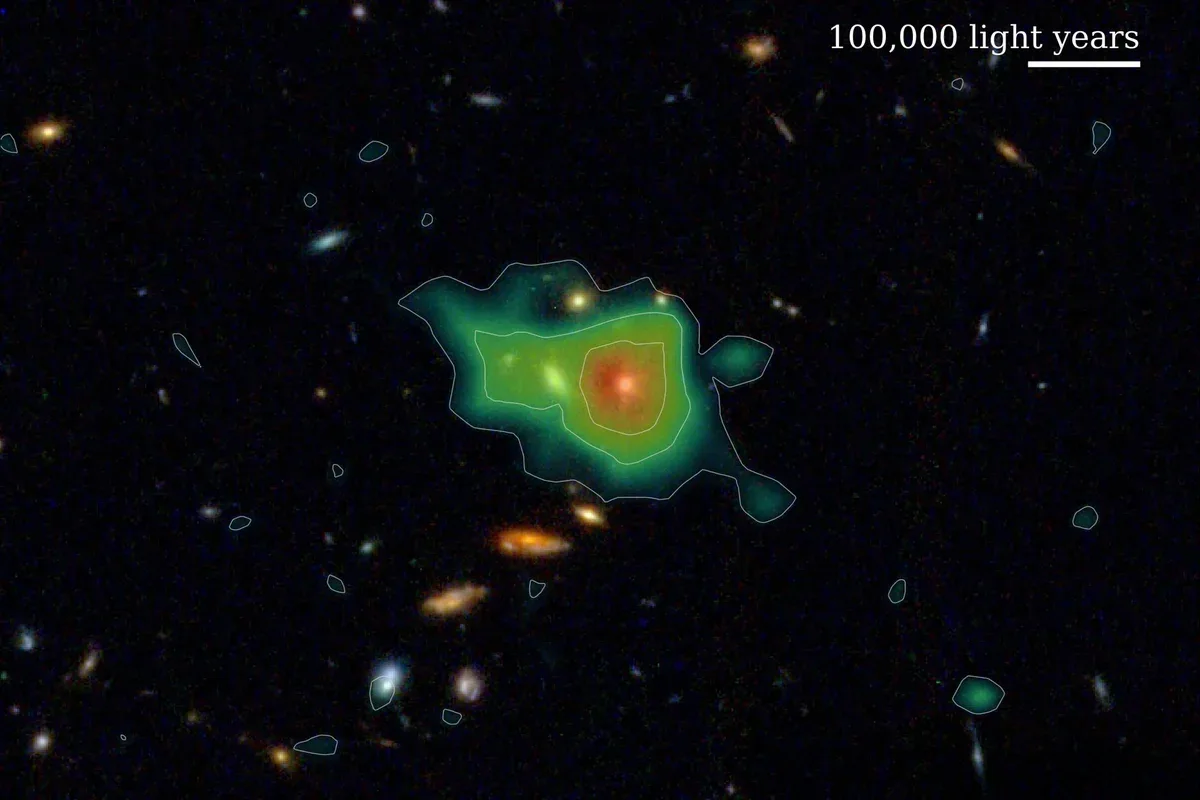
The innovative study utilized the Hobby-Eberly Telescope at the McDonald Observatory in Texas to gather nearly half a petabyte of data concerning galaxies and the intergalactic regions. Within this extensive data repository, scientists identified new hydrogen gas halos spanning from tens of thousands to hundreds of thousands of light years across.

Some of these structures are simple, football-shaped clouds enveloping individual galaxies, while others are large, irregular formations containing multiple galaxies. "Those are the fun ones. They look like giant amoebas with tendrils extending into space," remarked Erin Mentuch Cooper, a co-author of the study published in the Astrophysical Journal.

Implications for Cosmic Models and Future Research

The research team aims to examine the newly discovered halos in meticulous detail to gain deeper insights into the origins of the universe's 'missing' hydrogen. "There are various models for galaxies in this epoch that largely work and seem to make sense, but there are gaps and holes," explained Dustin Davis, a postdoctoral researcher at the University of Texas at Austin.

"Now we can focus on individual halos and see in greater detail the physics and mechanics of what's going on. And then we can fix or throw out the models and try again," Davis added, highlighting how this discovery could refine scientific understanding of galactic evolution.

Pickt after-article banner — collaborative shopping lists app with family illustration