Mars Rover's Tyres Eaten Away by Red Planet's Harsh Surface
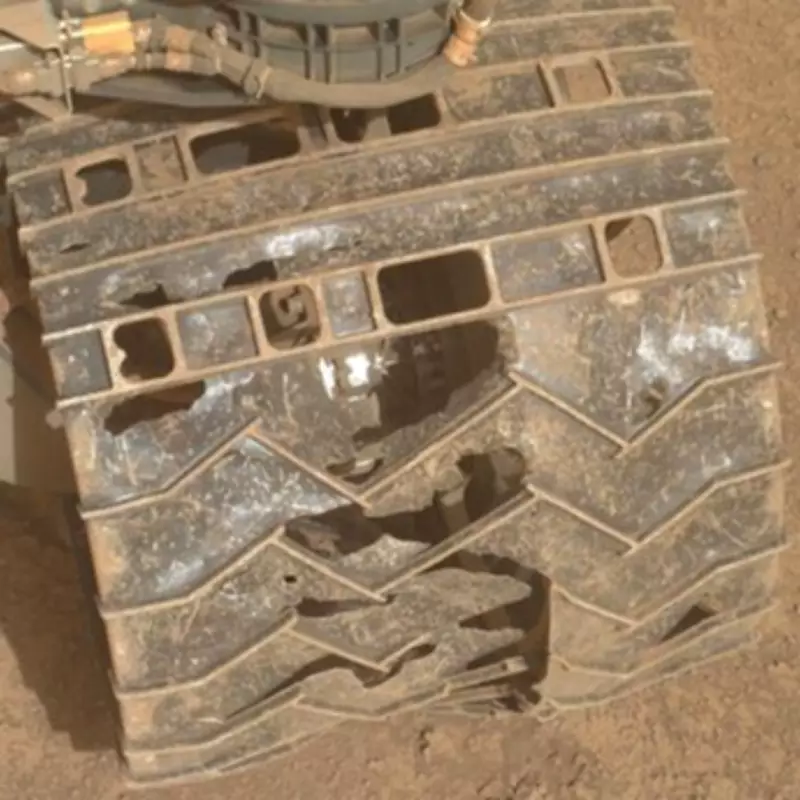
Recent selfies captured by the interplanetary robot reveal its tyres being gradually broken apart by the rough and unforgiving surface of Mars. However, this wear-and-tear is not expected to prematurely end its ongoing mission of scientific discovery.
Longevity Beyond Expectations
The Curiosity Rover, a $3.2 billion (£2.43 million) machine, was launched from Earth in 2011 and landed on the Red Planet the following year. Initially designed for a mere two-year mission, it has now surpassed nearly 15 years of operation. Powered reliably by nuclear energy, the rover continues to explore the Gale Crater and Mount Sharp, with projections suggesting it could remain functional through 2026 and beyond.
Visual Evidence of Damage
Pictures taken on Sol 4844, corresponding to March 23, 2026, display Curiosity's tracks wearing away, with the planet's abrasive surface having punctured substantial chunks into them. Despite this, the damage does not equate to a critical failure, such as a flat tyre, especially given the rover's location approximately 33.9 million miles from home. NASA officials have previously assured that such issues will not hinder the rover's ability to perform its duties.

Historical Context and Expert Insights
This is not the first instance of tyre troubles for Curiosity. In July 2023, the rover's social media account highlighted that its wheels "take the brunt" of Mars' rocky terrain, yet it remains undeterred in its explorations. Following the latest images, experts have emphasized the durability of the rover's design. Planetary scientist Emily Lakdawalla noted on Bluesky that Curiosity could drive "perfectly fine" even if the inner two-thirds of the wheel rim were to break off completely.
She elaborated: "Fun fact: the rover would be able to drive perfectly fine even if the inner 2/3 of the wheel rim totally breaks off. There is enough torque in the wheel motors to pull the entire rover up a vertical wall if only one of them was operating. It could drive fine if the wheels were square."
Mission Resilience and Future Prospects
Despite the visible damage, Curiosity's robust engineering ensures it can continue its scientific endeavours. The rover's ability to withstand such harsh conditions underscores the advancements in space technology and the meticulous planning behind long-duration missions. As it traverses Mars, collecting data and images, the mission remains a testament to human ingenuity and the relentless pursuit of knowledge beyond our planet.