Artemis II and Project Hail Mary: The Human Element in Space Exploration
The central premise of the blockbuster film Project Hail Mary revolves around a desperate, long-shot mission with a familiar goal: saving humanity from extinction. While the specific threat in the story is novel, audiences are accustomed to watching heroic quests to rescue Earth from doom, often set against the backdrop of space. From Armageddon to Interstellar, this genre consistently features seemingly impossible missions into the cosmos, tapping into a deep fascination with human endurance and adventure.
A New Era of Lunar Ambitions
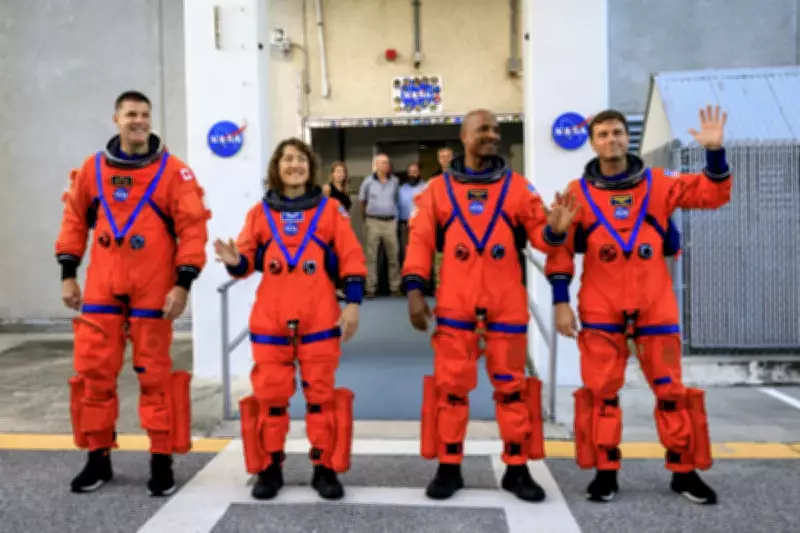
The film's release coincides with a significant moment in real-world space exploration. NASA's Artemis II mission, scheduled for an early April launch, will send four astronauts—CSA astronaut Jeremy Hansen and NASA astronauts Christina Koch, Victor Glover, and Reid Wiseman—on a journey around the Moon. This flyby will take them deeper into space than any humans have previously traveled, serving as a critical test of equipment ahead of a planned lunar landing in 2028.
In March 2026, NASA officials detailed broader plans to establish a permanent base on the Moon, marking a bold step in human spaceflight. NASA is not alone in these lunar ambitions. Private space companies like SpaceX and Blue Origin are developing next-generation spacecraft, rovers, and drones to support an American Moon base. Meanwhile, other nations, notably China, are pursuing their own lunar outposts, viewing the Moon as a stepping stone toward more ambitious goals, including human migration to Mars.

The Motivations Behind Billions in Investment
As billions in tax dollars and private funds flow into human space exploration, it is essential to examine the objectives driving this investment. From a biological perspective, humans face significant limitations as space explorers. Research, including insights from the book Becoming Martian: How Living in Space Will Change Our Bodies and Minds, highlights that while much is known about space's effects on the human body and mind, longer missions into deep space will expose astronauts to unknown health risks.
NASA's new administrator, Jared Isaacman, has framed the race to the Moon as a matter of national security, calling the Moon "the ultimate high ground." He also promotes the economic benefits of a space economy involving lunar mining and manufacturing. In Congress, subcommittees in both the House and Senate have passed bills to codify these initiatives into law, aiming to make a permanent Moon base official U.S. policy, with bipartisan support and expected votes soon.
The Mars Frontier and Technological Advances
The United States and China are targeting human landings on Mars in the 2030s, with plans to build infrastructure for long-term habitation. In March 2026, NASA announced intentions to test nuclear propulsion during an uncrewed flight to Mars in 2028. Nuclear-powered rockets could significantly reduce travel time to Mars, making crewed missions more feasible and accelerating the timeline for human exploration of the red planet.
Robots vs. Humans: Weighing the Risks and Rewards
Why send humans to Mars at all? The motivations often cited include scientific, economic, and geopolitical objectives, but these are distinct and sometimes conflated. Scientifically, NASA's Mars rovers have achieved dramatic successes, such as discovering a potential biosignature that might indicate past microbial life. Robotic missions are cheaper and carry lower risk than human missions, and NASA's plans include a suite of robotic lunar missions developed with companies, universities, and international partners.
Economically, tasks like mining and manufacturing could potentially be handled by AI-equipped robots, such as those being developed by Tesla. While robots cannot yet match the full range of human capabilities, prioritizing robotic activities could reduce human exposure to space hazards. If human presence on the Moon and Mars is deemed necessary, it is crucial to acknowledge the risks astronauts will face.

Health Risks in Deep Space
Despite six decades of human spaceflight, significant knowledge gaps remain. Deep-space radiation poses a major concern. The 24 Apollo astronauts are the only humans to have traveled past the Van Allen radiation belts, which trap radiation and make Earth habitable. The Moon and Mars lack magnetic fields, leading to substantial surface radiation. NASA experiments with simulated galactic cosmic rays on rodents suggest potential cognitive impairment, but effects on humans are unknown.
Additionally, while zero gravity causes muscle atrophy and bone density loss on the International Space Station, the effects of partial gravity—like the Moon's one-sixth gravity or Mars's one-third gravity—are poorly understood. Only the 12 Apollo astronauts have experienced partial gravity for more than 30 seconds, with the longest stay being about three days, leaving scientists to speculate on long-term health impacts.
The Irreplaceable Human Interest Factor
Sending robots to space avoids human health risks, but it comes with downsides. Robotic missions have fewer capabilities and often fail to capture public interest, imagination, and national prestige in the way human missions do. The four Artemis crew members will captivate global audiences as they embark on their daring lunar mission, much like moviegoers root for Ryan Gosling's character in Project Hail Mary as he strives to save humanity on screen.
This human interest is the common thread linking public and private space ambitions worldwide. While robotic missions are more practical and cost-effective, they lack the inspirational power of human crews. Ultimately, beyond economic, political, or scientific goals, space exploration is about people undertaking difficult challenges, pushing the boundaries of what is possible, and capturing the collective imagination of humanity.