Astronomers Uncover Universe's Missing Hydrogen in Vast Gas Halos
A groundbreaking new study has potentially solved one of astronomy's enduring mysteries by revealing where the universe's 'missing' hydrogen has been hiding. Researchers have discovered that hydrogen gas clouds surrounding galaxies are far more prevalent than previously understood, providing crucial insights into star formation during the cosmic dawn of the universe.
The Search for Hydrogen During Cosmic Noon
Between 10 billion and 12 billion years ago, during a period astronomers call the 'cosmic noon,' galaxies were forming stars at their peak rate. This intense stellar birth would have required enormous supplies of hydrogen gas, the fundamental building block for star formation. However, until recently, scientists had detected only about 3,000 of these essential gas halos throughout the observable universe.
The latest research has dramatically increased this number to over 33,000 identified hydrogen gas halos, giving astronomers a significantly more complete dataset to study how early galaxies began and evolved. This discovery represents a major breakthrough in understanding the cosmic processes that shaped our universe.

Detection Challenges and Technological Breakthroughs
Hydrogen presents unique detection challenges because it doesn't emit light on its own. Scientists can only observe it when it's sufficiently close to energy sources like galaxies filled with ultraviolet-emitting stars, which cause the gas molecules to glow faintly. Finding this subtle signal requires exceptionally long observations with highly sensitive instruments that aren't always readily available.
This technological limitation explains why only the brightest and most extreme hydrogen gas halos had been discovered previously. The faint, more common halos remained hidden from view, creating gaps in astronomers' understanding of cosmic hydrogen distribution.
Massive Data Collection Reveals Hidden Structures
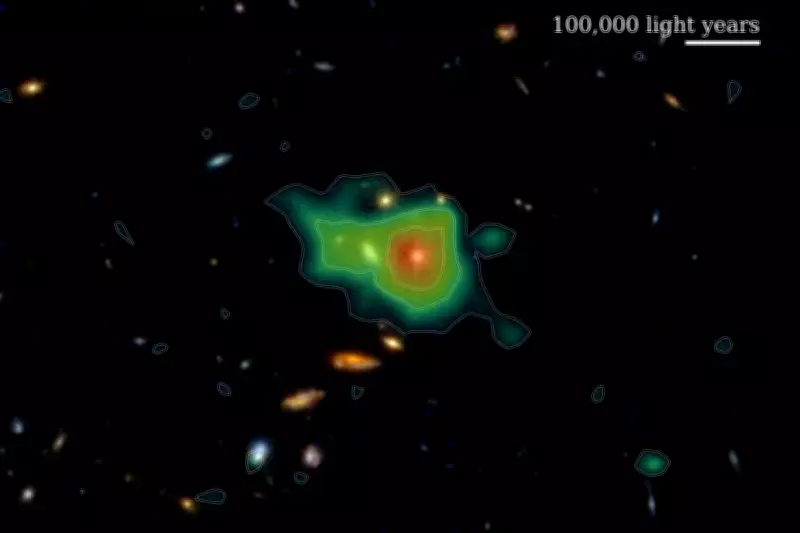
The new study utilized the powerful Hobby-Eberly Telescope at the McDonald Observatory in Texas to capture nearly half a petabyte of data on galaxies and the regions between them. Within this enormous trove of astronomical information, scientists identified thousands of previously undetected hydrogen gas halos ranging from tens of thousands to hundreds of thousands of light years across.
These structures display remarkable variety. Some appear as simple, football-shaped clouds surrounding individual galaxies, while others form large, irregular structures containing multiple galaxies. Erin Mentuch Cooper, an author of the study published in the Astrophysical Journal, described the more complex formations as particularly fascinating, noting they 'look like giant amoebas with tendrils extending into space.'
Implications for Cosmic Models and Future Research
The researchers now plan to study these newly discovered halos in greater detail to better understand the sources and distribution of the universe's previously 'missing' hydrogen. Dustin Davis, a postdoctoral researcher at the University of Texas at Austin, explained that while various models for galaxies in this epoch largely work and seem logical, significant gaps and holes remain in our understanding.
'Now we can focus on individual halos and examine in greater detail the physics and mechanics of what's occurring,' Davis stated. 'This enables us to either refine existing models or discard them entirely and develop new theoretical frameworks that better align with our observational evidence.'
This discovery not only solves the mystery of the missing hydrogen but opens new avenues for understanding galaxy formation and evolution during one of the universe's most active periods of stellar creation.