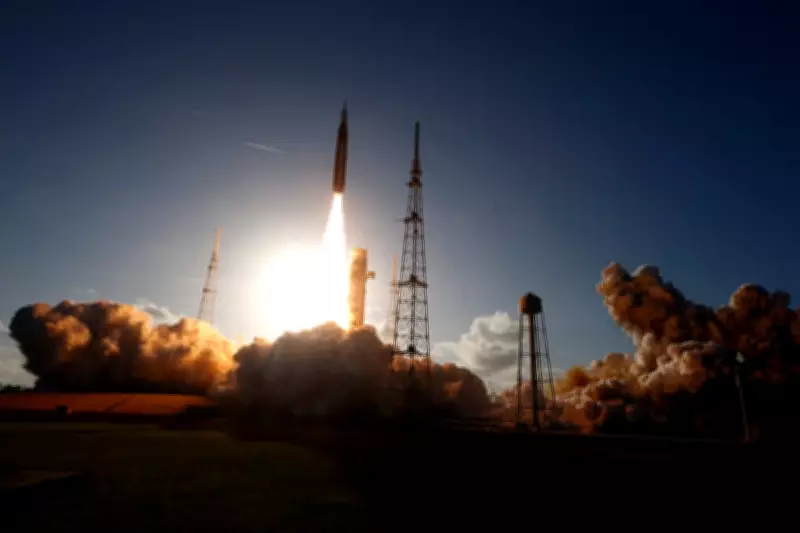
NASA's Artemis II Mission Successfully Launches, Marking Historic Return to Lunar Exploration
In a landmark event for space exploration, NASA's Artemis II rocket lifted off from the Kennedy Space Center in Cape Canaveral, Florida, on Wednesday evening, US time. This launch represents the first time in nearly 54 years that astronauts are being sent to the moon, reviving human missions beyond lower Earth orbit since the Apollo 17 mission of December 1972.
Crew and Mission Details
The Artemis II mission comprises the Space Launch System (SLS) rocket and the Orion crew capsule, which carries a diverse team of astronauts. The crew includes commander Reid Wiseman, pilot Victor Glover, and mission specialists Christina Koch and Jeremy Hansen from the Canadian Space Agency. Before boarding, the astronauts were seen greeting spectators and sharing light-hearted moments with their families, highlighting the human element of this historic endeavour.
Journey and Technical Aspects
Following the launch, the rocket is currently orbiting Earth and will continue to do so until Thursday. At that point, a critical translunar injection burn will propel it on the remaining 386,242-kilometre journey to orbit the moon. This mission serves as a crucial step in NASA's broader Artemis program, aimed at establishing a sustainable human presence on the lunar surface.

Public Engagement and Spectator Scenes
The launch attracted significant public interest, with spectators gathering at various locations, including the A Max Brewer Bridge in Titusville, Florida. Onlookers, including children wearing Artemis-themed caps, watched eagerly as the next-generation moon rocket ascended into the sky. Additionally, events such as a watch party at the Canadian Space Agency in Quebec, where astronaut David Saint-Jacques addressed reporters, underscored the global attention surrounding this mission.
Media Coverage and Preparations
Journalists from around the world assembled at the Kennedy Space Center, setting up cameras and equipment to capture the historic moment. The extensive media presence reflects the widespread fascination with space exploration and the significance of Artemis II in advancing scientific and technological frontiers.
This successful launch not only commemorates a return to lunar exploration but also sets the stage for future missions that could pave the way for human expeditions to Mars and beyond.