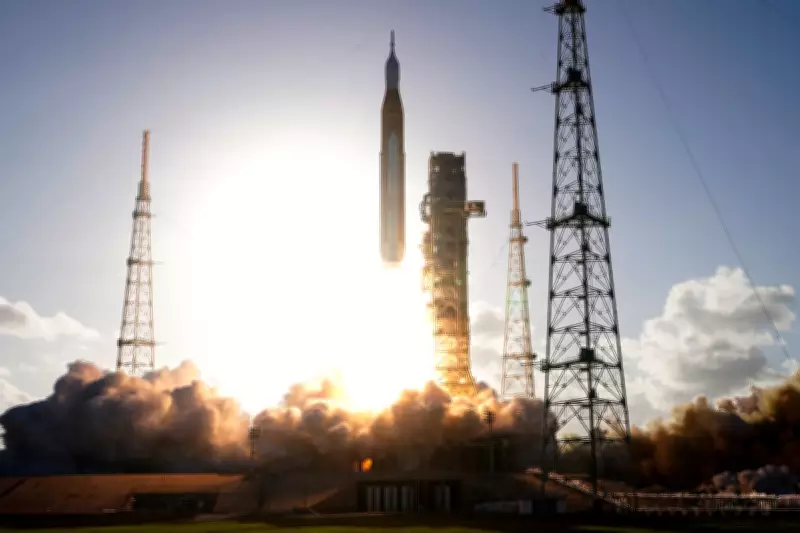
Historic Launch Marks Return to Manned Lunar Exploration
NASA has successfully launched its first manned Moon mission in over five decades, with the Artemis II spacecraft blasting off from Cape Canaveral, Florida. The monumental event signals a new era of human space exploration, taking astronauts further into space than any have ventured before.
Technical Triumph After Delays
The 322-foot Space Launch System rocket carrying four crew members lifted off at 6:36 PM local time on Wednesday, April 1, 2026. This launch followed a two-month postponement due to technical issues including hydrogen fuel leaks and clogged helium lines. The mission represents a significant achievement for NASA's Artemis program.
Commander Reid Wiseman reported a "beautiful moonrise" just five minutes into the flight, as the crew began their journey toward Earth's natural satellite. The astronauts had entered their capsule hours earlier, where they will spend approximately ten days in quarters comparable to a small camper van.

Record-Breaking Journey into Deep Space
The Artemis II mission will send the crew approximately 252,000 miles into space during their lunar flyby, surpassing the previous record of 248,000 miles set by Apollo 13 astronauts in 1970. As they pass about 4,600 miles beyond the far side of the Moon, the Orion module will experience up to 50 minutes of communication blackout with Earth.
While this mission does not include a lunar landing, it establishes critical groundwork for future Artemis missions that aim to return humans to the Moon's surface by 2028. The program also lays essential foundations for eventual crewed missions to Mars.
International Collaboration and Royal Support
The mission features significant international participation, with three American astronauts joined by Canadian Colonel Jeremy Hansen. The United Kingdom contributes through the Goonhilly Earth Station in Cornwall, which assists in tracking the spacecraft during its celestial voyage.
King Charles conveyed heartfelt good wishes to the crew alongside an environmental plea emphasizing sustainable space exploration. The monarch expressed hope that viewing Earth from lunar orbit would renew commitment to planetary stewardship, stating: "May that sight renew in you the conviction that we must learn from the lessons of how we have over-exploited and polluted our own planet."
Political Reactions and Future Implications
Former US President Donald Trump celebrated the launch on his Truth Social platform, declaring: "We are WINNING, in Space, on Earth, and everywhere in between." His message emphasized American dominance in space exploration while blessing the astronauts and NASA.
The successful launch comes amid renewed international interest in lunar exploration, with China planning its own crewed Moon mission around 2030. NASA's Artemis program represents not just a return to lunar exploration but a stepping stone toward more ambitious interplanetary missions, marking what many hope will be a new golden age of space discovery.