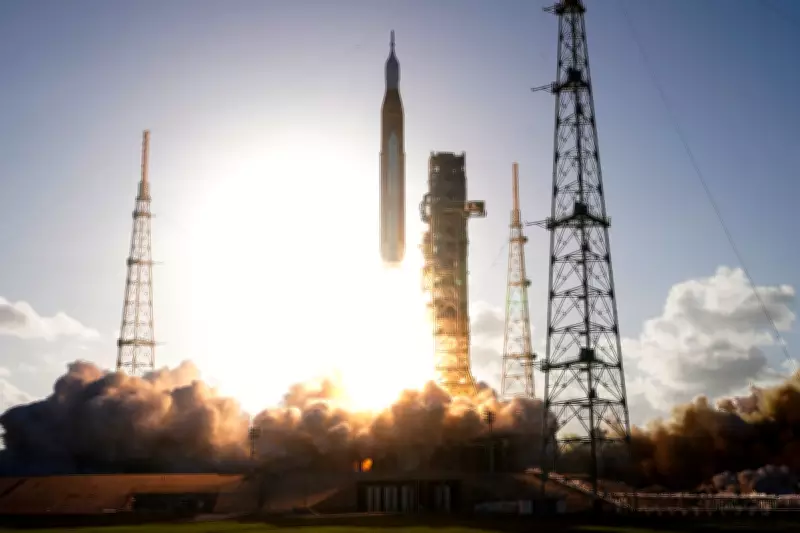
In a historic moment for space exploration, NASA's Artemis II mission has successfully launched from Cape Canaveral, Florida, marking the first crewed Moon mission in over five decades. The 322-foot Space Launch System rocket, carrying four astronauts, blasted off at 6:36 PM local time on April 1, 2026, embarking on a journey that will take humans deeper into space than ever before.
A New Chapter in Lunar Exploration
The four crew members—three Americans and one Canadian—reached orbit successfully and will circle Earth for approximately 25 hours before catapulting toward the Moon. Their flight is being tracked from Goonhilly Earth Station in Cornwall, UK, highlighting international collaboration in this mammoth technical operation. Commander Reid Wiseman reported a "beautiful moonrise" just five minutes into the flight, setting a poetic tone for the epic celestial voyage ahead.
Technical Details and Challenges
Prior to launch, more than 700,000 gallons of fuel were loaded into the spacecraft. The mission had previously been postponed by two months due to hydrogen fuel leaks and clogged helium lines. During the flight, Mission Control experienced a brief communication disruption during a satellite handover, but the issue was quickly resolved by resetting ground equipment.

The Artemis II mission represents a lunar flyby rather than a landing. The Orion spacecraft will carry the crew approximately 252,000 miles into space—surpassing the current record of 248,000 miles set by Apollo 13 in 1970. As they pass about 4,600 miles beyond the far side of the Moon, the module will lose communication with Earth for up to 50 minutes.
Royal and Political Reactions
King Charles conveyed "heartfelt good wishes" to the astronauts, particularly crew member Colonel Jeremy Hansen of Canada, where Charles serves as head of state. In his message, the King emphasized environmental stewardship, urging that the mission renew conviction "that we must learn from the lessons of how we have over-exploited and polluted our own planet." He expressed hope that the Moon would remain "a beacon of peaceful scientific discovery rather than a theatre of exploitation," referencing his Astra Carta initiative for sustainable space exploration launched in 2023.
Meanwhile, former US President Donald Trump hailed the mission on his Truth Social platform, declaring, "We are WINNING, in Space, on Earth, and everywhere in between" and praising American dominance in space exploration.
Living Conditions and Crew Experience
The astronauts entered their capsule several hours before launch, where they will remain for the next ten days in quarters comparable to a small camper van. As they headed to the launch pad, the crew waved to well-wishers and shaped their hands into hearts. Commander Wiseman shouted to the crowd, "It's a great day for us. It's a great day for this team," capturing the collective excitement surrounding the mission.
Future Implications and Historical Context
While Artemis II astronauts will not touch down on the lunar surface, this mission paves the way for future Moon landings and lays the foundation for sending humans to Mars. NASA aims to return a crew to the lunar surface by 2028, ahead of China's planned mission around 2030. The last time NASA sent astronauts to the Moon was during the Apollo 17 mission in 1972, making this launch a significant milestone in reviving crewed deep-space exploration.
The successful launch of Artemis II represents not just a technological achievement but a symbolic renewal of human ambition in space. As the crew journeys farther than any humans have gone before, they carry with them hopes for peaceful discovery, environmental consciousness, and the next giant leap toward interplanetary exploration.