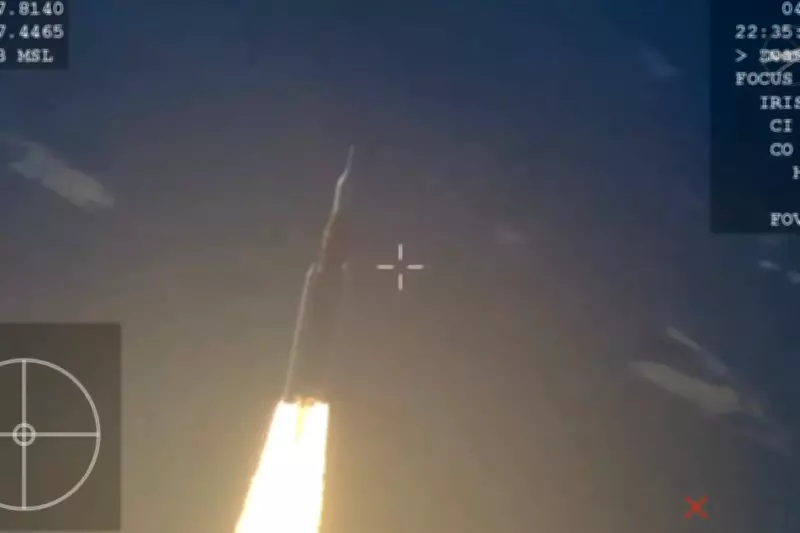
Artemis II Mission Successfully Launches, Carrying Crew on Historic Moon Voyage
In a landmark achievement for space exploration, NASA's Artemis II mission has officially launched, propelling four astronauts on a historic journey toward the Moon. This event marks the first crewed mission to the lunar vicinity since the Apollo 17 mission in 1972, representing a significant milestone in humanity's renewed efforts to explore deep space.
Launch Details and Mission Objectives
The Orion spacecraft, carrying three American astronauts and one Canadian astronaut, lifted off from NASA's Kennedy Space Center in Florida at 6:35 PM Eastern Time. The launch utilized the Space Launch System (SLS), which stands as the most powerful rocket ever constructed by NASA. This successful takeoff followed weeks of delays caused by fuel leaks and other technical issues that had previously forced a last-minute cancellation.
Hours into the voyage, NASA confirmed that the crew had successfully completed one of the mission's early critical objectives: evaluating the manual handling capabilities of the Orion spacecraft in the space environment. The mission involves a meticulously planned 10-day voyage that will take the spacecraft around the far side of the Moon before returning to Earth. While the astronauts will not land on the lunar surface during this mission, NASA anticipates that Artemis II will play a crucial role in paving the way for establishing a permanent human settlement on the Moon in the future.

Historic Departure from Earth's Orbit
In a momentous development, the Orion capsule performed a precise translunar injection burn, successfully departing Earth's orbit for the first time in over five decades. This maneuver propels the spacecraft on its approximately 400,000-kilometer (250,000-mile) journey to the Moon. NASA officials celebrated this achievement as a pivotal step in the Artemis program.
Dr. Lori Glaze, acting associate administrator for the Exploration Systems Development Mission Directorate at NASA Headquarters in Washington, emphasized the significance of this milestone. "Today, for the first time since Apollo 17 in 1972, humans have departed Earth orbit," she stated. "Each milestone we reach marks meaningful progress on the path forward for the Artemis program. While we have eight intensive days of work ahead, this is a big moment, and we're proud to share it with the world."
NASA Leadership and Program Vision
Following the successful translunar injection burn, NASA Administrator Jared Isaacman spoke about the broader motivations behind the Artemis program. In an interview with Fox News, he framed the current efforts within the context of a "second space race," asserting America's commitment to lunar exploration. "We are back in the business of sending astronauts to the Moon. We already won, but we are doing everything we can to win again. America will never give up the Moon again," Isaacman declared.
He later provided an update on social media, reporting that the "Artemis II astronauts are doing great" and that the Orion spacecraft is "performing well in an impressive elliptical orbit." He added that Mission Control teams are effectively managing the crew's needs, and preparations are underway for subsequent mission phases.
Mission Timeline and Unique Aspects
The Artemis II mission follows a carefully charted path. After launching from Pad 39B at Kennedy Space Center, the SLS rocket was jettisoned, and Orion entered a high-altitude orbit around Earth. The spacecraft then began a four-day outbound transit to the Moon. After completing a lunar flyby, Orion will initiate its return journey to Earth, culminating in a planned splashdown off the west coast of the United States.
Adding a touch of human interest to the mission, the astronauts are accompanied by a special mascot named "Rise"—a softball-sized toy designed by a second-grade student from California. This plushie serves as a zero-gravity indicator and carries a MicroSD card containing the names of 5.6 million people from around the globe, symbolizing the collective spirit of exploration.

Overcoming Challenges and Looking Ahead
The launch itself required coordinated efforts, including the temporary clearance of airspace off Florida's east coast, as visualized by flight tracking services. This ensured a safe trajectory for the rocket's ascent. The mission also highlights the enduring challenges of lunar exploration, with experts noting that establishing a sustained human presence on the Moon—a key goal of the Artemis program—presents formidable biological and technical hurdles far beyond those of the Apollo era.
As the crew continues its journey, NASA remains focused on the mission's success, viewing Artemis II as a critical testbed for future lunar endeavors. The agency's commitment to returning humans to the Moon after a 50-year hiatus underscores a renewed era of space exploration aimed at long-term settlement and scientific discovery.