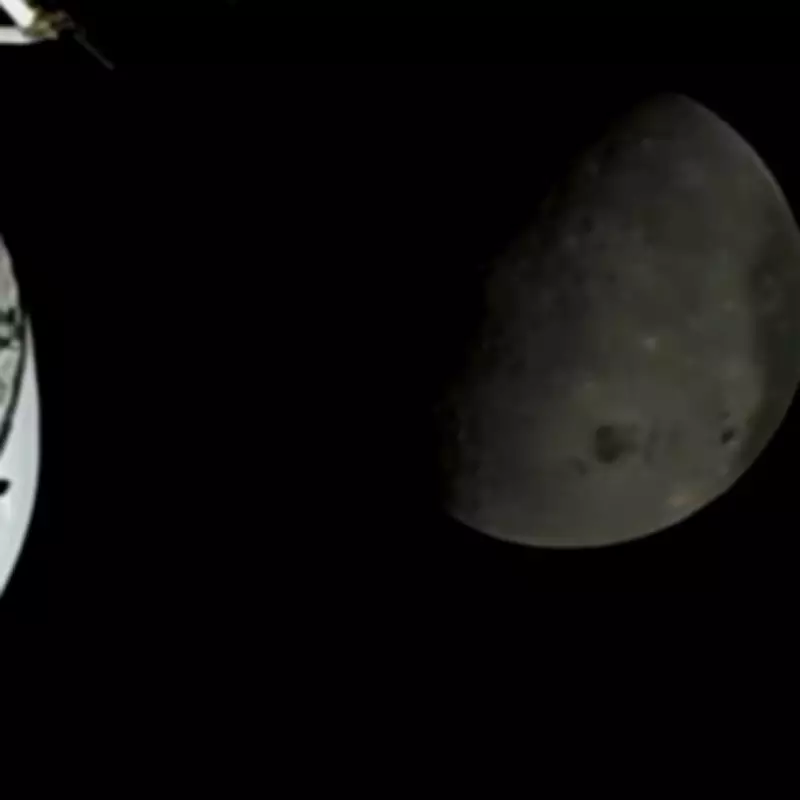
The Artemis II mission has achieved a monumental milestone in human space exploration, breaking radio silence with NASA Mission Control after a tense 40-minute communications blackout while behind the Moon. The crew's first words upon emerging were both historic and emotionally resonant, marking a pivotal moment in the mission's journey.
Historic Words Break the Silence
As the Orion spacecraft emerged from behind the lunar far side right on schedule, radio contact was instantly restored, ending what had been a period of complete silence for Mission Control. Mission specialist Christina Koch was the first to speak, delivering four carefully chosen words: "Houston, Integrity, comm check." She then added with evident relief, "It is so great to hear from Earth again."
A Tense Blackout Period
With no signal possible on the lunar far side, the capsule had been operating entirely independently during the blackout. Computers aboard Orion fired the engines at precisely the right moment to propel the spacecraft onto a homeward trajectory—a critical maneuver executed well beyond the reach of any ground controller. This period of uncertainty is an ever-present companion in crewed spaceflight, where nothing is guaranteed until communication is restored.

Record-Breaking Distance Achieved
Today, the crew reached its closest point to the Moon and will now begin the journey back toward Earth. In doing so, the four astronauts have become the furthest-flying humans in history, breaking the long-standing record set by Apollo 13 in 1970. At 1:57 PM ET, Orion transported its crew to 252,757 miles from Earth, surpassing Apollo 13's distance of 248,655 miles—a record that had remained unbeaten for 55 years.
Mission Control's Wave of Relief
When the connection was restored, a palpable wave of relief swept through Mission Control. Engineers watched as data began filling their screens, followed moments later by Koch's voice coming through clearly. Relatives who had gathered to watch the mission spent the communications blackout working through briefing documents, deliberately keeping their minds off the clock to manage their anxiety.
Data Transmission and Lunar Photography
A substantial queue of stored information is now transmitting back to Earth via NASA's Deep Space Network. Everything Orion recorded on the far side—including sensor readings, flight data, and imagery—is being downloaded, with mission teams expected to spend the coming days meticulously analyzing the results. Among the images already coming through are what appear to be the sharpest photographs ever captured of the Moon's far hemisphere.
Appropriate Farewell Before Blackout
Before communications ceased, astronaut Victor Glover delivered what proved to be an appropriate farewell. He referenced the teachings of Jesus, including the commandment to love your neighbor as yourself, before concluding with words that held dual significance: "We will see you on the other side." This statement foreshadowed both the physical journey behind the Moon and the emotional reunion upon re-establishing contact.
Independent Operations and Future Analysis
The communications blackout underscores the mission's historic nature, demonstrating Orion's capability to operate independently in deep space. The crew didn't waste a moment in acknowledging their milestone, but immediately returned to work as data transmission commenced. This mission continues to push the boundaries of human exploration, with the successful blackout period serving as a testament to both technological advancement and human resilience.